


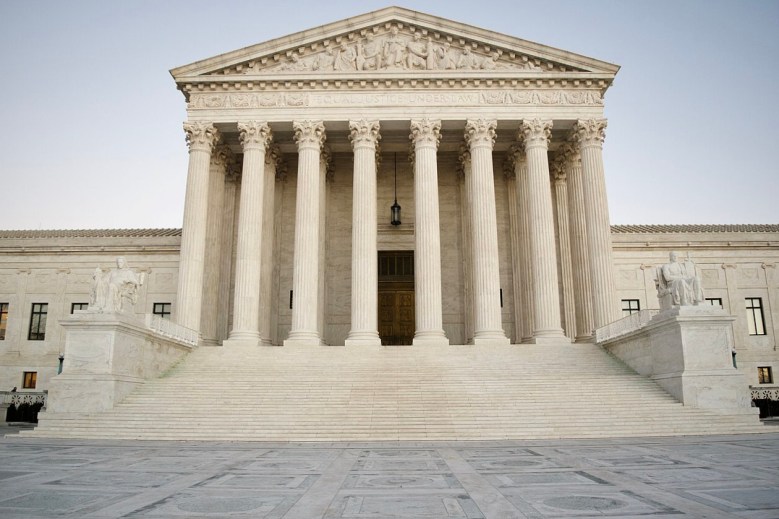
The Supreme Court will begin hearing oral arguments Wednesday in a lawsuit challenging whether children born to “unauthorized immigrant parents” in the U.S. have a constitutional right to citizenship — otherwise known as birthright citizenship.
On his first day in office, Trump signed an executive order calling to end birthright citizenship for children born to parents who are in the country illegally. The American Civil Liberties Union and other rights groups quickly sued, blocking the executive order’s implementation until the Supreme Court rules.
What is being challenged in the lawsuit?
The case, Trump v. Barbara, originated in New Hampshire and challenges if the Trump administration can end birthright citizenship through an executive order.
It stated the 14th Amendment has “never been interpreted to extend citizenship universally to everyone born in the U.S.”
“The Fourteenth Amendment has always excluded from birthright citizenship persons who were born in the United States but not ‘subject to the jurisdiction thereof,’” the order states.
In the executive order, Trump called to remove birthright citizenship to individuals who are not “subject to the jurisdiction thereof” including:
- If a child’s mother was unlawfully present and the father was not a U.S. citizen or lawful permanent resident at the time of their birth;
- If a child’s mother’s presence was lawful but temporary, including visiting through the Visa Waiver Program or visiting on a student, work or tourist visa, and the father was not a U.S. citizen or lawful permanent resident at the time of their birth.
If birthright citizenship is overturned, the executive order would apply to children born in the U.S. to parents not legally in the country on or after Feb. 20, 2025.
Three families challenged the order under pseudonyms, alleging the executive order “unlawfully strips” their children of citizenship. “Barbara” is an Honduran asylum applicant whose child was due in October 2025.
What does the law say about birthright citizenship?
The 14th Amendment grants birthright citizenship to “all persons born or naturalized” in the United States Individual states are not allowed to create or enforce laws not granting citizenship to children born to people in the country illegally.
In 1940, Congress codified birthright citizenship for any child born in the U.S.
What do Oklahoma leaders have to say about birthright citizenship?
In Oklahoma, Gov. Kevin Stitt has stated his support for ending birthright citizenship.
“As Governor, I have directed every available tool to enforce immigration law in Oklahoma,” he stated in a letter to the Oklahoma Freedom Caucus in February. “… I support ending birthright citizenship and have made my position known as this matter moves through the courts.”
Alongside 23 other attorney generals, Attorney General Gentner Drummond voiced his support in October for Trump’s birthright citizenship policy.
“I’m proud to support President Trump’s legal efforts to defend the Constitution and enforce our laws,” Drummond said in a statement. “This is an important case for our nation’s future and sovereignty. President Trump, my colleagues and I are on the right side of the law here, and we are confident a majority of Supreme Court justices will agree with our position and issue a favorable opinion.”
What do supporters of birthright citizenship say?
The American Civil Liberties Union and partners filed the lawsuit against Trump on behalf of the individuals “whose citizenship hangs in the balance.”
The ACLU claims the Constitution protects birthright citizenship and an executive order cannot change it — only amending the Constitution can.
“Ending birthright citizenship would upend the law and the lives of hundreds of thousands of families by creating a permanent subclass of people born in the United States who are denied their rights as American citizens,” the ACLU states.
What does it mean for Tulsans?
If the Supreme Court rules that Trump can end birthright citizenship by executive order, it means children born anywhere in the U.S. to parents who are not lawfully in the country will not be granted citizenship after the law goes into effect.
While exact numbers are difficult to track, the nonprofit immigrant rights group American Immigration Council estimates there are 98,000 people living in Oklahoma without legal status. About 52,300 U.S. citizen children in Oklahoma live with at least one parent who does not have legal status. Citizen children would not be affected unless they were born after Feb. 20, 2025.
The Supreme Court will begin hearing oral arguments Wednesday with a decision expected to come sometime in the summer.
This article was produced as part of a partnership between the Tulsa Flyer and La Semana, a Tulsa-based bilingual Spanish-English newspaper serving Latino communities in Oklahoma.
News decisions at the Tulsa Flyer are made independently of our board members and financial supporters. Read more about our editorial independence policy here.