



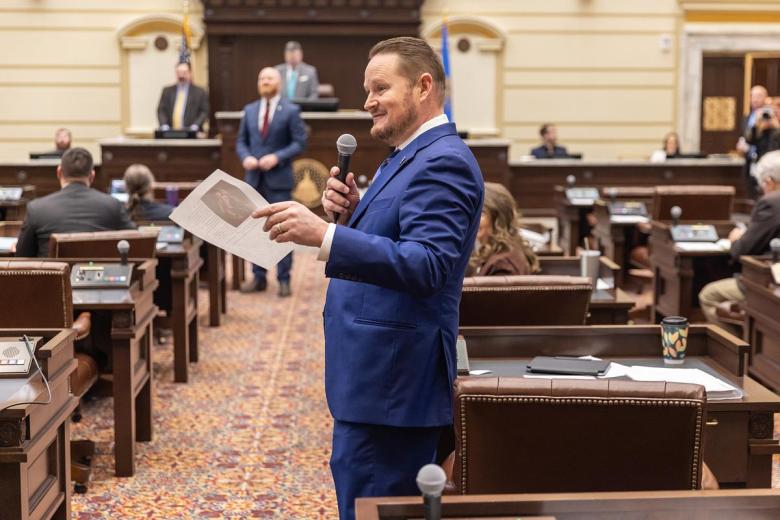
Oklahoma legislators will soon decide if ending in-state tuition for students in the country illegally will become law. They’re also considering whether non-citizens can own land — but other bills, including one making it a crime for nonprofits to provide support or resources to people in the country illegally, are not moving forward.
Senate Bill 1633, which removes language around eligibility for students who are not lawfully present in the U.S., is one of dozens of immigration bills introduced this legislative session.
Legislators have until March 26 to vote on the House and Senate floors to pass the bills to the opposite chamber for consideration.
Here’s what’s still moving forward in the legislative session and what’s no longer advancing as of March 16.
Still moving forward
House bills
House Bill 4422, authored by House Speaker Kyle Hilbert, R-Bristow, calls for the use of the Systematic Alien Verification for Entitlements (SAVE) program to determine an applicant’s eligibility and legal status for Temporary Assistance for Needy Families (TANF) and Supplemental Nutrition Assistance Program (SNAP).
- It passed 80-18-1 out of the House in February and is being sent to the Senate.
- The U.S. Citizenship and Immigration Services administers the SAVE program to verify immigration status and U.S. citizenship of applicants seeking benefits and licenses. According to USCIS, the program doesn’t determine an applicant’s eligibility, the agency determines it.
- SNAP offers food benefits to low-income families and TANF offers support to children dealing with a parent’s death, incapacity, absence or unemployment.
House Bill 4423, also authored by Hilbert, would require Oklahoma Health Care Authority to use the SAVE program to verify the immigration status of all applicants for state healthcare benefits before approving them. The authority will have to report to Immigration and Customs Enforcement if an applicant’s status cannot be verified as lawful. It earned 80-18-1 approval Feb. 26 and is now being sent to the Senate chamber.

House Bill 3551, authored by Cody Maynard, R-Durant, removes the process for students in the country illegally to apply for in-state tuition. This follows Attorney General Gentner Drummond’s announcement last year that the state would end the practice.
- It also requires the Oklahoma State Regents for Higher Education to verify a student’s lawful status through the SAVE program.
- It also clarifies that individuals not lawfully present are ineligible for postsecondary in-state education benefits, including scholarships, financial aid and resident tuition.
- The bill earned 24-6 approval out of the Appropriations and Budget Committee and needs a House floor vote to advance.
Senate bills
Senate Bill 1633, authored by Brenda Stanley, R-Midwest City, removes language providing eligibility for students who are not in the country legally to be eligible for certain scholarships and financial aid. It passed 39-7 in the Senate. The bill has gone through a first reading in the House chamber.
Senate Bill 1582, authored by Brian Guthrie, R-Bixby, would restrict buying land in Oklahoma to U.S. citizens and legal permanent residents. It would not apply to people who already own land in the state. The goal is to prohibit those in the country illegally from purchasing land. The bill passed out of the Judiciary Committee 5-1 and needs a Senate floor vote to advance.
“We must close legal gaps in the State of Oklahoma and prevent foreign influences from purchasing and owning property in our state,” Guthrie said in a press release. “These measures will protect Oklahoma lands from outside control, while keeping it in the hands of those with a real stake in our state.”
Senate Bill 1470, authored by Michael Brooks, D-Oklahoma City, would allow any elected official or religious leader to have access to private prison facilities to conduct informal inspections. It received 8-0 approval from the Public Safety committee and needs a Senate floor vote to advance.
No longer advancing
These bills missed the March 5 deadline to be approved by committees and made available for floor discussion. That means they are no longer moving forward through the legislative process.
House bills
- House Bill 2969, authored by Neil Hays, R-Checotah, called for the Oklahoma Health Care Authority to ask for proof of immigration status on applications when hospitals and health care providers are making presumptive eligibility for providing Medicaid or SoonerCare.
- House Bill 3597, authored by Mark Lepak, R-Claremore, called for “unauthorized immigrants” to not receive food stamp benefits under any circumstances.
- House Bill 3493, authored by Ryan Eaves, R-Atoka, would have required students to prove their U.S. citizenship or lawful presence to receive in-state tuition.
- House Bill 3598, authored by Mark Lepak, R-Claremore, would have amended existing Oklahoma law to prohibit people in the country illegally from receiving in-state tuition, financial aid and scholarships. It would have removed the option for students to establish eligibility for in-state tuition.
- House Bill 3725, authored by Jim Shaw, R-Chandler, would have required employers in Oklahoma to verify all employees citizenship status for all new hires. It would have directed the Department of Labor to create an online portal system for verification.
Senate bills
- Senate Bill 1554, authored by Randy Grellner, R-Cushing, called to prohibit nongovernmental organizations, including nonprofits, from providing support or resources to immigrants in the country illegally. Any officer or member of the nongovernmental organization would have been guilty of a felony and subject to imprisonment of one to five years with a possibility of a maximum fee of $50,000.
- Senate Bill 2098, authored by Dusty Deevers, R-Elgin, would have required birth certificates to include citizenship information for the child and the parents of the child. The bill also stated that no citizenship shall be granted to a child born to parents who are not citizens or legal residents. This would have been unconstitutional given the federal government’s current birthright citizenship policies.
- Senate Bill 1247, authored by Micheal Bergstrom, R-Adair, would have eliminated eligibility for people in the country illegally to receive postsecondary education benefits.
- Senate Bill 1248, authored by Micheal Bergstrom, R-Adair, would have prohibited people in the country illegally from enrolling in a higher institution within the Oklahoma State System of Higher Education.
- Senate Bill 1249, authored by Micheal Bergstrom, R-Adair, called to prohibit institutions in the Oklahoma State System of Higher Education from using state funds to provide scholarships, grants or tuition assistance to foreign national students, such as international students.
- Senate Bill 1308, authored by Michael Brooks, D-Oklahoma City, would have amended Oklahoma state law for in-state tuition eligibility. It would have specified that students can qualify for in-state tuition if they are U.S. citizens, graduated from an Oklahoma public or private high school and resided in the state for at least two years prior to graduation.
- Senate Bill 2006, authored by Ally Seifried, R-Claremore, would have prohibited the use of state funds for any higher education institution in Oklahoma State System of Higher Education to provide scholarships, grants or tuition assistance to a foreign national student from a country that is designated by the U.S. as a country of particular concern.
- Senate Bill 2050, authored by Adam Pugh, R-Edmond, would have removed language allowing students – who could not provide documentation of lawful presence – who graduated from an Oklahoma high school and resided in the state with a legal guardian to be eligible for in-state resident tuition.
- Senate Bill 1211, authored by Kendal Sacchieri, R-Blanchard, would have prevented manufacturing facilities employing individuals with H-1B non-immigrant visas from receiving a five-year property tax exemption.
- Senate Bill 1850, authored by Dusty Deevers, R-Elgin, called for all employers in the state to verify work authorization of all employees.
- Senate Bill 2073, authored by Dusty Deevers, R-Elgin, called for state entities to not employ individuals with H-1B visas or optional practical training authorization.
- Senate Bill 1910, authored by Dusty Deevers, R-Elgin, would have prohibited “nonresident “aliens,” temporary visa holders, foreign governments, and entities” from owning or controlling property in the state. Only U.S. citizens and lawful permanent residents would be eligible.
- Senate Bill 1918, authored by George Burns, R-Pollard, would have required applicants for groundwater permits to submit a valid Oklahoma driver’s license or U.S. passport.
- Senate Joint Resolution 31, authored by Brian Guthrie, R-Bixby, called for a constitutional amendment to prohibit noncitizens from possessing title to or owning land within the state.
- Senate Bill 1222, authored by Kendal Sacchieri, R-Blanchard, called to prohibit Service Oklahoma from issuing commercial driver licenses or learner permits to non-U.S. residents working temporarily in the U.S. It would’ve also prohibited and illegalized the use of non-domiciled commercial driver licenses from other states.
- Senate Bill 1230, authored by Kendal Sacchieri, R-Blanchard, called for Service Oklahoma to verify an applicant’s lawful presence for a Real ID non-compliant Driver Licenses or state IDs using the SAVE program.
- Senate Bill 1234, authored by Michael Brooks, D-Oklahoma City, called to prohibit law enforcement from wearing face coverings unless they obtained a specific court order. ICE agents have received criticism across the country for wearing face coverings. Several states and cities are considering bans on face coverings for law enforcement.
- Senate Bill 1243, authored by Micheal Bergstrom, R-Adair, called to require all persons operating motor vehicles in Oklahoma to be lawfully present in the U.S. It called for Service Oklahoma to verify the citizenship status of all driver license applicants during original, renewal and replacement applicants. It also called for driver licenses and state IDs to mark whether the individual is a U.S. citizen or a “lawful present noncitizen.”
- Senate Bill 1628, authored by Tom Woods, R-Westville, called to prohibit issuing commercial driver licenses or learner permits to individuals who do not reside in the state. It also clarified that individuals holding licenses or permits from other states operating commercial vehicles in the state must have a work visa and proof of citizenship.
- Senate Bill 2013, authored by Lisa Standridge, R-Norman, called for mandating all law enforcement agencies to enter into 287(g) agreements with ICE by Sept. 1. Tulsa County is among the 30-plus agencies to partner with ICE.
This article was produced as part of a partnership between the Tulsa Flyer and La Semana, a Tulsa-based bilingual Spanish-English newspaper serving Latino communities in Oklahoma.
News decisions at the Tulsa Flyer are made independently of our board members and financial supporters. Read more about our editorial independence policy here.