



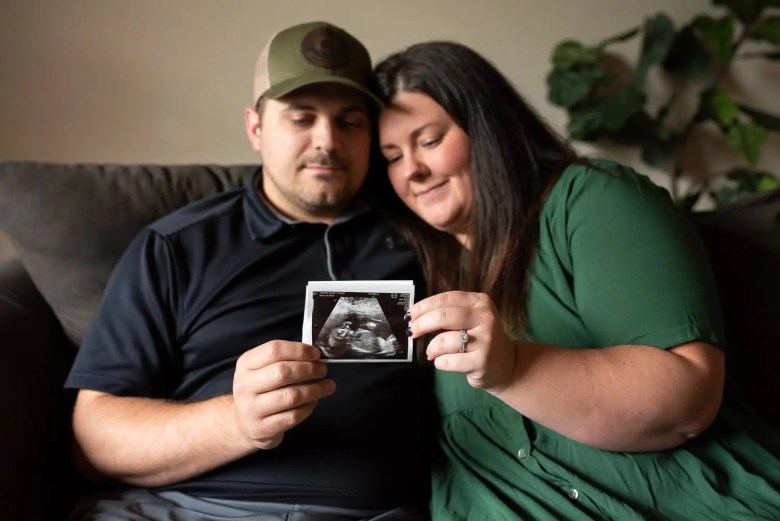
In December 2022, Magon Hoffman was 19 weeks pregnant when she and her husband, Lane, went to a maternal-fetal medicine specialist for an anatomy scan.
“I remember watching them do the ultrasound,” she told The Eagle. “When they got to her head, I remember it was measuring like 14, 15 weeks, so significantly smaller than the rest of her body.”
The ultrasound technician, who had been taking photos of the fetus, “got really quiet,” Hoffman remembers.
“I noticed that she had kind of stopped taking pictures as much and I just pretty much knew in that moment that something was wrong,” she said.
Hoffman had already experienced some complications with the pregnancy, having woken up in the middle of the night a couple of weeks before and finding she was bleeding heavily. But she said it never occurred to her or her husband, Lane, that the baby might not survive.
She was faced with a choice she never expected — a decision that would bring her to join a lawsuit challenging Oklahoma’s near-total abortion ban nearly four years later.
Hoffman remembers the ultrasound technician going to get a doctor who then came back with a diagnosis: anencephaly.
The Centers for Disease Control and Prevention classifies anencephaly as a serious birth defect where parts of the brain and skull do not develop properly. The condition commonly leads to death, the CDC states.
“He just made it very clear that she would never be able to survive, ‘never see the outside of a hospital,’ is how he put it,” Hoffman said.
From that moment, Hoffman said, the doctor advised them they had two options — leave the state to have an abortion or stay in Oklahoma and continue the pregnancy through to birth. The latter option meant doctors would assist the couple in “doing what they could to make her as comfortable as possible while we watched her die,” Hoffman remembers.
“I knew in that moment that I was going to have an abortion,” she said. But she was faced with a dilemma.
In June 2022, the U.S. Supreme Court overturned Roe v. Wade, the 1973 ruling that said individuals had a constitutional right to an abortion, returning authority over abortion legality to the states.
That same year, Governor Kevin Stitt signed legislation enacting multiple restrictions on abortions in the state. Hoffman experienced her ordeal in the shadows cast by these restrictions.
What followed the couple’s realization were days of phone calls to clinics in other states, looking for a place where she could have an abortion and to see if her insurance company would cover the cost of the procedure.
Hoffman says she was overwhelmed, exhausted, scared. She confided in her mother about her fears: What if anti-abortion protesters were waiting outside the clinic to confront her?
Eventually, the couple found a place to have the procedure safely in New Mexico. They drove over eight hours to have the abortion and spent around $3,000 for the cost of travel, lodging and the procedure.
She said this was possible because she had the resources to leave.
Now, Hoffman wants to make sure no other Oklahoman who hears from doctors that their fetus may not survive has to go through what she experienced.
She is one of two women to join a Sept. 16 lawsuit filed by the Center for Reproductive Rights in the Oklahoma County District Court. Two Oklahoma OBGYNs have also joined the lawsuit challenging the state’s total abortion ban and 22-week ban in regards to pregnancies with fatal fetal diagnoses.
Both restrictions “contain limited exceptions that permit abortion care when the pregnant person’s life is threatened” but there is no exception in the bans for fatal fetal diagnoses, the Center for Reproductive Rights states.
The lawsuit names Oklahoma Attorney General Gentner Drummond, Oklahoma State Board of Osteopathic Examiners Executive Director Steven Mullins and other state health officials as defendants. None responded to requests for comment by publication time.
Hoffman and the other plaintiffs argue women should not be forced to carry babies to term when they have received medical guidance that the child will likely not survive.
“Every year, many pregnant Oklahomans receive a diagnosis that means their pregnancy will end in miscarriage, stillbirth, or the death of an infant shortly after birth,” the legal complaint states. “Pregnant people should have the freedom to discuss these circumstances with doctors and loved ones, decide on the best course of action, and effectuate their decision, free from stigma or discrimination. But that is not the reality that Oklahomans face.”
Meetra Mehdizadeh, a senior attorney at the Center for Reproductive Rights who is working on the case, told The Eagle the law is harming families and putting doctors and other medical professionals in fear of legal retribution for providing care.
“Abortion is part of reproductive healthcare. It’s part of maternal healthcare,” Mehdizadeh said. She believes it’s “a hard situation for doctors to be in because this is care that they are qualified to provide, that they should be able to provide.”
As the lawsuit unfolds, Hoffman has turned her tragedy into advocacy, launching a podcast to give other women the chance to tell their stories.
Although she said she didn’t “need a lawsuit to know that what the state of Oklahoma did to me is wrong,” she hopes to bring change for other women.
“There’s nothing that we can do to prevent a fatal fetal diagnosis,” she said. “But if this lawsuit could give the next family a piece of their dignity back and their community back during their worst days then that would have made this entire thing worth it for me … to be a part of this lawsuit.”
