


What to know
Behind closed doors: Records show officials arranged one-on-one briefings to avoid public meeting requirements after signing confidentiality deals.
Public backlash: Nondisclosure deals are fueling outrage in communities where local leaders have approved data centers.
Failed reform: One Oklahoma lawmaker tried to limit the use of such agreements, but said legislative leaders “were too afraid that it would disrupt the businesses coming into the state.”
Kyle Schmidt’s family farmhouse sits in the rolling, wooded hills near Sand Springs. A short distance from the front porch, a goat Schmidt’s daughter is raising bleats in its pen, and more than a dozen ducks mill about the property. He’s worried about light and noise from the data center Google plans to build a mile north of his home.
“We come out and we sit out here at night and we just look at the stars and watch the weather and stuff,” Schmidt said. “Straight up over there, we would just see a nice glow from the data center.”
The City of Sand Springs annexed 827 acres of ranch land near Schmidt’s home in June 2025. The city didn’t tell residents that the property was being eyed by Google. The city manager later signed a nondisclosure agreement in October, agreeing not to talk about the project.
The property owners asked Sand Springs for the annexation, and the city wasn’t legally required to notify neighboring property owners.
Schmidt said he found out about the annexation the day after the council approved it. Months later, the application to build a data center, called Project Spring, became public. The Sand Springs City Council approved the project in February.
Sand Springs City Manager Mike Carter said the city wasn’t aware of definite plans for a data center when the annexation was approved, but a third-party developer had said it hoped to eventually attract one to the site.
Bringing the vacant land, which was about eight miles north of downtown, into city limits allowed Sand Springs to collect a 2% fee from electricity usage by the facility. The city expects the development to generate $100 million in revenue from the fee over 25 years.
Long before a new data center is publicly announced, local officials work behind the scenes to aid developers in determining whether the location is a good fit. But to protect the companies involved, public officials have often been sworn to secrecy.
Officials in other cities like Coweta, Claremore, Luther, Yukon, and Stillwateralso signed nondisclosure agreements with data center developers in the past two years. Though the language of the agreements vary, some require that public officials not reveal that any discussions with developers are occurring, that any confidential information has been received, or even that a non-disclosure agreement exists. Some agreements allow the companies to sue cities to enforce the terms of the deals, sometimes in other states. In Claremore and Coweta, data center developers have briefed public boards and commissions on their plans, one or two members at a time to avoid quorums that would require a public meeting under the Oklahoma Open Meetings Act after signing nondisclosure agreements, emails show.
One official in Wagoner County warned local leaders there that a nondisclosure contract could be illegal or run afoul of Oklahoma government transparency laws.
At The Frontier’s request, Oklahoma City University School of Law professor D.A. Jeremy Telman, who specializes in contract law, reviewed some of the nondisclosure agreements Oklahoma public officials have entered into with data center developers.
While some of the non-disclosure agreements have language to allow companies to seek a court order to stop sharing confidential information and penalties for violating the contract, others contained no enforcement mechanisms, Telman said.
“It’s not clear to me that they would be enforceable,” he said.
Public officials would also have a strong defense that the First Amendment protects their right to speak in the public interest, or as a public official, he said.
Google did not respond to interview requests or written questions about the Sand Springs project or the nondisclosure agreement. But the company has publicly said it has made changes to the data center design to reduce noise, light and water usage in response to community concerns.
Schmidt said he would have protested the annexation if the city had notified him about the development plans.
“By the time the citizens even get a voice or even find out what’s going on, the decision’s already been made and the rest is a mere formality.”
Schmidt is now the president of Protect Sand Springs Alliance, a group formed to fight against data center development.
Back-room meetings and secrecy deals
Many secrecy deals Oklahoma officials signed were with the data center developer Beale Infrastructure, which is spearheading plans to build at least three data centers in the state.
The company said in response to questions that it seeks feedback from communities for each of its proposed Oklahoma data centers and in some cases, has made changes to site designs to address community concerns.
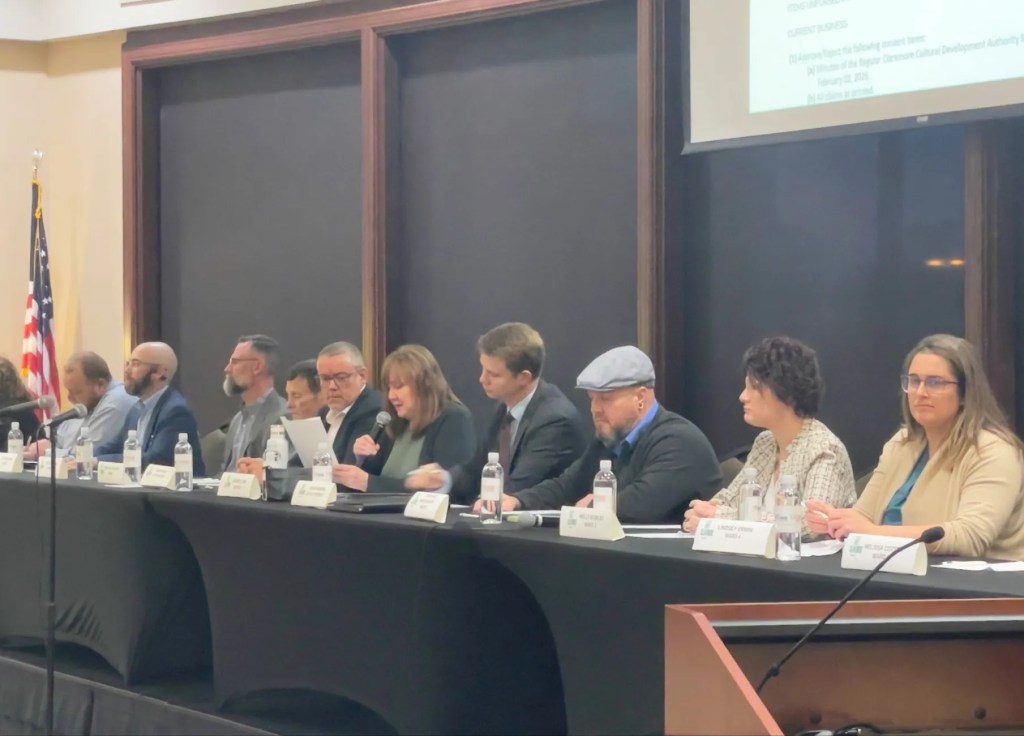
In Claremore, more than a year before plans for the Project Mustang data center were publicly announced, city officials signed a nondisclosureagreement with Beale Infrastructure. After signing the agreement, City Manager John Feary advised an executive from Beale to speak with members of the local tax incentive district privately before holding a public meeting. The public outcry that had occurred a few weeks earlier during the Tulsa County Commission meeting for a different data center project had lasted more than three hours, and Feary was worried something similar may happen in Claremore.
“In seeing and tracking the goings on with Tulsa County’s project we are more convinced that this first meeting should be utilized to vote on our at large members and should not be a forum to have an open discussion about the project specifics with the owner/developer,” Feary wrote. “I strongly encourage your team to have those conversations with NE Tech and Sequoyah Schools prior to any public meetings.”
Meggie Froman-Knight, Claremore’s economic development director, who had also signed a nondisclosure agreement, coordinated one-on-one meetings between company representatives and county commission members, as well as informing the project team when public questions came in about agenda items related to the project.
“If you desire to meet with (Wagoner County) Commissioner Delozier only to avoid quorum prompting a meeting notice, I am happy to reach out to him,” Froman-Knight wrote.
in May 2025, more than a year after city officials signed a nondisclosure deal with Beale Infrastructure. the Claremore City Council approved an agreement with a shell company affiliated with the developer to procure equipment to build the data center, formed a committee to discuss tax incentives and signed a utility agreement to power the facility.The meeting agenda gave no indication that Beale was planning to develop a new data center in town, It would not be until December that plans for Project Mustang were made public.
The Claremore city manager said in a written response to The Fronter’s questions that the city followed all requirements under state open meeting and records laws. Froman-Knight declined to comment.
“As with all private investment projects, decisions regarding whether to proceed and when to publicly share details remain at the discretion of the companies involved,” Feary wrote.
Non-disclosure agreements “allow communities to review important project information while protecting proprietary, copyrighted or sensitive infrastructure details. Unauthorized disclosure of such information could violate intellectual property rights, create legal liability and pose potential safety risks,” Feary wrote.
In Coweta, where Beale Infrastructure pitched another data center development called Project Atlas, City Manager Julie Casteen signed a non-disclosure agreement in May 2024. The agreement required her to keep secret any discussions with Beale Infrastructure about the project location, and even the existence of the non-disclosure agreement itself.
By early September, 2025, Coweta Mayor Naomi Hogue and Vice-Mayor Jeremy Barnett had also signed non-disclosure agreements and later met with company officials about the project.
Five days after Hogue and Barnett signed the confidentiality deals, the city council voted to annex part of the proposed data center site into the city limits, though no mention was made during the meeting of what was being planned for the property.
Officials in Coweta did not respond to requests for comment.
The Wagoner County District Attorney’s office found significant issues with the same nondisclosure agreement Coweta officials signed when an economic development official for the county sent it to him for review on Aug. 28, emails show.
Assistant Wagoner County District Attorney Reginald Armor said in an email that the contract was designed for private-sector use, not government employees. The agreement included clauses requiring legal disputes to be settled in Delaware, and was overly broad in its confidentiality requirements, he wrote.
“Concealment of the very existence of discussions is overbroad and problematic: The form requires the County to keep ‘the existence of any discussions’ confidential,” Armor wrote.
The agreement could clash with public officials’ legal requirements under the Oklahoma Open Meeting Act down the line, he wrote.
Armor agreed to revise the document to bring it into compliance with Oklahoma law for Wagoner County officials.
On Oct. 17, Armor wrote to another county official that non-disclosure agreements are essentially unenforceable, and included a memorandum detailing how such agreements are against the Oklahoma Open Records and Oklahoma Open Meetings acts and were likely unenforceable.
“Commissioners simply cannot sign binding contracts individually on behalf of the county. That’s just a basic rule,” Armor wrote.
State law bars public bodies from using private contracts to get around transparency requirements, he wrote.
After Armor’s memo, no county official or employee signed the agreement, said Lori Hendricks, Wagoner County Clerk.
Public backlash
In Coweta, crowds of residents packed city council and planning commission meetings that involved the data center, voicing their opposition to the project, and in January, the planning commission voted against the development plan. Beale scrapped plans for the project in March.
The town’s anti-data center Facebook page pivoted to become one dedicated to firing the town’s city manager, who residents had learned called those opposed to the data center “not very smart” in text messages obtained through records requests and had known about the project since 2024.
In early May, Coweta Police Chief Mike Bell announced he was opening a formal inquiry after citizen complaints about the way Project Atlas was handled to investigate allegations of wrongdoing by some city leaders, including possible Open Records Act and conduct violations by city officials.
Beale Infrastructure said in its statement to The Frontier that it is taking into consideration the public pushback against non-disclosure agreements when dealing with data centers.
“Non-disclosure agreements are a common practice in economic development for projects and business recruitment, and have been an industry standard for decades,” the company said. “However, we have found that NDAs can inhibit the kind of communication we want to have with communities, especially as we seek community feedback.”

There has also been pushback against the use of nondisclosure agreements from state lawmakers, but efforts to ban or limit their use have so far failed.
Rep. Jim Shaw, R-Chandler, introduced a bill this legislative session, House Bill 3030, that would have prohibited any elected or appointed public officials from signing non-disclosure agreements related to the performance of their public duties. The bill quickly died in committee without a hearing, he said, as House leadership was concerned it would keep companies from coming to Oklahoma. House Speaker Kyle Hilbert’s office did not respond to interview requests or written questions from The Frontier.
“I was told that bill wouldn’t be ran because, quite frankly, they were too afraid that it would disrupt the businesses coming into the state, which, I think, is a common belief with a lot of folks at 23rd and Lincoln.”
More residents are taking matters into their own hands.
In Sand Springs, the Protect Sand Springs Alliance began a recall petition against the entire city council, but the effort did not garner enough signatures. Recall efforts related to potential data center deals have also begun in Claremore and Yukon.
The Protect Sand Springs Alliance has also filed two lawsuits against the city and property owners, alleging the annexation was illegal. Land Legacy Inc., a local conservation group, has filed a separate suit alleging that it was not notified beforehand about the annexation. The nonprofit has an easement on the land for conservation efforts. As of early June 2026, none of the three lawsuits had been resolved.
Carter said he expects the city and landowners to win those lawsuits and that he believes they are “without merit.”
Schmidt said that the scope of nondisclosure agreements signed by public officials should be limited. not restrict city officials from saying even what industry a property may be developed by.
“Just the fact that there is a data center project being considered? That should never be hidden by an NDA” he said.
This article was originally published by The Frontier. You can see the original story here.