


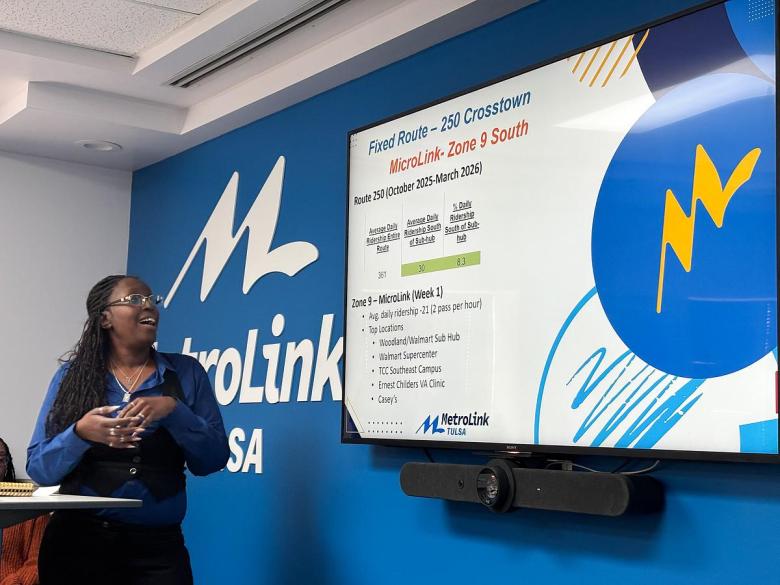
Crys LaCroix used to hop on MetroLink’s Route 250 from downtown all the way to Tulsa Community College’s southeast campus. Now, LaCroix is dropped off at a Walmart hub — still a 10-minute drive from where she teaches classes at TCC.
Changes to Route 250 mean LaCroix has to book a MicroLink, an on-demand service similar to Uber or Lyft that comes with a 10- to 15-minute wait time in the morning. It has taken up to an hour for a vehicle to arrive in the evening, she said.
LaCroix is among the students, staff and veterans who are feeling the impact of recent changes to bus routes by MetroLink Tulsa, the city’s primary public transportation provider. The agency removed bus stops from part of Routes 250 and 470, including direct stops to TCC’s southeast campus and the Ernest Childers VA Outpatient Clinic.
Scott Marr, MetroLink’s CEO and general manager, said those changes were made to move resources where they were needed most.
“I think a lot of people are hesitant to change and then it’s really up to us to educate the customers and the students,” Marr said. “I thought we did a really good job of that.”

Students, veterans among those impacted
LaCroix, an adjunct professor at TCC, said it’s a choice for her to use public transportation, but many people don’t have that privilege.
She was concerned by MetroLink’s decision to make bus changes in the middle of the semester. LaCroix made friends with students who are dealing with frustrations as well.
“I just felt a lot of confusion,” LaCroix said.
In the weeks leading up to the April 12 shift, MetroLink hosted public meetings to inform students and staff at TCC about the upcoming changes. MetroLink also had staff members on the ground at the hub to help with the first day of changes.
Many expressed concerns directly to the transit provider. In letters sent via email to MetroLink, one community member wrote that they’re a disabled veteran who relies on routes 250 and 470. The changes affected the way they get to the Ernest Childers VA Outpatient Clinic near 91st and Mingo.
General managers for businesses along the routes, including McDonald’s and Golden Corral, also sent issues to MetroLink.
Sarah Burns, business office manager at EyeCare Associates of South Tulsa, wrote in a letter to MetroLink about how many of her patients rely on the bus routes to make it to their appointments. Burns told the Flyer a client asked her to write the letter.
“In my professional opinion, this change is unacceptable and risks preventing patients from receiving necessary care,” Burns wrote. “I respectfully request that you reconsider the removal of Bus Routes 250 and 470 and take into account the significant negative impact this decision has on veterans, patients, students, and working community members.”
Low ridership led to changes
MetroLink tracks riderships through two different ways: automatic passenger counters and fare boxes. A bus can stay in service if it has 13 passengers per hour, according to guidelines set by the agency’s board.
Route 250 originally made its way from downtown all the way to TCC’s southeast campus. The final destination is now a Walmart-Woodland Hills Mall hub, cutting the original route by about 10 minutes.
MetroLink Deputy General Manager Naaja Jefferies said ridership from the Walmart hub to TCC southeast campus only accounted for 8% of Route 250’s total ridership.
That is about five passengers per day, Marr said. Meanwhile, the route segment to the VA only had about three passengers per week.

MicroLink takes on bigger role in transit
In response to removing stops from the routes, MetroLink created a new MicroLink zone that will provide single-car rides within a certain area.
“Micro Transit replaces low ridership areas where it doesn’t make sense to have a 40-foot vehicle,” Marr stated in an email to LaCroix.
However, LaCroix said MicroLink is not like taking a bus to another part of the city. She can’t access The Gathering Place or downtown from TCC’s southeast campus with it like she could with the bus. It’s a helpful solution if someone is trying to maneuver within a small area, she said.
“I have real concerns that MetroLink is increasingly relying on this as a solution and I don’t think it’s a solution,” LaCroix said. “I think maintaining steady bus routes that take people across the city is what will ultimately serve populations better.”
TCC spokeswoman Kelsey Kane said in an email that TCC and MetroLink have had a partnership since 2015. A few students have voiced their concerns about the bus changes, Kane said, but most students wanted to understand how to use MicroLink to get to their next destination.
“The cost structure for transportation support is part of an evolving agreement with MetroLink,” Kane stated. “As the partnership has transitioned from a fixed‑route service to MicroLink, TCC is working within that framework.”
This article was produced as part of a partnership between the Tulsa Flyer and La Semana, a Tulsa-based bilingual Spanish-English newspaper serving Latino communities in Oklahoma.
News decisions at the Tulsa Flyer are made independently of our board members and financial supporters. Read more about our editorial independence policy here.