


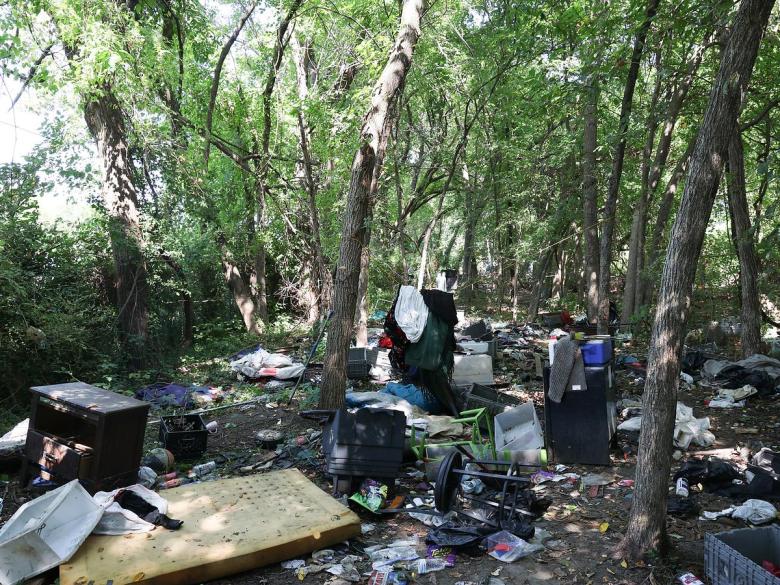
For the first time in city history, the Tulsa city auditor asked the public last year what they wanted the office to examine. The answer — ranking roads and tracking programs for the unhoused — created an unforeseen problem: There was no way to capture all the nonprofit money coming into the city to help combat homelessness.
“Right now, what we’re trying to do is just get a grasp of resources and investments being made into housing and homelessness in the city,” said Mike Stout, an Oklahoma State University professor on leave and currently serving as deputy city auditor. “Nobody seems to have a complete roadmap.”
Other cities have more central accounting through municipal departments. Tulsa’s history of nonprofits leading the way has led to fractured data.
To locate all public and private funding sources involves many sources, such as federal 990 nonprofit tax forms, agency budgets, city invoices, grant applications and other public records.
The goal is to track at least 80% of the total funds going to homeless reduction programs between 2021 and 2024.
“This information is something people keep asking for,” City Auditor Nathan Pickard said. “We wouldn’t have tried to jump into it if it wasn’t the second-highest response from last year’s citywide survey.”
To provide a framework, Pickard tapped Stout to bring a social sciences approach to auditing principles.
Tulsa’s Continuum of Care organization — the federally recognized group that serves as a hub for homelessness reduction — is the nonprofit Housing Solutions, but the city auditor report will go beyond what it does.
“We’re doing this bigger risk assessment because it allows us to have a more comprehensive picture of what the system looks like as it currently exists, what the funding environment looks like in that system, where those funding streams are going and how those are being used,” Stout said.
The audit’s first phase is slated for release in June. The second phase will be a performance audit on the city’s programs related to homelessness and housing. Outcomes and progress of all audits are found on tulsacityauditor.org.
A second citywide 918 Survey was recently launched and looks different from last year’s inaugural effort. Only about 300 Tulsans responded to the first survey, or less than 1% of the population.
Stout has refined the survey to capture a more representative sample. The questions are more specific, include a ZIP code request, and resurrect some topics from the Gallup-Tulsa CitiVoice Index that was administered in 2018 and 2020.
“The hard part is we don’t have funding for this survey, so it’s based on how many people we can convince to fill it out,” Pickard said.
One incentive: Entering a drawing for a $100 QuikTrip gift card. The survey, open through April 30, can be completed in English or Spanish.
News decisions at the Tulsa Flyer are made independently of our board members and financial supporters. Read more about our editorial independence policy here.