



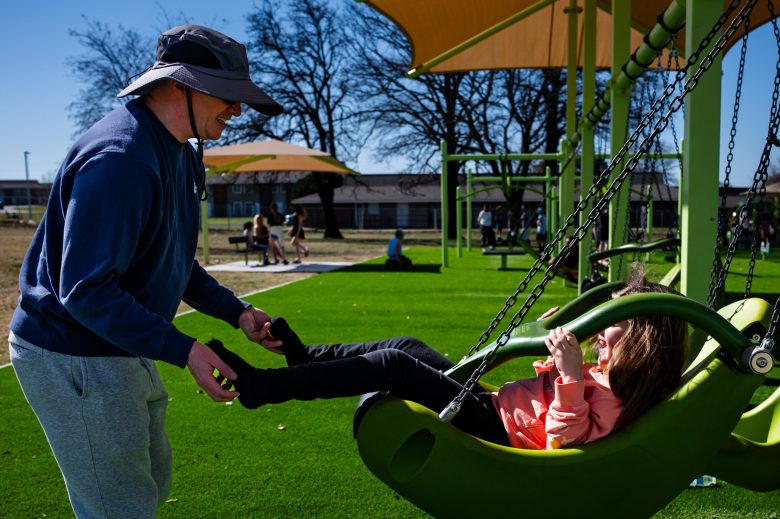
When kids go to a playground, they see a place to run, climb and have fun. But when the parent of a child with physical challenges sees a playground, they might see barriers.
Since 2023, Tulsa has installed two inclusive playgrounds at parks. On Friday, Tulsa Parks plans to celebrate the grand opening of its third one at Bales Park. The west Tulsa park is also near Bike Club’s new headquarters, where the group will operate a hub to teach students how to cycle, support trail development and offer adaptive riding opportunities.
The differences in the parks are there, but they’re not always obvious.
“That’s the point,” said Lauren Pool, a Tulsa mother of four.
Pool approached the city in 2022 about the need for more adaptive parks.
“We were going to the park all the time when all of the kids were little, and realizing how quickly she was outgrowing all of the elements that are made for babies,” Pool said. Her daughter, Lincoln, now 9, has cerebral palsy and epilepsy.
Growing up, Pool says, she would be left out of playing with her two brothers but the inclusive designs are changing that.
“Everybody is engaged the whole time, instead of relegating Lincoln to the sidelines to watch everybody play because she can’t access even the surfacing on the playground,” Pool said.
Inclusive parks, like Bales, feature wheelchair-accessible merry-go-rounds and bigger swings. There’s also a communication guide.
“The wheelchair-accessible merry-go-rounds just don’t go as fast, and they allow an opportunity for even caregivers. You know, these parks are not only about kids, they’re for caregivers too,” Pool said.
Each playground has some unique features for different experiences. They all have larger swings and merry-go-rounds at ground level so wheelchairs can roll into them. In addition, kids can play on climbing towers modified with rails, chairs and ramps for kids with mobility challenges, specially-designed nets for climbing and musical chimes to integrate the auditory senses into play.
Assistive communication boards allow nonverbal children to point to icons to tell their parents what they want to do or where to go. The mulch playground surface also has been replaced with turf for level ground so anybody with a mobility device or a cane can use them. Part of the parking lot pavement has also been turned into a wheelchair-accessible softball field.
Anthony Meadows, adaptive sports coordinator for the Tulsa-based Center for Individuals with Physical Challenges, said he worked for three years with various park systems to create a field. He is advocating for more inclusive sports fields and playgrounds.
“The more inclusive spots that you can have, the better … you also get the families that come along with that,” Meadows said. “So you not only impact one person’s life, you impact the whole family. Now my family can recreate with me, and I can recreate with them, like anybody.”
Both Pool and Meadows are part of an advisory committee that continues to work with Tulsa Parks to recommend modifications and designs for more inclusivity.
The three parks were funded through about $2.4 million in gifts from the Sanford & Irene Burnstein Family Foundation. The other two locations are at Whiteside Park, 4009 S. Pittsburg Ave., and Hicks Park, 3443 S. Mingo Road.
