


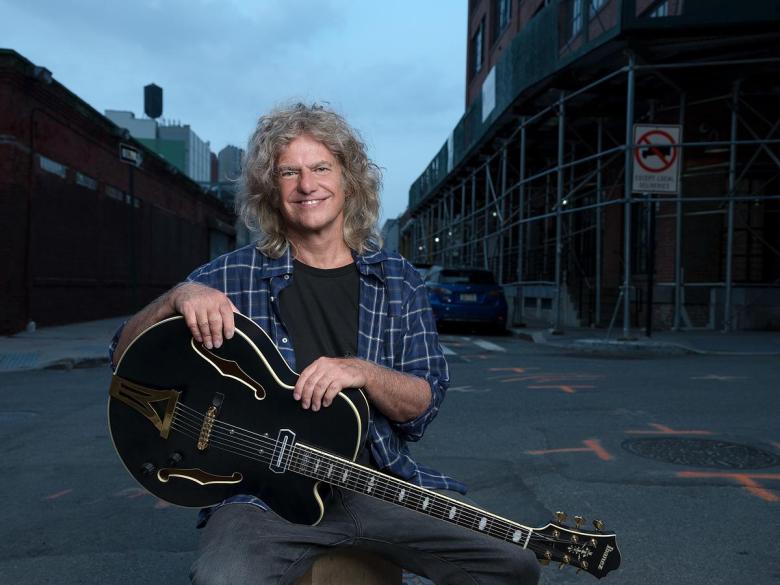
Years before he won his first of 20 Grammys in 10 different categories — a feat only he has accomplished — legendary jazz guitarist Pat Metheny was playing for Tulsans at a little place called The Magician’s Theater. The venue at 1643 S. Boulder Ave. became a routine stop on his tours.
“I was lucky that the owner of the place — a guy named Don Duca — would always give me a gig there,” Metheny said by email. “Sometimes my band would come to Tulsa, and we’d stay for a week, sometimes sleep on people’s floors, and play the Magician’s Theater for an extended time.”
Metheny says those were transformational performances in his career. He is set to return to the city March 31, this time for a performance at the Tulsa PAC’s Chapman Music Hall.
“There was a lot of really interesting sort of evolutionary progress that happened during those gigs, and Tulsa has been a special place for me because of that,” he stated. “I’m always happy when I see it added to the itinerary, and really thrilled that we’re going to get to come and play there this time around.”
The 71-year-old musician is touring in support of Pat Metheny’s Group’s latest release “Side-Eye III+.” He answered the Flyer’s questions from the road.
You recently released “Side-Eye III+.” How has the reception been to the album and to the live performances since you kicked off the tour a couple weeks ago?
It’s been great so far. We’re about 2.5 weeks in at this point, and each night it just keeps getting better and better. It’s a very interesting hybrid of things that represent the new record and some of the older things that I’ve done over the years that fit this exact instrumentation. But all of it feels new because of the perspective that those guys are bringing to the music.
What can fans expect when you play the PAC on March 31?
This is one of those tours where anyone who maybe has heard about me over the years but is not quite sure what exactly it is — this would be a really good concert to come to, because it covers a lot of different territory of my thing.
The new record is actually kind of an advancement for me on a bunch of levels, in terms of harmony and just conceptual things about how to have a band like this represented through the prism of my current sense of things. But also, this band has sort of opened the door for me to look at some of the older pieces in a different way, and we’re doing that too.
It’s quite a wide-ranging type of performance. It’s not just focused on one particular aspect of my thing — it really covers a wide range of it. I think people who are really familiar with what I have done over the years are going to enjoy it, but I think maybe people who don’t know that much about my particular thing will also be able to come and get a really good sense of what it’s all about and what it’s been about all these years.
Tell me about the guys you have supporting you on stage. How much fun is it jamming with Chris Fishman, Joe Dyson, Leonard Patton and Jermaine Paul?
When I started putting this music together, it was really with the idea of it being another Side-Eye trio-type record — meaning that it was going to be this thing that I’ve always imagined of an organ trio, but in the 21st century. The idea being that the keyboard player is going to play the bass parts as well as the harmonic information, but it’s not going to be limited to just a Hammond B3, that it could be any kind of modern keyboard. That basic idea has really proven to be a pretty fertile area for me, particularly once I settled in with the band being Chris and Joe.
But having written all this new music, once I got it into the studio with Chris and Joe, before we went too far I started to realize that there were several other layers of information sort of hovering right above what the trio part was going to be. I’ve always trusted my instincts, and when I get a sense of possibilities beyond what I originally imagined — whenever that may be — I usually feel OK to tear up the planned page and go ahead and go for it.
In this case, that meant adding a bunch of other musicians that I had not really anticipated adding, and it ended up with a record that was quite a bit beyond what just a keyboard/guitar/drum trio was. The most significant decision in all of it was the thing of adding a bass player. Once I kind of crossed into that zone, it really became a different kind of record, and that meant for the tour I was probably going to hire a bass player.
I feel very lucky to have Jermaine Paul playing with us. He’s, in my opinion, one of the most exciting new bass players around, and he’s really just been a fantastic contributor already to what’s going on on the bandstand. Leonard Patton is somebody I’ve known for a while. I’ve always wanted to use him on things, and with his participation on the new record, it was just a natural thing for me to invite him to come out on the road with us.
Having him on the bandstand has just been a pure joy. He’s a beautiful person and a fantastic musician. It’s quite a nice band with a bunch of really good people who also happen to be excellent musicians.
You’ve consistently released new music, and now have more than 50 releases to your name. What motivates you to keep making new albums versus touring on your extensive catalog?
I guess I’m one of those people where I don’t really worry about stuff like that too much, because I always have so many ideas. I’ve got so many things that I want to do that I still haven’t gotten to. The issue of motivation is actually not even a remote issue for me — it’s the exact opposite, which is I just don’t have time to do all the things that I’m interested in.
But that being said, I’m catching up now. I have about five records that are pretty much ready to go, and I’m really looking forward to getting those things out there so that I can move on to these next other things that I’m imagining. I’m hoping, over these next couple years, to really do a lot of record releases to kind of get caught up with everything.
I’m always working on music. I wake up every morning — sometimes four or five in the morning — and start working on new things every day, and still never feel like I have enough time to get everything that I want to get to.
Who are the current jazz musicians that have your attention and get your listens?
There are so many musicians that I really love out there. The generation that came along 10 or 12 years after I came along is special. That’s a generation that I really love. That’s the generation of Brad Mehldau, Christian McBride, Joshua Redman, Antonio Sánchez, Larry Grenadier, Bill Stewart — even Kenny Garrett, who is just a little bit older than those guys.
All of them really felt like this tribe that did not exist in my exact generation, but then, suddenly, there they were. And to a person they all kind of sought me out to get together to play, which was really cool. So I feel real closeness with those guys.
Then it feels like there’s been a little pause again, and I have to say that Chris and Joe are two musicians that really stand out to me. Part of the reason that I’ve devoted so much time and energy to this band is because of their individual talents, and the way that they also have a broad understanding of what my thing really is. That is really gratifying to me too.
That thing that I look for is hard for me to quantify, because it requires a lot of inside knowledge about very specific musical things, but it also requires musicians who can play very, very simply in addition to playing the really complicated stuff. Folks who can bridge those two things well are the hardest players for me to find.
Both Joe and Chris are able to do that, and I’m happy to say that Jermaine is joining that crew of people who can play the really complicated things and immediately shift gears and play the very simple things. I can find lots and lots of people who can play really complicated stuff, but it’s really hard for me to find people who can play the really simple things and have it carry real meaning.
News decisions at the Tulsa Flyer are made independently of our board members and financial supporters. Read more about our editorial independence policy here.
