

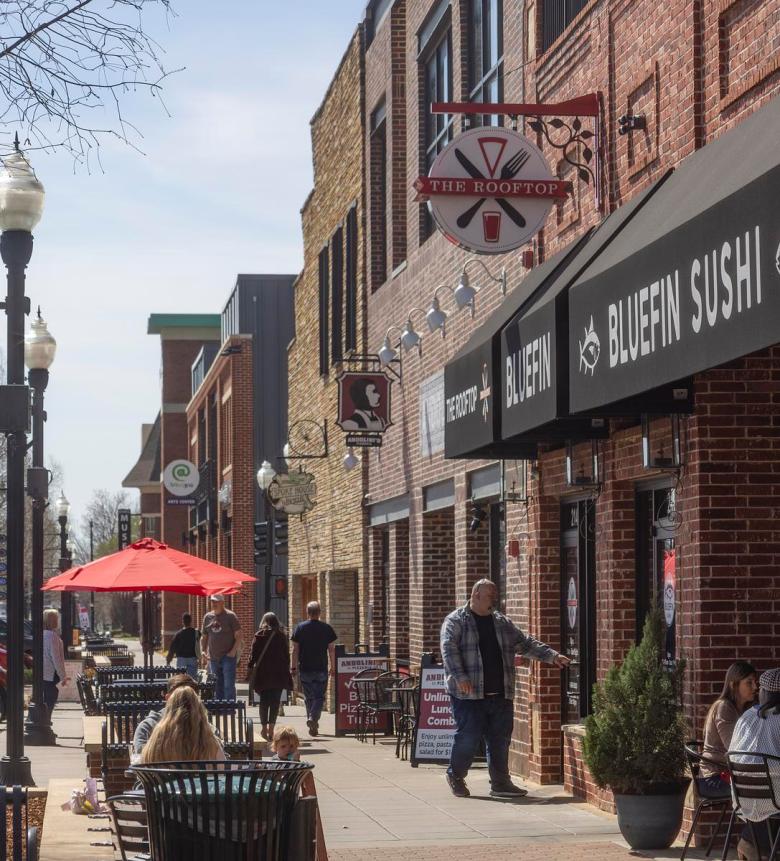
Broken Arrow voters are deciding whether it’s worth spending half a cent more in sales tax and keeping its property tax level to pay for more than 100 city projects.
Eight propositions will be on the April 7 ballot, asking for $415 million in general obligation bonds and a .5% temporary sales tax increase. The bonds would be repaid by revenue from property taxes. But property taxes would remain the same if the package passes because these bonds would replace retiring ones from previous initiatives.
The price of Broken Arrow’s 62% growth since 1997 has been bond debt. Since then, the city has passed eight bond packages worth about $478 million for nearly 265 major infrastructure projects. Those include widening two-lane roads to five lanes, building fire stations, adding community centers and improving the stormwater drainage system.
Oklahoma is the only state that restricts its cities to using solely sales tax revenue to pay for general government operations. To finance big-project items, municipalities rely on residents approving bond debt for financing.
“All sales tax collected, except for the half-cent for capital improvements, goes to pay for day-to-day operations,” said City Manager Michael Spurgeon. “There simply isn’t the revenue from sales tax available to pay for the proposed projects.”
For every dollar paid in property tax in Broken Arrow, about 13 cents goes to paying off general obligation bonds and legal judgments. The last bond package passed in 2018, amounting to $210 million across six propositions. About $22.1 million of that is paid off and 74% of the projects are complete or in construction.
“It normally takes 12 to 13 years to complete a 10-year package because bonds sold for projects in years nine and 10 still take the same amount of time to complete as bonds issued earlier in the package,” Spurgeon said.
The debt of a general obligation bond is typically paid off 20 years following the date when it was sold, Spurgeon said. In the case of the 2026 bond, the city expects to sell its final bond by Dec. 1, 2037. The final debt payment would be made in 2057.
If all propositions fail, it would decrease property taxes on $229,300 —- the median value of a Broken Arrow home — by $2.02 in 2027 and then incrementally each following year. The most homeowners would save is $324.37 by 2038.
“Paying down the interest and principal of general obligation bonds is one of only two ways cities may use property tax. Therefore, if a proposition is voted down, the needs for the capital improvements don’t go away, but the funding source to pay for them does,” Spurgeon said.
Breaking down the bond propositions
The largest portion, $205 million, would be used for transportation projects such as widening roads, improving intersections, repairing residential streets and connecting sidewalks and trails. The $56 million in Proposition 2 includes about $18 million for fire trucks and $10.2 million for a new fire station on the southeast side of the city.
Proposition 3 would invest nearly $50 million of the $74 million quality-of-life projects into Elam Park to build a community center, pickleball courts and a splashpad. Among the projects in the $65 million Proposition 4 for public facilities are expansions of the city’s senior center, Rose District plaza, history center and veterans center. Proposals for stormwater (Proposition 5) and drainage (Proposition 4) total $11 million.
“The city believes all 100-plus proposed projects are critical to maintaining the high quality of life in Broken Arrow,” Spurgeon said. “The Broken Arrow community has consistently prioritized transportation and public safety. Over the past 10 years, many residents have also expressed a desire to see additional improvements to the park system, city facilities, and stormwater management.”
Proposition 7 creates a partnership between the city and Tulsa City-County Library to build a South Broken Arrow Library. The library system planned its construction using savings it had built for years. Then costs shifted, and the library came up short. Rather than delay construction, the library asked the city if it would help with funding.
About 4,200 residents responded to a city survey about the library’s request, and 90% of respondents stated the city should contribute monetarily to the library.
If passed, the city would chip in $4 million and the library system would pay $9 million. With money in hand, construction would begin next year.

Sales tax increase explained
The last proposition asks for a half-cent temporary sales tax for five years to pay for about $53 million in major upgrades at four sports complexes: Indian Springs, Arrowhead, Nienhuis and Challenger.
The sales tax would rise from 3.55% to 4.05%. This would add about 50 cents for every $100 spent, or 10 cents on a $20 meal, the city states. State tax of 4.5% for non-food items is on top of this amount.
Spurgeon said the temporary sales tax approach was used for the sports complex projects to keep property tax levels the same.
“Those that come into Broken Arrow to shop and eat will help pay for the initiative, meaning 100% of the proposition is not on the taxpayers of Broken Arrow,” Spurgeon said. “All of the improvements will be completed in three years, meaning the kids and grandkids of the parents and grandparents who vote for the proposition will get to use the complexes in just a short period of time.”
This isn’t the first time Broken Arrow voters have been asked to support a temporary sales tax for a specific project.
In 1998, voters approved a half-cent sales tax to build the $16.3 million campus for Northeastern State University located at 3100 New Orleans St. Between 1999 and 2005, the tax was raised to 8.42% in Tulsa County and 9% in Wagoner County.
News decisions at the Tulsa Flyer are made independently of our board members and financial supporters. Read more about our editorial independence policy here.