


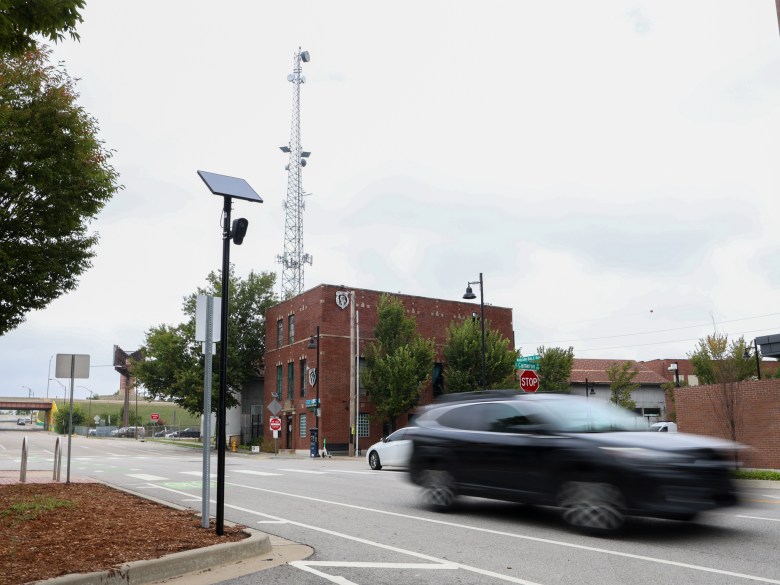
The Tulsa Police Department used Flock Safety cameras and automatic license plate readers to investigate protest activity throughout 2025, according to data collected by the Electronic Frontier Foundation, a nonprofit that advocates for privacy rights.
Now, EFF’s report is raising concerns of whether TPD’s use was a violation of constitutional rights.
The San Francisco-based group conducted a 10-month analysis of Flock Safety’s servers and found thousands of law enforcement agencies across the country — including TPD — used the cameras to investigate protest activity.
Tulsa police were one of the most consistent users, logging at least 38 searches last year.
According to EFF, TPD’s searches corresponded with a February 2025 anti-ICE demonstration on Riverside; a March 2025 protest at city hall in support of a pro-Palestinian activist; and June 2025 “No Kings” protests in downtown and Dream Keepers Park, among others.
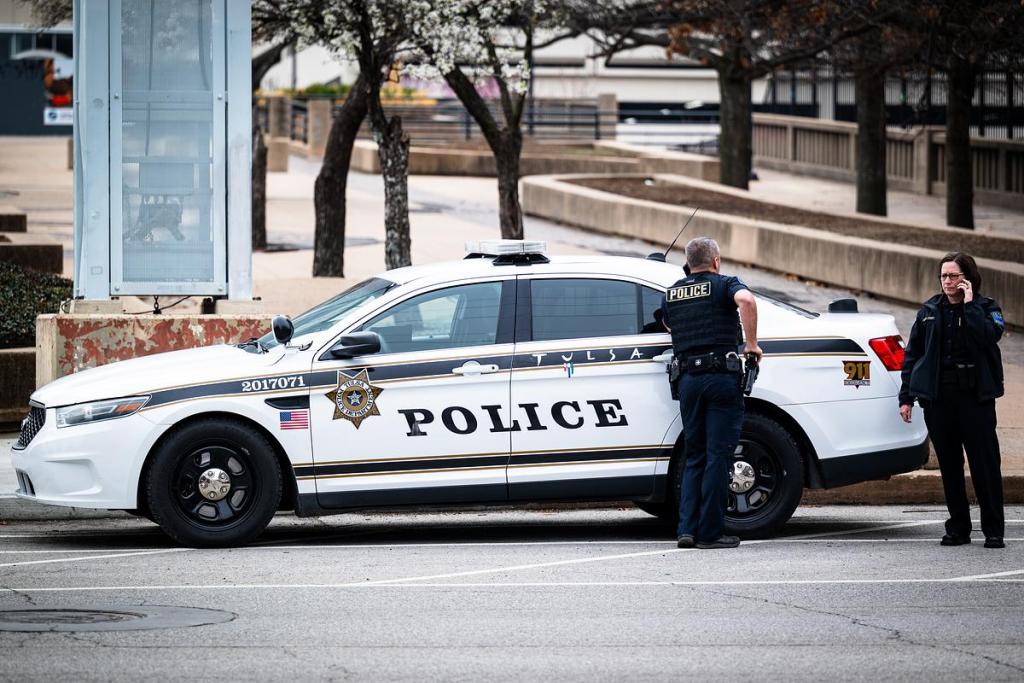
TPD Captain Shane Tuell said the department uses Flock cameras as a “reactive” tool.
“We don’t use those to be proactive or investigate individuals exercising their First Amendment,” Tuell said. “We don’t do that at all.”

He said the 38 queries represent police investigating suspected crimes at protests.
“That would only be after the fact if someone did something bad — assaulted someone in the crowd — then we could go back and say, ‘who is this individual and how can we use that technology to find out who they are so they can be held accountable?’” Tuell said.
He said he isn’t aware of TPD making any arrests at protests last year.
Joe, a Tulsa resident who requested his last name not be published due to privacy concerns, said he has long worried law enforcement could use surveillance technology to target protestors.
“Sure enough, they are,” he told the Flyer. “I frequent those protests. I’ve got my protest signs hanging up in the front windows of my house. If they wanted to find me, it wouldn’t be hard.”
He said a Flock camera captures his vehicle each time he leaves the house.
“It’s very concerning that they can track us to and from churches, to and from protests, rallies, meetings — everything,” Joe said.
Tulsa City Councilor Laura Bellis, who represents part of midtown and along Riverside, said TPD’s behavior raises concerns with the First and Fourth amendments.
“We’re seeing this play out with current protests (nationwide) where they’re at least acting like they’re collecting information on people,” Bellis told the Flyer.
She shared concerns about TPD’s use of Flock Safety cameras during protests in a Feb. 19 Instagram post, including responses to questions she asked Laurel Roberts, the city’s public safety commissioner. Roberts told Bellis: “It would not be unusual to monitor vehicles coming and going from protests even if no crime was committed.”
Additionally, Bellis said she’s worried TPD could share data with the Tulsa County Sheriff’s Office, who holds a 287(g) agreement with Immigration and Customs Enforcement. The 287(g) program allows ICE to deputize state and local law enforcement to arrest immigrants. More than 30 law enforcement agencies in Oklahoma, including Tulsa County, have active agreements with ICE.
However, Tulsa City Councilor Karen Gilbert, who represents a portion of midtown Tulsa, believes these cameras have been an effective resource for law enforcement. Gilbert has served as the executive director of the nonprofit Tulsa Crime Stoppers, which works with the police department on crime prevention, since 2018.
“This is just another tool to keep everybody safe, not to use as an investigative tool for those that are out there utilizing their First Amendment,” Gilbert said.
She said the department may use the cameras to get identifying details of a vehicle that has circled a protest several times.
“Then they will use it to capture that tag number in case it shows up at another protest,” she said. “That way they can use that as probable cause to have a conversation with the vehicle owner.”
According to the TPD’s Flock transparency portal, the department currently deploys 102 Flock Safety automatic license plate readers. Including the department’s real-time information center, TPD operates more than 200 cameras in public areas and roadways.
A search vs. a query
Flock Safety cameras and automatic license plate readers use artificial intelligence to gather data on each vehicle that drives within its view, including license plates, color, make and model as well as bumper stickers or dents.
That data is then uploaded to a searchable database police can use to track the locations of vehicles. Law enforcement agencies can share this data through mutual agreements with other agencies nationwide that use the technology.
Data is deleted after 30 days, unless it is considered evidence. Then, it can be retained throughout the related legal process.
While privacy advocates argue these queries should require law enforcement to have a search warrant, Stephen Galoob, a law professor at The University of Tulsa, said it does not constitute a search and seizure under law.
“In many contexts, courts — although not the Supreme Court yet — have ruled that the creation of databases, the utilization of publicly available data and querying databases, all these things do not constitute searches under the Fourth Amendment,” Galoob said. “You don’t need a search warrant because it’s not a search, it’s a query.”
Tuell said these cameras have been “invaluable” for helping TPD solve homicides, including the Juneteenth shooting last year in downtown. They have also been used to recover nearly $4 million in personal property since they started being installed in summer 2022.
When Tulsans are in public spaces, they are likely to be on camera, Tuell said.
“When you’re out in public and you’re in the public view, you’re in the public view of a camera,” Tuell said. “But when you’re in your home — the privacy of your home — (the department’s Real Time Information Center) does not intrude on that.”
TPD’s use of Flock technology has Gilbert’s support.
“We are utilizing every tool that we can to make sure that we keep everybody safe in a time where tension in the nation is at its highest,” she said.
News decisions at the Tulsa Flyer are made independently of our board members and financial supporters. Read more about our editorial independence policy here.
