



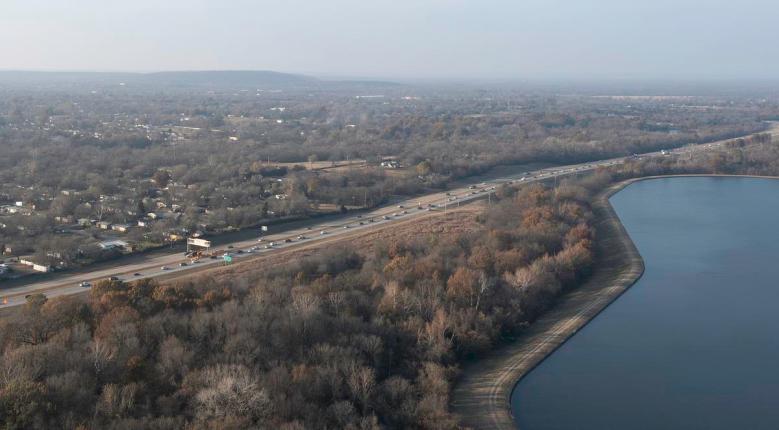
When it comes to ozone pollution, Tulsa is one of the worst cities in the country. The American Lung Association ranked the Tulsa-Bartlesville-Muskogee metro 20th in its “Most Polluted Cities” list.
Tulsa County, meanwhile, received an F for its number of high ozone days in the 2026 “State of the Air” report. Oklahoma only reported data for 15 counties and eight were given the failing grade.
The association uses data over the past three years to account for anomalies. Tulsa County recorded 28 “orange” days when air is unhealthy for sensitive groups, the most in the state.
Not to be confused with the upper atmosphere version that protects humans, ground level ozone occurs when certain pollutants react in sunlight and heat.
Clint Johnson monitors Tulsa County’s air quality and works for the Indian Nations Council of Governments (INCOG).
“It doesn’t come out of a tailpipe. It doesn’t come out of a factory stack. Nobody emits ozone,” said Johnson, who directs the council’s Office of Energy and Environmental Sustainability.“But any of us that are using gas-powered equipment, we’re contributing to it.”
It also tends to be worse in the summer when there’s more sunlight and the temperature is hotter. Despite the low grade, Johnson said the county showed some improvement last year.
He said thanks to a cooler summer and milder weather outside the Lung Association’s survey period, air quality remained within healthy standards and no ozone alerts were issued at all in 2025.
Tulsa County and Oklahoma perform much better on particle pollution than ozone. The county received a “C” grade with only five orange days.
However, it’s still a concern, according to Charlie Gagen, the American Lung Association’s advocacy director for Texas and Oklahoma.
“It is worth noting, the annual particle pollution is down significantly over the last two decades in the Tulsa metro, but the annual levels are still kind of flirting up and above what we deem a passing line,” Gagen said. “We give Tulsa passing grades, but that doesn’t mean that the air is perfectly safe.”
As for keeping track of pollution levels, INCOG has an hourly index that reports real-time ozone and particle pollution conditions.
“Our promise to everybody is you’re going to know by 4 p.m. the day before an ozone alert day, so you have time to make arrangements or plan for the next day,” Johnson said. Even when days may be unhealthy overall, there may be pockets of time that are better than others.
With the summer approaching, Johnson said he’s a bit concerned about the El Niño climate pattern that’s been forecasted. The phenomenon happens every two to seven years and can cause increased flooding in the Gulf Coast and southeastern U.S.
“That might affect our general weather pattern, where we have some more of those high heat domes that just settle in over us, and it’s just hot and there’s no wind,” he said. “That would be bad.”
Johnson said to help counteract high ozone days Tulsans should consider carpooling or using more battery-powered lawn tools.
