




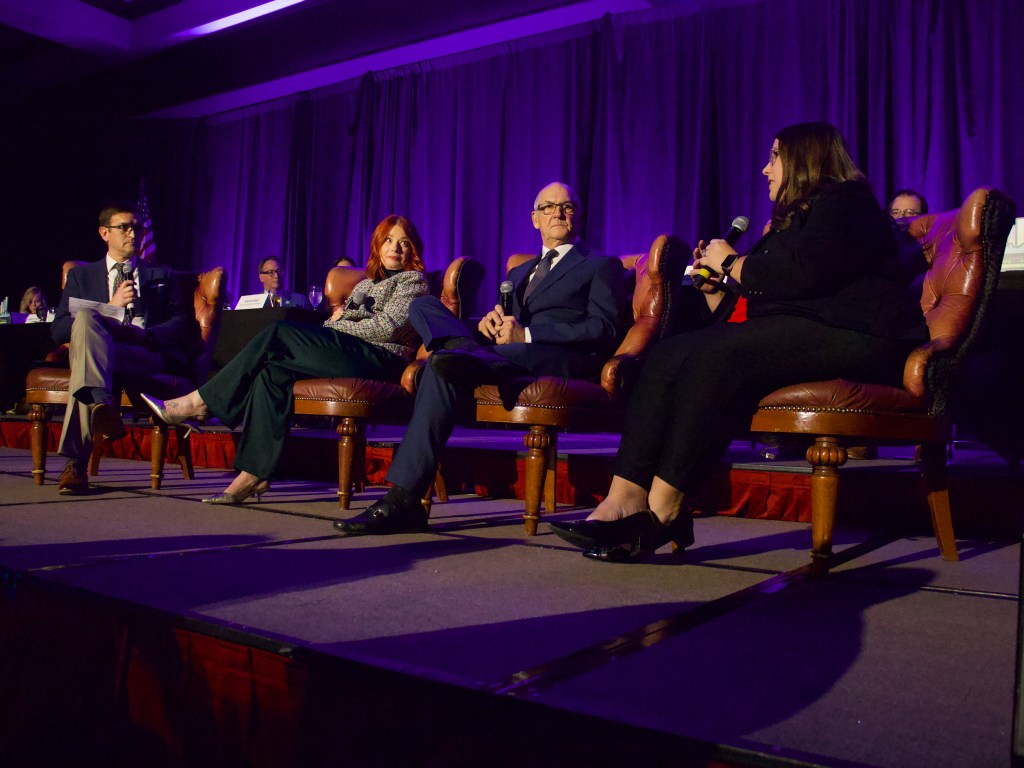
If there’s one word to define what Tulsans can expect for the future of the city’s job market and population, it would be growth. At least that’s what national and state economists predicted Thursday during Tulsa Regional Chamber’s annual State of the Economy meeting.
Mark Snead, an Oklahoma economist and president of RegionTrack, and Joe Seydl, an economist at JPMorgan, also urged residents to be prepared for changes to Tulsa’s economy as tariffs and artificial intelligence become more prevalent and the city grows even more.
Snead said the projected growth is a positive sign for both the city and state.
“Tulsa is just a nice place to live, work, do business, raise a family and live your life,” Snead said. “Oklahoma in general has really blossomed into a great place to live, work, shop and entertain yourself. Things have changed so dramatically.”
The event featured several membership organizations of the chamber including PartnerTulsa, PSO, George Kaiser Family Foundation and Tulsa Airport Improvement Trust.
Tulsa outpaces OKC; AI to bring ‘creative destruction’
When it comes to job growth, Tulsa is outpacing Oklahoma City, which is benefitting the state overall, Snead said.
“The past 18 to 24 months, Tulsa’s growth has really accelerated, and Oklahoma City’s slowed a bit,” Snead told The Eagle. “Having both of the major metropolitan areas really clicking at the same time is underlying one of the reasons why the state is placing 14 out of the 50 states in job growth the past 12 months.”
As for the future of AI, Snead said jobs aren’t being eliminated. Instead, they are requiring more knowledge of technology. Those skills will determine who will be ready for a future where AI is embedded in almost every job.
“We’re slicing up tech workers and putting their tasks into thousands and millions of other jobs,” he said. “There will be a lot of creative destruction, but there will be an incredible amount of creativity that comes along with it, and everyone’s job will be partly tech.”
Oklahoma benefiting from coastal affordability crisis

Seydl, who recently moved from New York to Dallas, said Tulsa is primed for more transplants due to its cheaper costs of living — particularly in its housing market.
“The median home price today is very unaffordable for first-time homebuyers,” he said of the state of the nation’s housing market, noting the problem is mainly concentrated in coastal states like Washington, Florida, Oregon and California.
Twenty-five years ago, the average age for first-time homebuyers was 30. Now, that number has reached an all-time high of 40 years old, according to the National Association of Realtors.
“Over time, it’s going to really benefit states like Oklahoma, states like Texas, because this is an affordability problem,” Seydl said. “It’s just going to continue to be more population growth away from (states) like California and New York, (because) younger folks (are) looking for more affordability.”
Looking ahead to 2026
Businesses should expect President Trump’s tariffs on foreign goods to stay, but Seydl is confident the U.S. will avoid a recession given the number of items that are exempt.
“The technology sector, semiconductors, electrical equipment, all the things that are powering the artificial intelligence revolution, have been exempted from tariffs,” Seydl said. “That’s been really important because that sector has been such a critical component of U.S. growth this year.”
That growth has played out in northeastern Oklahoma, where several major data centers are set to be built over the next several years.
Snead predicted both Tulsa and the state will either match or slightly outperform the country in terms of job growth. Next year, Snead projects, Oklahoma City will match Tulsa in terms of job growth rates.
Ismael Lele is a Report for America corps member and writes about business in Tulsa for The Oklahoma Eagle. Your donation to match our Report for America grant helps keep him writing stories like this one; please consider making a tax-deductible gift of any amount today by visiting this link.
Editor’s note: The George Kaiser Family Foundation is a major funder of The Oklahoma Eagle and Tulsa Flyer.
