



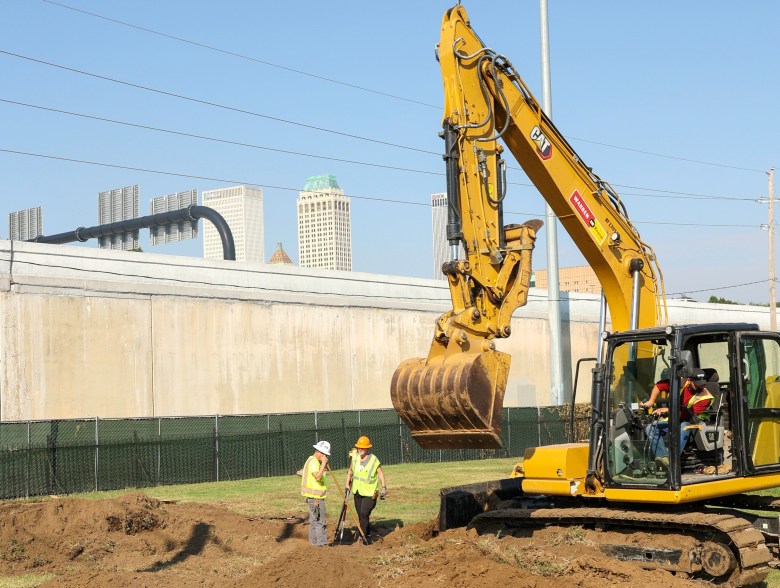
The fifth round of excavations for potential victims of the 1921 Tulsa Race Massacre at Oaklawn Cemetery will wrap this week, but officials say the work is far from over.
The excavation, which began Oct. 14, has uncovered 80 previously unknown unmarked graves and nine potential victims, University of Oklahoma anthropologist Kary Stackelbeck said Thursday. The potential victims will undergo further examination in an osteology lab to determine cause of death and identify their family heritage.
“It will definitely (take) weeks,” forensic anthropologist Phoebe Stubblefield said of the identification effort. “I’m hoping we’ll get them through this process. We’re shooting for before Thanksgiving, but it’s going to be very tight.”
Stackelbeck said each of the unmarked graves has been mapped and reported to the city, which will integrate the information into its records.
“We have got a really good cadence and rhythm with our excavation process and how we’re encountering the graves, identifying them,” Stackelbeck said. “It’s been challenging, because observing the grave shafts in this cemetery is much more difficult compared to other cemeteries.”
To determine which graves to exhume, researchers looked for mass graves of plain wooden containers and atypical crates, or coffins, which according to Stubblefield was a common way to bury people in Oaklawn Cemetery during the 1920s.
Upon finding a body, examiners look for signs of trauma. Just last week, researchers identified a potential victim with a gunshot wound.
The 1921 Tulsa Race Massacre, in which a white mob descended upon the Historic Greenwood District in one of the worst episodes of racist violence in U.S. history, killed an unknown number of people and destroyed 35 blocks of Black Wall Street.
Brenda Nails-Alford, a descendant of massacre survivors, told reporters Thursday that witnessing the excavation process and identifying victim families has helped close old wounds that have never been treated.
“It has been seven long years, but I so appreciate the strength, the courage and the capacity of everyone who has been involved,” Nails-Alford said. “Because if we didn’t do this work, it would basically say that, ‘We want to continue to erase that history,’ and we do not want to do that.”
Since the first excavation began in 2018 under then-Mayor G.T. Bynum, two likely victims have been identified. C.L. Daniel was identified in July 2024, and James Goings was announced in June. A man named George Melvin Gillispie has also been identified, but his status as a victim has yet to be determined.
Determining the exact number of victims of the race massacre will be a difficult endeavor, Stubblefield said, though they are learning more as their research continues.
“We’ve made progress,” Stubblefield, herself a descendant of massacre survivors, said. “We’re not in all of the sites we want to visit yet, but we are making progress.”
Other gravesites of interest include Newblock Park, also known as “the Cane” west of downtown, and Rolling Oaks Memorial Gardens, formerly known as Booker T. Washington Cemetery in southeast Tulsa.
Ismael Lele is a Report for America corps member and writes about business in Tulsa for The Oklahoma Eagle. Your donation to match our Report for America grant helps keep him writing stories like this one; please consider making a tax-deductible gift of any amount today by visiting this link.
