


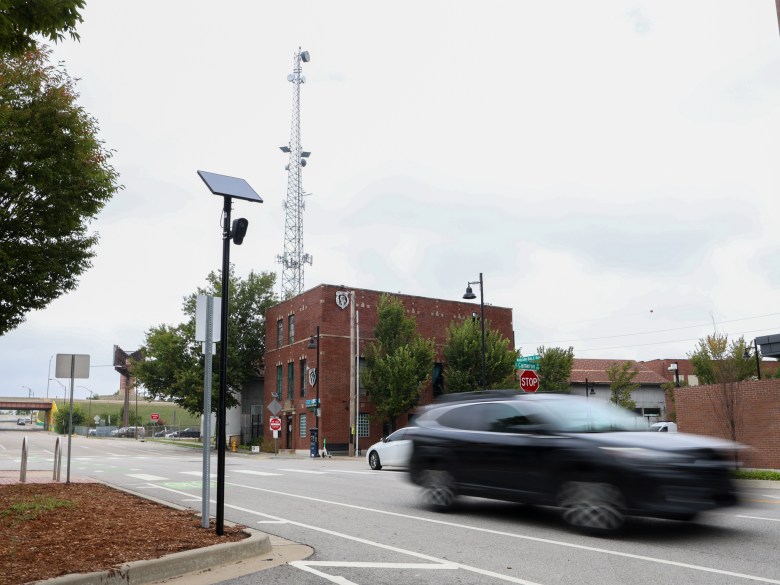
Mary Riggins has lived in Tulsa her whole life. Just three blocks from her north Tulsa home sits a Flock Safety camera, one of hundreds across the city operating as license plate readers — and used by law enforcement to solve crimes.
Riggins says she spends much of her time working to keep kids out of trouble through her nonprofit organization Taking It To The Streets. She’s allowed different people to stay in her home for nearly three decades, but she never felt unsafe until learning about the Flock camera in her neighborhood.
“I pass through there every day that I leave here and when I come back home,” said Riggins. “They [Flock Safety] get a picture of my tag.”
About 20 minutes away in east Tulsa, Joe says he passes a Flock Safety camera in his neighborhood every day as he takes his child to and from school. He asked us not to share his last name, but Joe reached out to the Flyer about his privacy concerns with Flock cameras.
“They know every time I leave my neighborhood, for any reason,” Joe said. “And that just seems not like a good idea.”
Riggins and Joe live in different parts of town, but they share the same anxieties about Flock’s ability to track vehicles. When you drive past a Flock Safety camera, an image of your license plate is captured and stored in Flock’s system. If your vehicle is tied to a criminal investigation or stolen property, Flock’s system sends an alert directly to police.
Joe worries about the cameras tracking where people go to church, what protests they participate in and even when they have to go to the courthouse. He questions how the technology interferes with citizens’ right to privacy.
“If we strapped a body camera to every person and made them upload their video at the end of every day, we would have no crime,” he said. “But that is not legal, and I don’t think this should be either. Because it is mass government surveillance.”
The Tulsa Police Department began using Flock Safety cameras in summer 2022 after county commissioners approved the installation of 25 cameras across the city. Police later said those cameras helped them make a number of arrests and recover stolen property.
Then, dozens more cameras were added.
In January, The Frontier reported the City of Tulsa pays a private company more than $696,000 a year for the Flock Safety cameras. Neither the city nor police have shared the cameras’ locations; however, an online portal on Flock Safety’s website says the city has 102 license plate readers and 151 live video cameras operating in the metropolitan area as of Oct. 27.

That camera network is about to grow significantly too. This month, Flock announced a partnership with Ring, an Amazon-owned company that manufactures home security devices. In the new partnership, law enforcement can send a direct request to citizens to access Ring video through the company’s Neighbors app.
TPD did not respond to the Flyer’s questions about Flock’s recent partnership with Ring or how the department would utilize the larger camera network.
Mixed reviews from both sides of the aisle
Until now, Flock Safety cameras have yielded mixed reviews in Tulsa and throughout Oklahoma. Earlier this month, State Rep. Tom Gann, R-Inola, led an interim study at the capitol about the use of automated license plate readers, like Flock Safety cameras.
Gann says the cameras are “mass surveillance” tools that can be used against people. He also says they skirt state law, which prohibits the use of automated license plate readers for anything other than identifying uninsured motorists.
“They are just everywhere, and it gets to a point, we are at a level of saturation that people can not really travel about without being tracked or surveilled,” said Gann. “It is a constant state of mass surveillance we are under right now. The assumption that because you put these cameras you are safer is erroneous.”
Attorney Shena Burgess, who was present during the interim study, said the Tulsa County Sheriff’s Office testified in federal court that license plate readers were used frequently for means beyond checking if someone has insurance, including during criminal investigations.
“They are using this technology without any oversight or without the courts involved,” Burgess said during the study.
Cindy Nguyen, director of policy and advocacy with the American Civil Liberties Union of Oklahoma, has no issue with automated license plate readers being used for insurance verification. But, she says, that’s where it should end.

Nguyen says officers are using the technology for other means. She cited the case of Oklahoma man Saadiq Long, who filed a federal lawsuit against the Oklahoma City Police Department in 2023. According to court documents, Long, who is Muslim, says he was pulled over five times as a result of automated license plate readers. The lawsuit is ongoing.
“We are seeing that many communities that are already overpoliced are weighing the brunt of these Flock cameras,” Nguyen told the Flyer. “What we are seeing is that folks’ civil liberties are being violated because of this.”
The Flyer reached out to Flock but the company declined to answer specific questions, instead referring us to past news releases.
In September, Josh Thomas, chief communication officer for Flock Safety, wrote in a blog post that cities control how they dole out justice but said Flock operates without “compromising” community values.
Back in north Tulsa, Riggins says she knows crime can occur, but she doesn’t want her neighborhood under surveillance.
“Everybody is being watched,” Riggins said. “Everybody that comes through Oklahoma is being watched. I know I have been. I know I have been watched.”
News decisions at the Tulsa Flyer are made independently of our board members and financial supporters. Read more about our editorial independence policy here.
