




This story is part of a series produced in collaboration with La Semana, KOSU, The Frontier, The Oklahoma Eagle and the Tulsa Flyer.
As reports rise of U.S. Immigration and Customs Enforcement (ICE) officers detaining immigrants across Tulsa, the two remaining employees for YWCA Tulsa’s refugee health team say their clients are living in fear.
“A few months ago, my wife was praying and she said, ‘God, you brought us from one war to another home, and now you put this on us?’ She was talking about ICE,” said Mohammad, an Afghan refugee who works at YWCA Tulsa and asked that his last name not be used to protect him from retribution.
“There’s a lot of pressure, it’s not just me,” he continued. “It’s a lot of pressure for all of the immigrants in the United States.”
Leaders at YWCA Tulsa were informed in February that $6.5 million in federal and state funds would be slashed in September, forcing the nonprofit organization to downsize staff and eliminate services for about 1,200 refugee families in the Tulsa metropolitan area. The cuts came as the Trump administration followed through on a campaign promise to deport people living in the country illegally and drastically reduce refugee admissions.
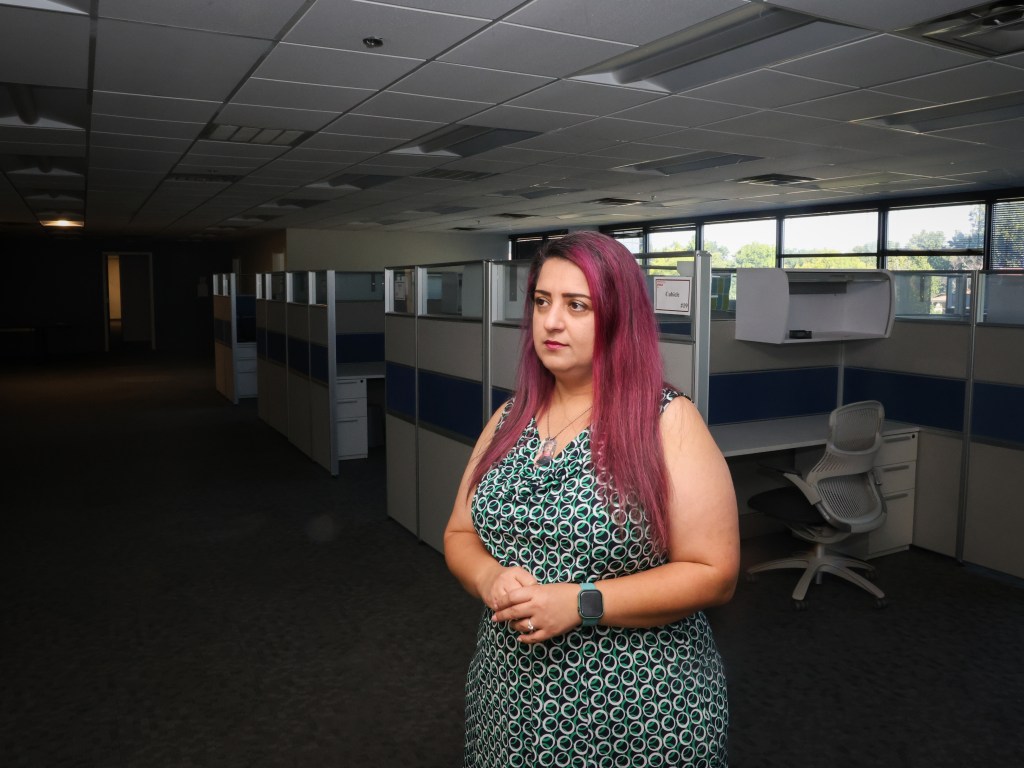
“We had 1,500 clients from different countries,” said Elham Kucirek, an Iranian immigrant who serves as YWCA Tulsa’s refugee health manager. Her team has been slashed from 11 staff to two — and serving up to 300 clients.

Immigrating to the U.S. is not easy, but entering the country as a refugee presents even more challenges, Kucirek said.
“I immigrated. I studied English as a second language. I did some exams to enter into the U.S. with all of the legal documents,” she explained. “But for refugees, some disaster is happening. One night, they have to leave everything.”
The fall of Kabul
For Mohammad, that night came on Aug. 29, 2021. Kabul, the Afghan capital, fell to the Taliban 14 days prior. Mohammad had become a target of the Taliban for working at the U.S. embassy in Afghanistan’s capital.
“They were threatening everyone who was working with the Americans, with non-Muslim countries,” Mohammad said. “They were thinking we are not Muslim, too, and they wanted to kill us.”
Between Aug. 13 and Aug. 30, 2021, the U.S. and its allies evacuated over 120,000 people from Kabul in Operation Allies Refuge. Evacuees included at-risk Afghan citizens and Afghan nationals who were eligible for Special Immigrant Visas due to their work on behalf of the U.S. government.
“I just did what I could do,” Mohammad said. “I left with my wife, my sister-in-law and my nephew.”
Just days before Mohammad and his family were evacuated, a lone ISIS-K suicide bomber attacked the Kabul airport, killing about 170 Afghan civilians and 13 U.S. service members.
“I just moved out of that place and there was a bomb blast behind me,” Mohammad recalls.
After a week-long stop in Kuwait, Mohammad arrived in the U.S. on Sept. 6, 2021. With assistance from organizations such as Catholic Charities of Eastern Oklahoma and Tulsa-based The Synagogue, along with support from Gov. Kevin Stitt, around 2,000 Afghan refugees have resettled in Oklahoma.
Mohammad first worked as an Uber and Lyft driver. He was motivated to apply at YWCA after facing difficulties with the U.S. health care system during his wife’s pregnancy.
“I didn’t know the system. The health care system over in the United States is really complicated,” Mohammad said. “After that, I promised myself that whatever I learned, I’m going to help our clients with that.”
Trump, state leaders set sights on Afghan refugees
Four years after narrowly escaping Afghanistan, refugees are facing a new set of struggles under the Trump administration, Kucirek said. For two decades, she said, Afghans provided services to the U.S. in exchange for a promise of safety.
“But when they are here, many of them are scared of ICE because they don’t know who they are targeting,” Kucirek shared. “Many news [outlets] are saying that ICE wants to stop non-documented or illegal immigrants, but all of our clients, they came here with documents and 80% of our clients came with SIV visas.”
In addition to the pressure from the federal administration, state leaders have also turned their sights on Oklahoma’s Afghan population. Oklahoma Attorney General Gentner Drummond, a Republican running for governor in 2026, demanded removal of the state’s Afghan refugees in June after Trump issued a travel ban on 12 countries, including Afghanistan.
“At great risk to public safety, Gov. Stitt partnered with the Biden Administration to import thousands of poorly vetted Afghan refugees to our state,” Drummond said. “Adding insult to injury, Gov. Stitt illegally directed millions of our tax dollars to pay for resettlement expenses.”
In response, Stitt said in a statement that Drummond was using “prejudice and fear tactics to sow discord.” Refugees aided troops in dangerous combat situations, he added.
“It is unconscionable that anyone would suggest that we should have left them at the mercy of the Taliban,” Stitt said. “If the attorney general can identify laws being broken, he should use his existing authority to prosecute criminal activity. Oklahomans see through the political rhetoric.”
Asked about Drummond’s statement, Mohammad said he feared that the state’s top law enforcement official could take further action.
“I was scared as hell,” Mohammad, who declined to be photographed, said. “I don’t want to see my wife in handcuffs or my child taken away from me. I’m not going to allow that.”
Despite the challenges, Mohammad said that his experience in Tulsa has been positive. The community has largely welcomed him and his family since they escaped the Taliban four years ago, he said.
“Good people are in Tulsa, in Oklahoma,” Mohammad said. “Most of these people have been respectful to me since I came over here. Most of the people were very nice to my family, to me, to my community. They were respectful.”
However, Mohammad said he is not going to judge those who were disrespectful.
“We are not illegal over here. We came legally to the United States by the United States Army,” Mohammad said. “We are trying to find a place to be safe for my child, for my family, for myself. I want to give my benefits to this community, not just the Afghan community — the Tulsa community.”
‘I wish I was born a boy’
While Kucirek came to the U.S. to pursue education, her experiences in Iran have informed how she works with the refugees who walk through YWCA’s doors.
As a 12-year-old girl in Iran, she knew she wanted to leave her country.
“I hated many of the things happening around me,” Kucirek said. “Even at that age, I was thinking, ‘I wish I was born a boy.’”
Iranian women and girls do not hold equal rights with Iranian men and boys regarding marriage, divorce, age of criminal responsibility and many other aspects of everyday life, Kucirek said.
“If you go to ask for the divorce, they will ask your husband if he wants the divorce. You’re stuck in that life. It doesn’t matter if domestic violence or child abuse is happening, because men have the power in my home country,” Kucirek said.
In 1979, a revolution transformed the country from a secular monarchy into a theocratic Islamic republic under cleric Ruhollah Khomeini.
“They ruined my country,” Kucirek said of the 1979 Iranian revolution.
As a little girl, Kucirek said she devised a plan to earn a degree in hopes she could move out of Iran one day.
“I don’t want to have a future here,” Kucirek remembers thinking in middle school. “I didn’t marry there because I was thinking that I was born there accidentally. I don’t want to give birth to my child on purpose in this country.”
But while pursuing her bachelor’s degree in Mashhad, Kucirek often found herself in trouble with Iranian police. She was arrested seven times.
One time, Kucirek said she was arrested for talking with her boyfriend in public. Premarital relationships are largely banned and culturally rejected in Iran, Kucirek said. Another time, she was arrested for having a sleeve pulled up, exposing her forearm. On another occasion, Kucirek said campus police in Mashhad arrested her for teaching a classmate English.
Kucirek said she never went to jail thanks to a family friend within the police department who would release her.
“I was a fighter, but I was tired from how many times I fought,” Kucirek said. “They’re not arresting people with crime. They’re arresting innocent people. Because the way that my government is working, they want to stop protests, and protests are happening from educated people, young people.”
‘It’s not easy to live in fear’
At YWCA Tulsa, Kucirek said that despite having green cards, many of her clients are asking if there is any way to speed up the citizenship process amid pressure from the federal administration. After arriving in the U.S. as a student in August 2014, Kucirek received her U.S. citizenship a decade later, in November 2024.
“They ask me, ‘how can we get citizenship faster?’ There’s not a faster way, but they are scared of ICE,” Kucirek said. “I got my citizenship last year. Even me as a citizen, a U.S. citizen right now, I have a fear or stress because you never know who is the target of ICE.”
Asked how she keeps morale high during budgetary and political pressure, Kucirek said she will never give up.
“If I have to leave, then who will stay? Who will help?” Kucirek said.
With so many cuts on staff, Kucirek said she has been able to work directly with clients more frequently.
“I work in the front with Cuban clients, Burmese clients, Arabic clients from Africa, Syria, and when I’m listening to them and I see how I can help and support them, it’s a really good feeling,” Kucirek said. “It gives me more motivation every day.”
While YWCA Tulsa employees recognize the value of their work, they also recognize the colossal task they’re undertaking.
“The client’s need is more than the capacity. This budget cut is really affecting them,” Kucirek said. “And the fear of ICE. It’s not easy to live in fear.”
