


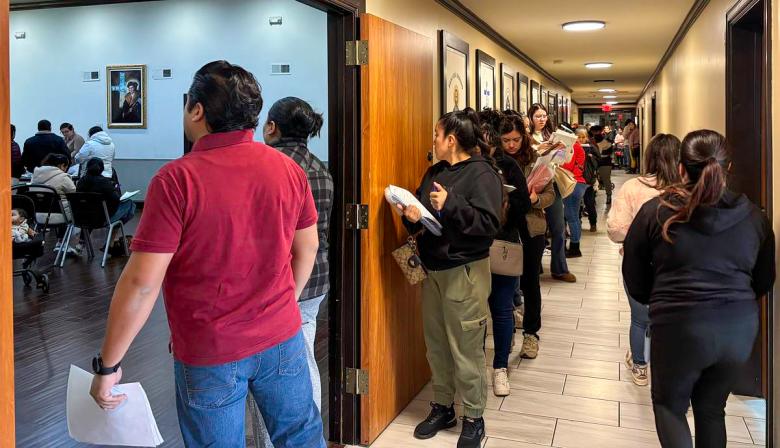
You could barely walk through St. Thomas More Catholic Church’s hallways on a recent December morning. They were lined with people clutching documents and children. Staff from the Mexican consulate in Oklahoma City had traveled there to help hundreds of people register for dual citizenship.
M. Rubio, who is not in the country legally and asked not to give her full name, was one of many that spent their morning waiting for help. She got into line at 7:40 a.m. to register her U.S.-born daughter for dual citizenship.
Rubio is one of many Mexican nationals in Oklahoma and across the country applying for dual citizenship for their U.S. born children as the Trump administration continues its deportation campaign, igniting fears of family separation.
Rubio didn’t leave the church until 10:15 a.m., after providing her daughter’s birth certificate and passport to staff.
“It’s easier for my daughter to have double citizenship if we have to leave for Mexico and we’re looking for a new school,” Rubio said in Spanish.
Dual citizenship applications rise
Carlos Padilla, consul at the Mexican consulate in Oklahoma City, said his office has seen an increase in demand for dual citizenship this year. He believes most of the increase has to do with an awakening from the Hispanic and Latino community about identity.
He recognized that many people currently are dealing with uncertainty and want to be prepared in case they must return to Mexico.
Double citizenship is a right that everyone has to connect to their heritage, Padilla said. Someone may be a U.S. citizen but have parents born in Mexico, qualifying them to apply for dual citizenship.
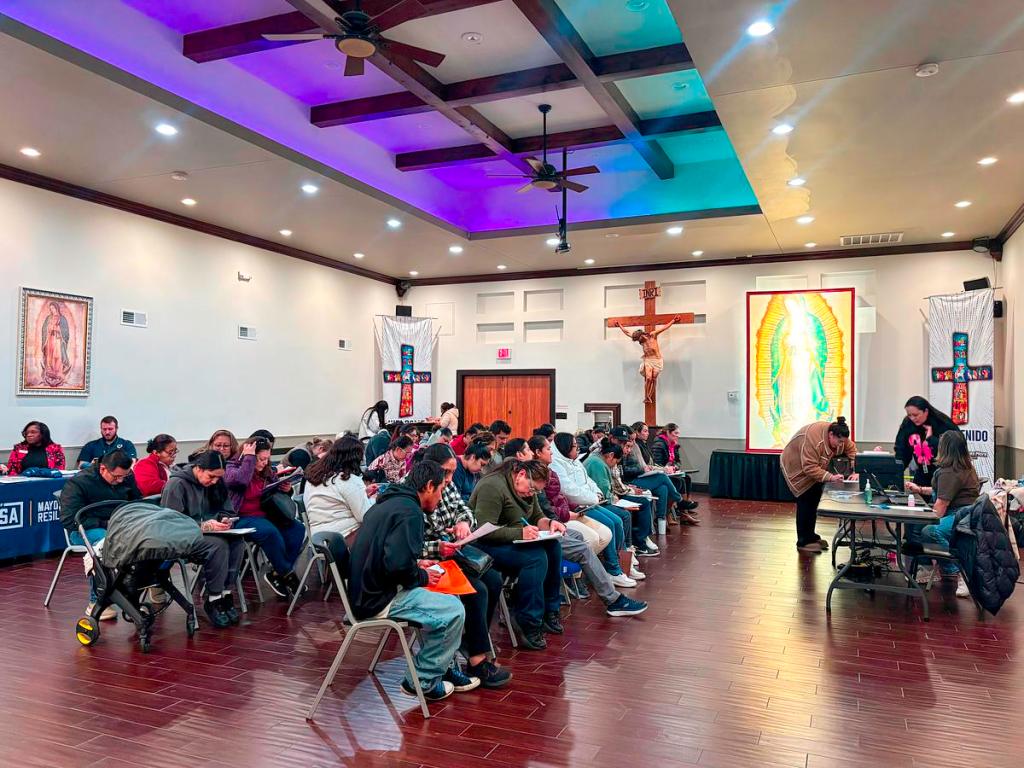
“Mexican nationality is a right,” Padilla said. “It’s part of their story, of their heritage … it signifies that you have the right to receive protection from not only the U.S. government but the Mexican government, too.”
Many applicants for dual citizenship tend to be adults, he said. It’s becoming more apparent and important to many people during these times the importance of embracing their Mexican heritage.
“Many people do it to feel empowered with their entire identity,” he said. “There has been an increase and we’re responding to it.”
The consulate has hosted two events at St. Thomas More focused on helping people apply for dual citizenship. Each served roughly 250 people.
The demand for dual citizenship is greater now than when the consulate established the program two years ago.
“A lot of people didn’t know this was a possibility,” Padilla said. “Many people also hear from others with bad intentions where they’re convinced that making their children Mexican makes them less American, or puts them in vulnerable situations.”
Dual citizenship as protection
Rubio began making a Plan B for her children three months ago. The increase in conversations about Immigration and Customs Enforcement presence in Tulsa raised alarms for her family.
She wanted to have a plan in case she and her husband were arrested and deported to Mexico.
“In my case, I don’t have papers, so I wanted to make sure there was someone to take care of them once I’m on the other side,” Rubio said.
She signed a power of attorney for her two children. She also prepared her 6-year-old son for the possibility of his parents not returning home if they were ever arrested.
“I started talking to him about this topic so he would know if one day his dad or I didn’t return home to stay calm, and that we would find each other again,” she said. “It’s a difficult topic.”
Her son isn’t a U.S. citizen, but she finally got him a Mexican passport and her daughter a U.S. passport. She then started the process of making her daughter a dual citizen.
“Immigration, I believe, has all of us of the Hispanic population really tense, especially for those without (legal status), like in this case, myself,” Rubio said. “It’s a good option for my daughter to have double citizenship in case immigration gets me. Maybe the Mexican consulate can interfere with her since she’d also be Mexican.”

Similarly, E. Espinoza carried her 10-month old son throughout the entirety of the three hours she spent waiting to file his dual citizenship application. She kept her other son entertained, while her husband kept moving in line.
Espinoza, who also requested not to use her full name, came to the U.S. through the asylum process two years ago. She said she wanted to make sure her 10-month old’s paperwork was in order. Her eldest was born in Mexico.
“That’s why I’m planning ahead, in case something happens, like my deportation,” Espinoza said. “My son would be able to leave properly if his paperwork is in order.”
Most parents aren’t coming to consulate events out of immediate fear, but rather to protect their children, Padilla said.
“Every parent has an instinct to protect their children,” he said. “I think if it were an emergency, we would see a very different reaction … There doesn’t have to be anything bad happening for someone to want to apply their children for double citizenship.”
Ultimately, Rubio wants to protect her daughter. She doesn’t know if she’ll return to her home in the U.S. if she gets arrested.
“If they detain you, you don’t know if they’ll detain you for long or detain you for a short time,” she said. “The rate they’re separating families is extremely strong and you always want to have a Plan B because you just never know.”
This article was produced as part of a partnership between the Tulsa Flyer and La Semana, a Tulsa-based bilingual Spanish-English newspaper serving Latino communities in Oklahoma.
News decisions at the Tulsa Flyer are made independently of our board members and financial supporters. Read more about our editorial independence policy here.