

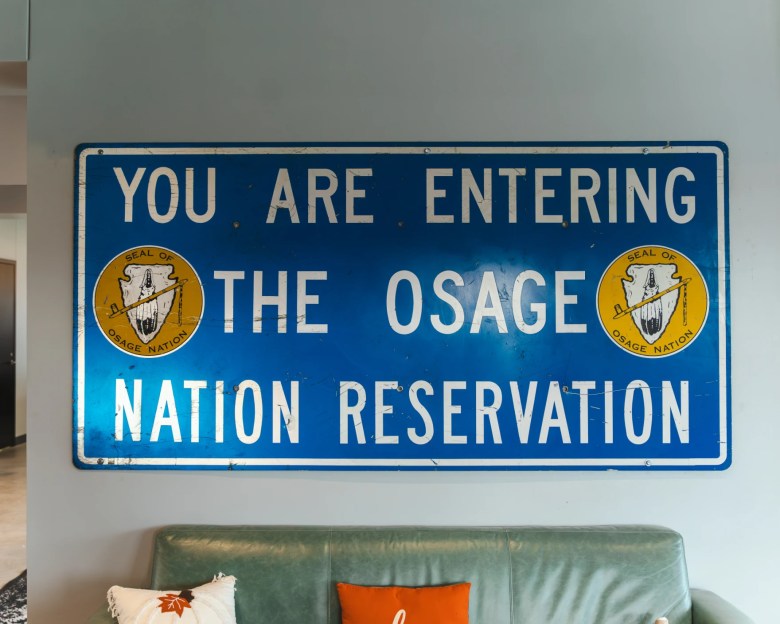
Osage Nation Congress will consider legislation that would require tribal government entities to receive congressional approval before working with any hyperscale data centers.
ONCA 26-70
Osage Nation Congresswoman Angela Pratt introduced ONCA 26-70 on Friday. It would require any Osage Nation governmental entity to consult the tribe’s 12-member legislature before approving any hyperscale data center on tribal territory.
Pratt said a data center would impact more than just a single governing body, adding such AI facilities pose dangers to Osage lands and communities broadly.
“It’s something that the government needs to speak to as a whole,” Pratt said.
Project Spring and the Osage Minerals Estate
The legislation was introduced in response to an ongoing discussion between the tribe’s minerals council and Google representatives over land in Sand Springs at the southern end of the Osage reservation. That’s where the tech giant wants to develop an 827-acre data center site known as “Project Spring.”
While some municipalities across Oklahoma have issued blanket pauses on data center developments, Sand Springs hasn’t. Instead, its city council approved Project Spring in February.
But while the project passed the city, it likely can’t move forward without the sovereign tribe’s approval. That’s because it requires leasing permissions to mine the area from the Osage Minerals Council, which oversees the tribe’s 1.47 million-acre oil and gas subsurface.
Osage Congress’ input
Most of the Osage Nation Congress Natural Resources Committee – the body assigned to discuss ONCA 26-70 – was receptive to Pratt’s proposal.
However, Nathan Tinker Hauth, the only minerals council member present at Friday’s committee meeting, questioned the legislation.
“Now you’re saying we have to come to Congress before anything like a data center happens? Is that a slippery slope?” Hauth said. “The council doesn’t come and get into Congress things, but Congress wants to step into council and kind of supersede what council does.”
Pratt told Hauth that his comments were “a bit out of line.”
And Congressman Billy Keene said he can not find any way to interpret the bill as relating to something other than a data center. He added he thinks the legislation would hold up in tribal court.
“We have the power to create laws that govern the minerals council. That’s in our constitution,” Keene said.
Congresswoman Maria Whitehorn, chair of the committee, said she’s opposed to data centers on the reservation. Pratt’s bill, she said, stops the conversation around data centers from being “siloed” in one part of the government.
“We need to learn how to come together and work in unity when we’re not in crisis,” Whitehorn said. “When we’re in crisis, we do pull together and we’re pretty darn good at it.”
The committee postponed considering the bill until a future meeting, which Whitehorn suggested could come next week. The tribe is currently undergoing a session to prepare its budget for the incoming fiscal year, which begins on Oct. 1.
Other tribes, including the Cherokee Nation, Seminole Nation of Oklahoma and the Kickapoo Tribe of Oklahoma, have banned data centers on tribal lands. The Muscogee Nation is currently investigating data center impacts to prepare future legislation.
This story was produced as part of a partnership between the Tulsa Flyer and KOSU.