

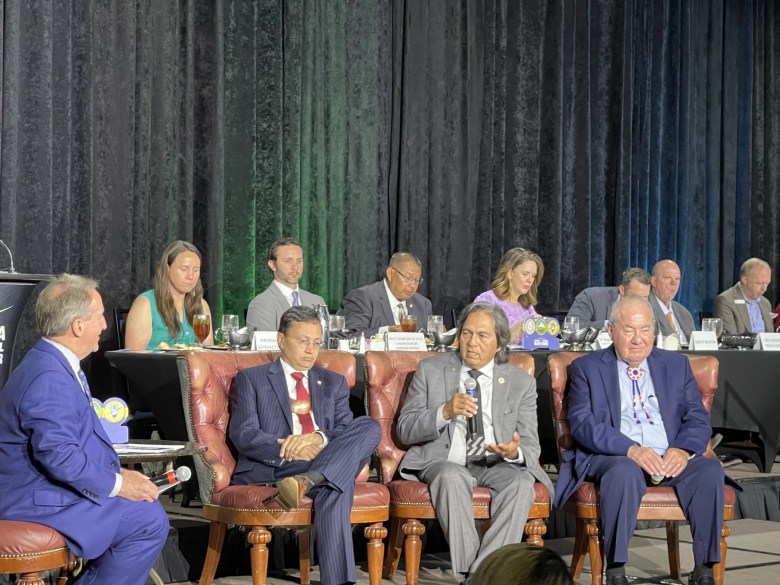
Tribal leaders discussed the possibility of Medicaid being removed from the Oklahoma constitution, federal energy grants and AI data centers at an event in Tulsa on Thursday.
The event, called the “State of the Tribal Nations,” was hosted by the Tulsa Regional Chamber.
Principal chiefs from the Muscogee, Cherokee and Osage nations attended. Here’s what they had to say:
Medicaid and healthcare
Cherokee Principal Chief Chuck Hoskin Jr. warned against the possibility of Medicaid expansion being removed from the state’s constitution.
That potential removal is central to one state question being reviewed for a public vote in November by the Oklahoma Secretary of State’s office. It would move Medicaid expansion language from the constitution to state statutes, if put on the ballot and approved by voters.
Hoskin said if that happens, rural and state healthcare will suffer.
“It is a matter of not only principle for the Cherokee Nation … It’s really a matter of the fiscal health of this whole state,” Hoskin said. “If people in (the event) are listening, are interested in economic development in this state, making sure people have a baseline to succeed in their lives … you’ve got to be for protecting Medicaid expansion, because if it is tinkered with, this state will not achieve what it can achieve economically.”
His statements were met with applause from the crowd.
But healthcare is a big priority for the tribe overall, he said.
The tribe is opening a new $400 million, 400,000-square-foot hospital in Tahlequah this summer. Hoskin called it the “largest hospital in Indian County.”
Hoskin also promoted the Cherokee Nation’s assumption of Claremore’s Indian Health Service facility last summer. He said the money invested in the location will bring it to the “Cherokee standard above the federal standard.”
Data center concerns
The three tribal leaders have been approaching artificial intelligence data centers on their reservations with caution.
Muscogee Principal Chief David Hill said the situation is reminiscent of when the tribe signed its first treaties with the federal government. He said while it could be good in terms of business, it could also negatively impact the environment.
“Every treaty that we signed, we gave up something, and it was our land and other rights,” Hill said. “And that’s the point where I don’t want to get to.”
In January, the federal government recommended tribal nations partner with data center developers for economic development, as artificial intelligence infrastructure expands.
But the tribes have remained wary.
The Muscogee National Council rejected a proposal to build a data center on its reservation last November.
Cherokee Nation created a task force in February to determine the costs and benefits of data centers. Hoskin Jr. said the research it’s conducting can help the tribe make the best decision possible.
And Osage Principal Chief Geoffrey Standing Bear said he needs to see more scientific evidence on what data centers could do to the reservation before making a decision.
But he added he hasn’t been provided with that information from developers, including those constructing a facility in Sand Springs.
“People can still go into the Osage, walk out as millionaires and leave us with nothing,” Standing Bear said. “If I’m going to do any more work in this Indian business, it’s on that issue. I’m tired of getting ripped off.”
Energy funding
Standing Bear prompted the use of federal money to be used to increase oil and gas production in the Osage Nation, which the tribe’s minerals council oversees.
“As we lift off these federal regulations and unleash the path to oil and gas production once again…, that money in Department of Energy and other agencies can come into the Interior Department and we can rebuild the oil and gas energy business in the Osage,” Standing Bear said.
The Department of Energy has opened more than $50 million for tribal governments to push for American international energy dominance through the “Unleashing Tribal Energy Development” notice of funding opportunity. It’s reportedly designed to provide funds for developing and planning energy projects to accommodate Native communities and tribal economic development.
The notice references the Trump administration’s guidelines to expand American energy output, which stem from a national emergency declared by the president last year.
This article was originally published by KOSU. You can see the original story here.