

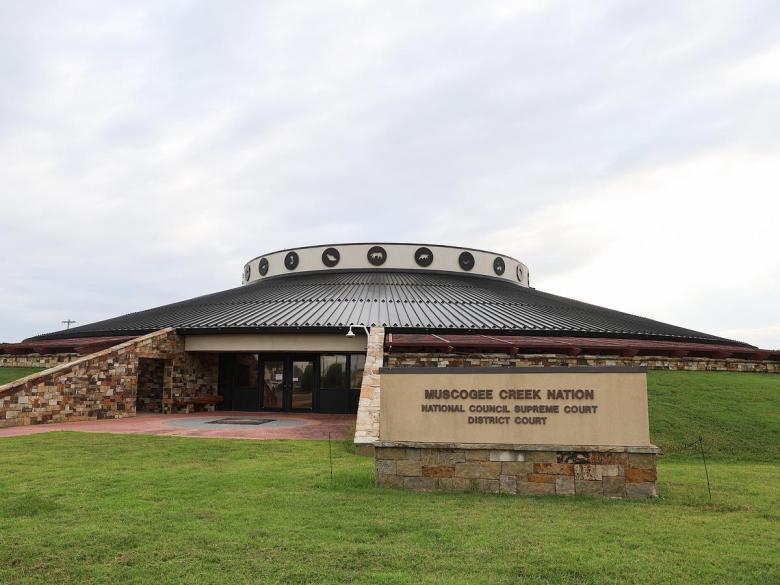
Muscogee Nation asks the Tenth Circuit Court of Appeals to reconsider a decision granting state authority over non-member tribal citizens for minor crimes.
The Muscogee Nation is appealing a decision about prosecutorial power over tribal citizens who commit crimes that do not fall under the Major Crimes Act on a disparate reservation.
The issue central to the lawsuit is whether Tulsa County District Attorney Steve Kunzweiler can assert concurrent criminal jurisdiction on the Muscogee Nation reservation over tribal members who aren’t Muscogee.
The tribe filed an opening brief last Wednesday, arguing Tulsa County requires Congressional authority to grant state prosecutors authority to try tribal citizens in Indian Country.
“Since the Constitution’s ratification, Congress has recognized that the power to try and punish Indians (including non-member Indians) in Indian country is an important facet of tribal self-government, and that concurrent jurisdiction interferes with that sovereign power,” the brief says.
The Muscogee Nation continues to argue that the decision threatens irreparable harm to tribal sovereignty and that Tulsa County’s jurisdiction over nonmembers is unnecessary for public safety.
This comes six months after a federal judge initially ruled that Kunzweiler could try nonmembers for nonmajor crimes on the Muscogee reservation. In November, U.S. District Judge Gregory Frizzell argued that the threat the Muscogee Nation described does not “outweigh the harms that the preliminary injunction will cause the state,” because the injunction would go against the status quo.
The decision writes that the McGirt v. Oklahoma ruling, which ultimately determined the eastern half of Oklahoma is reservation land, only grants tribes authority over Indians who commit major crimes in Indian Country. The case’s namesake, Jimcy McGirt, was a member of the Seminole Nation, though he committed child sex crimes in the Muscogee Nation.
“This court concludes that the Nation has not met its burden of showing that the exercise of concurrent criminal jurisdiction over nonmember Indians unlawfully infringes on tribal self-government,” Frizzell wrote in November.
A spokesperson for the Tulsa County District Attorney’s Office said its responsibility to prosecute state crimes in accordance with state and federal laws does not violate tribal sovereignty.
“In the same way that concurrent jurisdiction can occur on a case involving the state and federal governments, so can concurrent jurisdiction occur on a case involving the state and an Indian Nation,” the statement from the district attorney’s office said. “This was the ruling of U.S. Northern District Court of Oklahoma, and we will continue to partner with Indian Nations on cases involving concurrent jurisdiction according to the law.”
A spokesperson for the Muscogee Nation did not immediately respond to a request for comment.
This article was originally published by KOSU. You can see the original story here.