


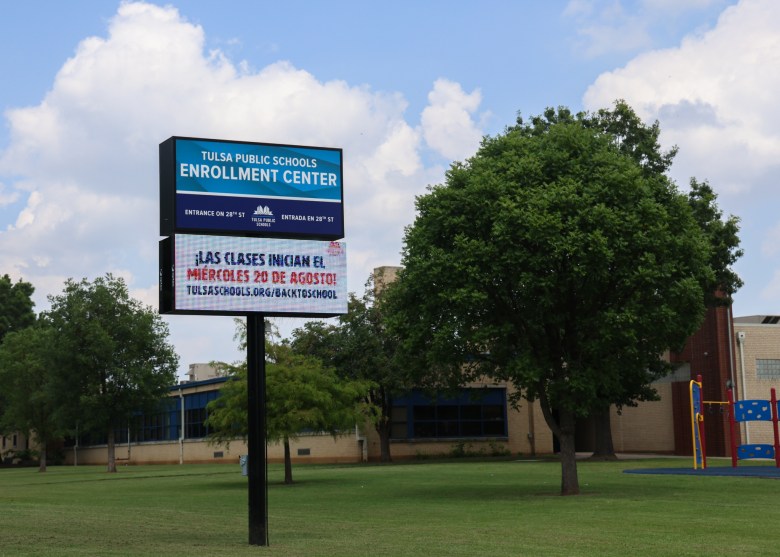
The faces in Tulsa’s public schools are changing. And the school district itself is changing to accommodate it.
Tulsa Public Schools has seen a massive shift in the makeup of its student body in the last decade: Declining white and African American enrollment and a soaring enrollment of Hispanic students. And that’s created some changes.
The district offers phone line assistance in multiple languages. Staff members have trained deeper on language development.
Some of the changes come from a 2011 U.S. Department of Justice finding that the district did not have written policies or procedures for languages other than English. The investigation shaped the district’s Language and Cultural Services department.
The district has continued to make efforts to meet the demands of its growing multicultural student population. TPS is home to roughly 34,000 students as of the 2023-2024 school year with an increasing number identifying as Hispanic and Latino. The district is also seeing an increase in English language learners, meaning students whose first language is not English.
“One of the reasons that I think that we’re seeing both, honestly, is that we are very intentional to create a very warm, welcoming and supportive environment,” Laura Grisso, executive director of Language and Cultural Services with TPS, said. “We have worked really hard to make our signs multilingual, to have interpreters available, we have dedicated phone lines for Spanish speakers, as well as some other languages.”
Here’s a look at the district’s changing student population between January 2015 to 2025, according to TPS data analyzed by La Semana.
Latino student population increases as African American, white decreases
The district’s Latino population has increased about 15% in the last 10 years.
Notably, the enrollment of African American and white students has declined over the past decade.
African American student enrollment dropped roughly 31% since 2015, while white student enrollment dropped nearly 39%.
The district’s Black student population is similar to the overall Black population in Tulsa, according to the most recent census data released in 2020. There are fewer white students in the district when compared to the overall white resident population in the city.
English language learners population rises
TPS began tracking English language learners in 2018, with 7,874 students identified at the time. It has seen a nearly 40% increase since then.
The Language and Cultural Services department has shifted to improve instructional practices across the district over the last two years, Grisso said. It has also expanded its community events to include monthly sessions and welcome meetings for newly arrived students.
The district has offered more services to multilingual students and emphasizes providing services in other languages. TPS has added a dual language and world language pathways program to support students who speak multiple languages.
The district received refugees from Afghanistan, Nicaragua, Cuba, Syria and other countries before the program was paused by the Trump administration in January. Educators continue to serve those students today.
“So that really kind of changed some of those practices because those students have different needs, depending on the experience that they’re coming with,” Grisso said.
Lea este artículo en español aquí.
This article was produced as part of a partnership between the Tulsa Flyer and La Semana, a Tulsa-based bilingual Spanish-English newspaper serving Latino communities in Oklahoma.
News decisions at the Tulsa Flyer are made independently of our board members and financial supporters. Read more about our editorial independence policy here.