


Teacher reactions to the Oklahoma Senate’s $254 million education spending plan came swiftly Tuesday. They say the state already tried dipping into teacher pension contributions to pay for education reforms once before — and trying it again is a “terrible idea.”
The package would redirect planned contributions to the state’s Teacher Retirement System, a fund that supports more than 70,000 retirees annually. The money would instead support the Senate’s education priorities, including a $2,500 raise for Oklahoma teachers, $50 million to the Strong Readers Act and $25 million more for the Parental Choice Tax Credit.
After billions of investment in TRS over many decades, Republican senators say it’s time to put the money elsewhere. Many teachers disagree.
“I don’t know how anybody would think this is the way to fund something good for the teachers by making the retirement system more unstable,” said Lynn Stockley, vice president of the Oklahoma Retired Educators Association. “You are creating a bigger problem than you have right now.”
The state’s teacher pension program only became 80% funded last year after four decades of investment. In that period, the state put in nearly $9 billion in tandem with $20 billion from members and their employers. The Senate’s plan would cap future state deposits at $200 million.
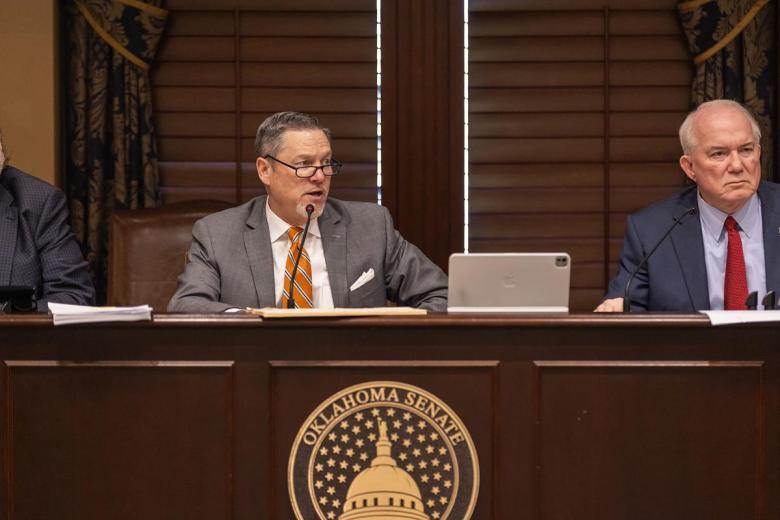
“The system should be strong, and it is strong, and there is no reason to think that it won’t stay that way,” said Senate Appropriations Chair Chuck Hall, R-Perry, in a news conference Tuesday. “And we’ll be able to fund these good policy decisions that the Senate will be making very shortly.”
With funding unchanged, the agency estimates it would take another nine years to be fully funded. It’s been more than five years since members of the retirement system have received a cost-of-living increase. Texas, Arkansas, New Mexico and Colorado all issued cost-of-living increases in that period.
“We’re not even keeping up with Social Security, we’re not keeping up with anything,” Stockley said. “I think many of our retirees — if not most of them — really do feel pretty much left behind.”
LeeAnne Jimenez, vice president of the Tulsa Classroom Teachers Association, says messages rolled in throughout the day Tuesday from panicked and angry educators. One simply read, “W. The ACTUAL F?”
Jimenez and others celebrate the initiatives funded by the Senate’s plan, especially further investments in literacy and teacher pay. But taking from planned retirement contributions isn’t the answer, they say.
“They’re taking the money from our future and giving it to us now, and pretending like that is going to solve our future,” Jimenez said. “We already have retired educators who need that cost-of-living increase and cannot afford to live.”
“So once again, a broken promise for teachers,” said Shawna Mott-Wright, president of the Tulsa Classroom Teachers Association, which bargains on behalf of Tulsa Public Schools educators. “You can’t screw me with one hand and high five me with the other.”
Stockley pointed to the state’s last cap on the retirement system as a cautionary tale. In 1982 policy makers capped state contributions at $125 million and diverted $311 million, driving the retirement system down to the fourth-most poorly funded pension in the country by the 1990s, according to the retirement system.
Had funds not been diverted then, TRS history reads, the system would have been fully funded by around 2014, “eliminating the need for State contributions.”
The Senate’s plan is in no way set in stone. Republican House leaders have already pushed back, concerned the plan would compromise “educators’ long-term stability.” The Senate and House must work together to balance the state’s budget before May 30 to end the 2026 session.
“There needs to be a lot of hashing out,” said Jimenez. “If they want to do what the Mississippi miracle did, then they will add money — lots and lots of money, training teachers.”
News decisions at the Tulsa Flyer are made independently of our board members and financial supporters. Read more about our editorial independence policy here.
