


When Microsoft opened its Columbia Data Center here in 2007, it was the biggest in the world at 500,000 square feet — equaling the size of five Super Walmarts and consuming enough electricity to serve 40,000 homes.
It was a big gulp for a 5,000-population farm town in the high desert of central Washington, about 120 miles east of Seattle.
Today Microsoft and a handful of other companies operate millions of computer servers in 4 million square feet of buildings on about 1,000 acres. All told, they consume enough electricity to light every home in Tulsa and Broken Arrow.
Ask people how the two-decade rise of data centers has impacted their town, and most will shrug.
“You don’t even notice they’re here, except for the money they bring in,” said Raymond Clark, a retired truck driver who was shooting the breeze over coffee at The Brunch Box.
Yet there’s trouble on the horizon.
The data centers are here to stay, and all of their owners have banked land for expansion. But for the first time in 20 years, their growth could be checked even as artificial intelligence drives a global boom in data center construction.
The debate over what to do about data centers in Washington portends what could be ahead for land-rich states like Oklahoma. Bills pending in Washington’s state capitol would increase regulation of the state’s 100 data centers, require disclosure of natural resource use, ensure that other ratepayers are not charged for center-driven infrastructure and make them the first to go dark in an energy shortage.
And as much as Quincy might welcome more centers, it’s running short of electricity to power up millions of computer chips and water to cool them down.
Not just a farm town anymore
Quincy was established by the Great Northern Railroad at the end of the 19th century and has long been defined by the rail line that cuts through it. Even now, it is dominated by companies that process fruit and produce from irrigated farms, with many jobs going to immigrants from Mexico. About 85% of Quincy’s residents are Hispanic.
The largest share of jobs here are still in places like the Lamb Weston french fry plant, which gives the town a unique aroma. But that percentage is changing.
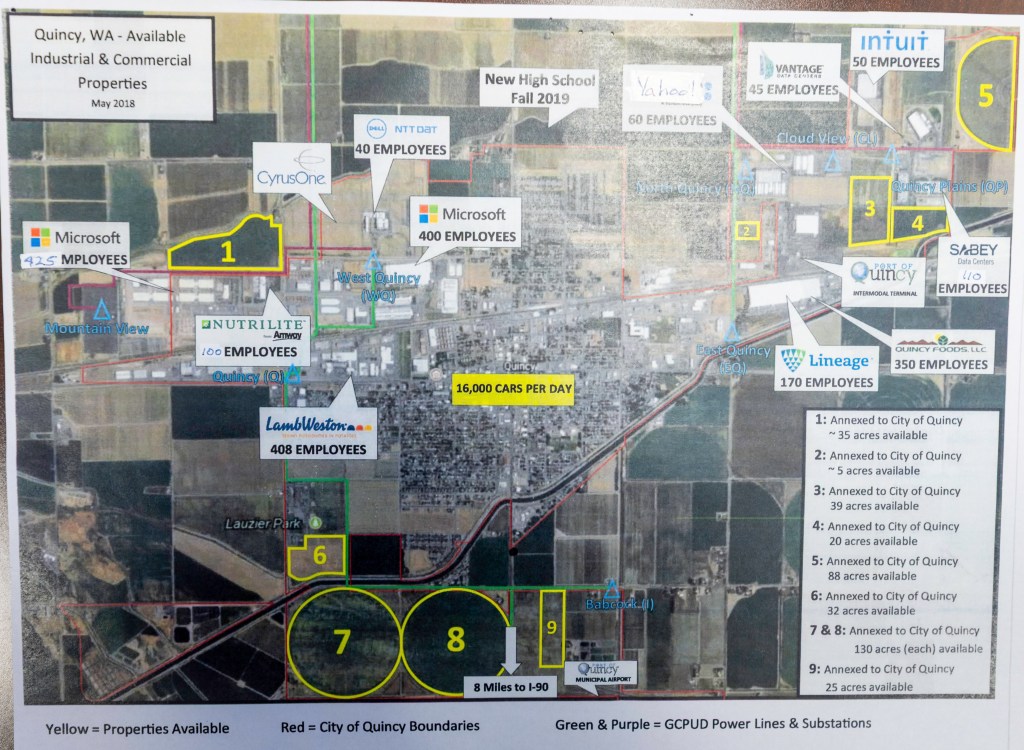
There were no data centers in Quincy two decades ago. Now they directly employ about 900 people, compared to 1,700 in agriculture, according to a recent state report. The centers rely heavily on contractors for everything from security guards to electricians, creating four to six indirect or induced jobs per center employee.
Quincy has grown by about 3,500 residents and 1,000 homes since Microsoft came to town. Not all newcomers work in the data centers, and many tech employees commute from larger cities. But the change is told in new apartments being built — and in other economic indicators, too.
Data center jobs tend to pay far better than the french fry line, so much so that the town’s poverty rate fell from 29.4% in 2013 to 13.1% in 2023.

“They (local kids) can go directly to the data centers and make a family-sustaining income,’’ said Quincy School District Superintendent Nik Bergman. “Before the data centers, the only option for our graduates was to work in agriculture or food processing.”
Realtor Debra Adams said the centers have breathed new life into the town where she’s lived nearly her entire life. She and others praised the companies for civic involvement, often through donations like Microsoft’s recent $50,000 contribution to the senior center and Sabey Data Center’s $30,000 check for a school auditorium sound system.
“They have been really, really good neighbors,” Adams said. “It’s been positive. All positive, with very few downsides.”
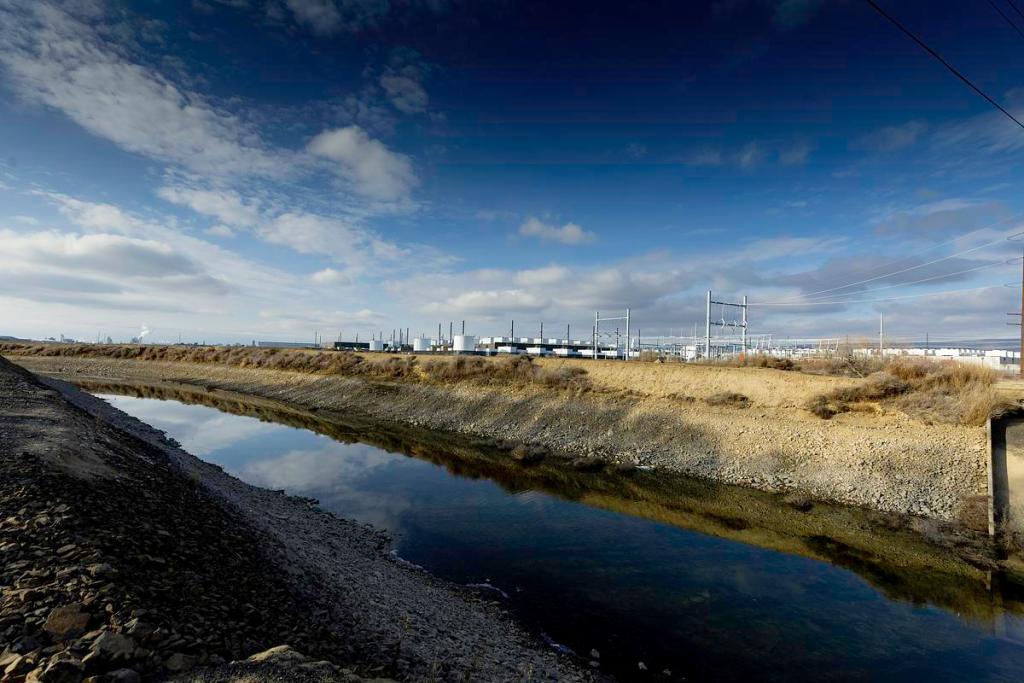
The centers do tend to blend in, particularly where they’re nestled among big produce storage warehouses. Most look more like quiet, well-landscaped office parks than industrial giants, though the multiple exhaust stacks for emergency generators give them away.
Quincy remains a quiet small town. Anyone interested in seeing a movie, eating at Olive Garden or shopping at a big box store drives 30 miles or more to Wenatchee or Moses Lake.
“If someone is moving here, there’s not a lot to do,” said Ron Linden, another Brunch Box regular who moved here in 2017 from the Seattle area. He wasn’t complaining.
‘The Quincy Miracle’
Economic benefits aren’t limited to those who work in the big, faceless buildings. Quincy has made a dizzying array of debt-free civic improvements, including a state-of-the-art medical center, wastewater treatment plant and reuse system, a new City Hall and stations for expanded emergency services.
It’s a point of pride that almost all streets are now paved. About 80% have sidewalks, up from 5% in 2007.
The city is building a water park and will soon break ground on a massive sports complex with four indoor soccer fields and other facilities calculated to bring in regional sports tournaments, boost tourism and attract sorely-needed hotels and restaurants.
All improvements have been covered by the data center-driven increase in the property tax base, even as rates for residential and commercial properties plummeted from $3.12 per $1,000 of assessed value in 2006 to 88 cents last year.
“I call it the Quincy Miracle,” said former City Administrator Pat Haley.
That miracle extends to the 3,200-student Quincy School District, where 57 cents of each property tax dollar comes from the centers. In 2019, the district opened a 200,000-square-foot high school, with facilities rivaling a college campus, for 930 students. The $65 million project included a 550-seat performing arts center for choir, band and drama programs the district couldn’t afford in the past.
The district has also renovated and expanded two other schools and added three gyms, all while its property tax levy rate has fallen from $3.50 per $1,000 to $1.25, well below the state average.
Bergman said the new facilities help recruit new teachers, including former students who might not have moved home after college. In 2014, Bergman noted, less than 20% of high school graduates who went on to a four-year college required remedial math and English courses, down from 38% a decade earlier.

Lingering concerns
But like most “miracles,” this one involves some pain — and attracts skeptics.
Former Mayor Patty Martin and retired art teacher Dana Dal Porto run the environmental group Save Our Soils. They say life has deteriorated since the centers arrived.
“To me, it’s worse because it makes me angry,” Dal Porto said. “We’re being duped and bullied to believe they’re for the good of all, but I don’t believe that’s true. It’s for the good of corporate America.”
The two raise complaints about the data centers. Diesel backup generators top the list.
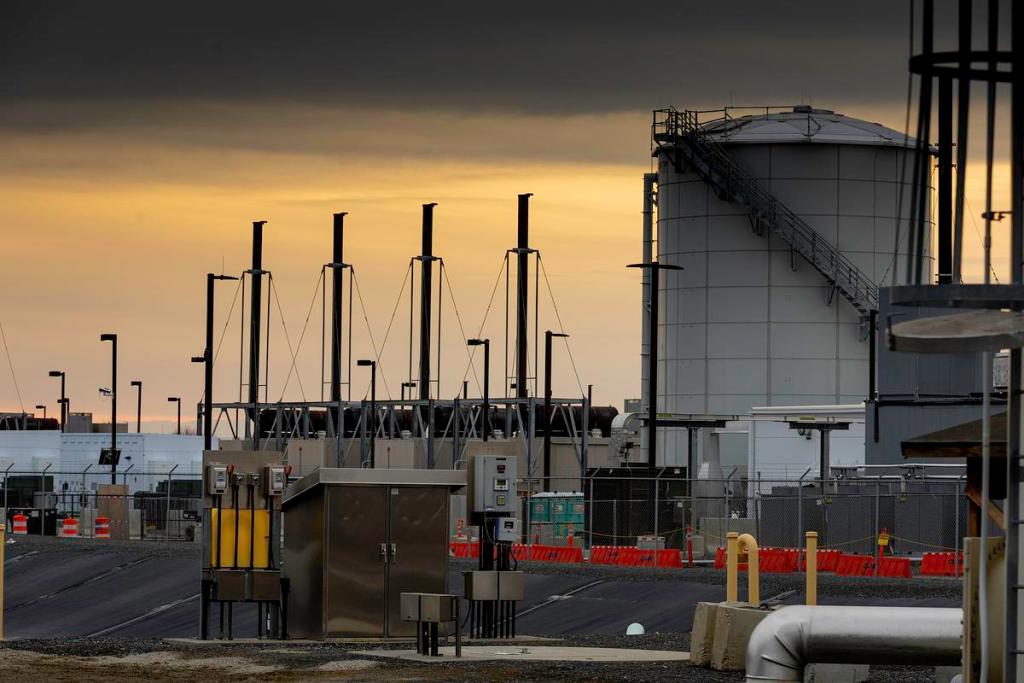
Data centers require uninterrupted power, and they’ll switch on locomotive-size generators if they ever lose electricity from the Grant County Public Utilities District grid.
Haley and others note the centers have never lost power, but acknowledge air quality would suffer if all 640 permitted generators ever ran at the same time.

State regulations, which Martin helped influence, limit non-emergency generator operation to no more than 15 minutes each per month for maintenance and testing.
Martin and Dal Porto have long pushed for more diesel pollution control devices, but state regulators have said there isn’t enough pollution to warrant the expense. Save Our Soils disputes that.
“We’re not an agricultural town anymore, we’re a corporate town,” Martin said. “The data centers are only here to rape, pillage and take advantage.”
Yet Martin and Dal Porto acknowledge that most would vote in favor of the centers. Martin notes she was elected mayor on a 2-1 margin in the 1990s. After years of fighting the centers, she ran again in 2013 — and lost by the same margin.
Water and power
Data centers were built in Quincy for the same reasons they’re built in Tulsa: cheap land, an adequate water supply, fiber-optic internet services and tax breaks. But the top reason for Quincy’s data center explosion was cheap power.
It’s the cheapest in the nation, generated by two Columbia River dams that create enough hydropower to serve 500,000 households. For decades the public utility district generated far more than the county needed, and sold the surplus to other utilities at cost. Much of it now goes to data centers, which in 2024 accounted for nearly 43% of all local demand.
The district says it has enough generating capacity to serve Quincy in the near-term, but its transmission line is tapped out at 300 megawatts. In 2024, the data centers alone gobbled up 269 megawatts, and will need 515 megawatts — enough for the entire Tulsa metro area — by 2045. A new transmission line will more than double the electrical load for Quincy in late 2028, but it comes at a cost to farmers and rural homeowners living far from town.
“We’re basically collateral damage,” said Alan Rasmussen, who is fighting the loss of about a half-acre of his four-acre homesite 11 miles south of town to a 100-foot-wide power line easement. “They’re doing their project and getting their millions for it, but we’ll live with this forever.”
Residential and commercial electrical rates remain the lowest in the nation, at about 6 cents per kilowatt hour, but they’ve grown about 50 percent in the last 20 years, though it has grown at less than the rate of inflation. The average resident pays about $106 per month, up from $70 in 2006, according to the utility district. The utility blames the increase on inflation.
“Data centers and other large industrial customers will pay most, but not all, of the (Quincy grid) upgrades and maintenance over time, through their rates, which are currently about 50% above the cost to supply them with electricity,” a district spokeswoman said in an email. “Core customers — residential, irrigation, small business/general service — pay about 30% below their cost to serve.”
Quincy is also running short of water, having allocated almost all of the 2.1 billion gallons it mostly pumps from wells.
Data centers do consume a lot of water, Haley said, but they only take about 10% of Quincy’s supply. Food processors drink nearly six times as much, the former city administrator said.
Microsoft has developed cooler-running computer servers, and its recycling system has cut potable water use by 97%. Quincy still needs more.
The city has the right to take more water from the Columbia River, but the Quincy Basin Irrigation District’s canals are already strained to their limits and farmers face rationing during peak summer months.
Haley has a plan: Tap a canal when ag demand is low, treat it and pump it into the city’s aquifer for later use. He expects the data centers to pay for all of it, though neither Microsoft nor Sabey would comment.
“Yes, they use power and water and there are diesel emissions, but we’ve lived with them for 20 years with no problems,” Haley said. “Like anything, there are tradeoffs … but I’d like to say the tradeoffs have been minimal.”
An earlier version of this article incorrectly stated the percentage increase in utility rates.
News decisions at the Tulsa Flyer are made independently of our board members and financial supporters. Read more about our editorial independence policy here.