



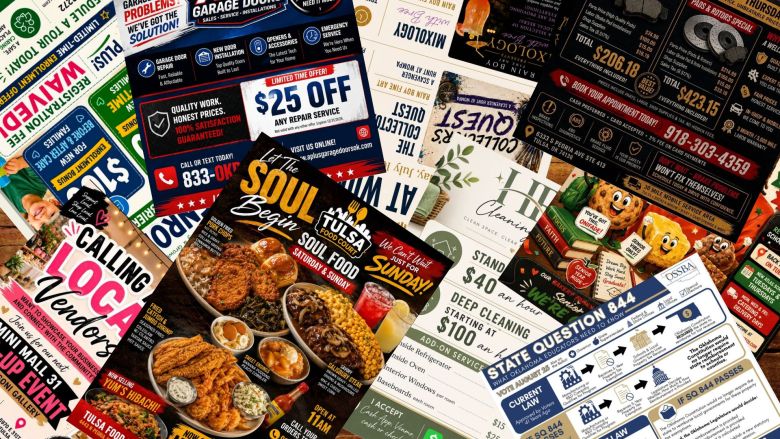
Carl Carbonell has been working in graphic design for almost 20 years. The Tulsa-based artist and musician has seen the industry change and reinvent itself thanks to the evolution of technology and new strategies to catch people’s attention.
But recently he’s noticed the appearance of a totally new trend: AI-generated flyers.
“I feel bummed about AI. It’s definitely something that kind of makes me sad for a lot of reasons,” Carbonell said.
He said he’s been studying the advertisements and he hates that the technology is getting better — and replacing paid work for humans. But he also sees a chance for designers to stand out.
“If anything, it is just kind of another opportunity to find a solution to be a little more (of) a better steward of the skillset and the knowledge,” Carbonell said.
On social media sites like Facebook, businesses, politicians and even some creative spaces are turning to artificial intelligence to advertise events and themselves.
Instead of hiring a graphic designer or manually making an image, people can simply generate flyers or enhanced menus in a matter of minutes on platforms like ChatGPT.
The proliferation of AI-generated flyers has made things difficult for some graphic designers seeking work. As a result, they’re taking matters into their own hands by posting their own pitches online, asking people to stop using it and to instead employ a real person.
Carbonell is taking a more direct approach. He plans to lead a free workshop from 2 to 5 p.m. Aug. 29 in conjunction with the Tulsa Office of Film, Music, Arts & Culture for the city’s music industry.
The session, hosted at Chimera Ballroom, will offer design tips and practical steps on how to make flyers without the use of AI. Attendees will get a crash course in design tools such as Canva and will have a chance to participate in a Q&A after the session.
“From a very objective place, I feel like I would be lying if I said the aesthetic of it was capital-B bad because enough of it stylistically kind of hits,” Carbonell said. “I’m more concerned with the separation of the doing from the doer than I am necessarily even with the final product.”
The final product of an AI flyer can be quite jarring, even when it leads to the desired outcome of bringing in customers and attendees.
In north Tulsa, you can find Tulsa Food Court, a new business offering burgers, hibachi and burritos. The entire exterior of the building is decorated with AI-enhanced images of its menu items. Its website also heavily uses AI-generated texts and images.
Owners Scott Gordon and Ken Johnson say the use of the technology is saving them money and time.
“It allows us to be able to just get stuff done a little bit quicker,” Johnson said. “So it’s really about efficiency. (When we’re) trying to get out some ads (it takes) 12 hours compared to having to wait on a three- to seven-day turnaround with our designers.”
Johnson said AI isn’t going anywhere and they have to either adapt or get left behind. The owners don’t see an issue with the difference between the images that AI creates and what their food actually looks like because they are confident in the quality of their food.
Gordon said the business heavily relies on word of mouth and believes AI to only be a small part of its marketing strategy. For some consumers, that doesn’t matter.
“I never trust an AI ad,” Tarra Quinn, a social media manager and content creator who frequently partners with restaurants for videos, said. “I want to see what my food actually is going to look like, not just a fake picture of it.”
However, she acknowledged being conflicted “because I understand the struggles of a small business and why they are probably doing it.”
Quinn showcases herself trying different foods all over Tulsa to her tens of thousands of followers, primarily on Instagram and TikTok. As a social media manager, she finds the use of AI distasteful, but thinks some small businesses are unaware of its perception.
The formatting alone can make it hard for an event or business to stand out, Quinn said.
“There’s no originality. (They) look like every other business. Some of them (have) run-on words and weird graphics,” she said. “(It) all looks exactly the same. So whenever I’m looking or scrolling online, it’s almost like I can’t ever figure out who the business is.”
Carbonell said he understands the convenience of AI but doesn’t want to let the human element get lost when it comes to design.
Throughout his years as a designer, he’s made several relationships that have made finding work fairly easy, but he fears for early-career designers who may be starved for opportunity to showcase their work.
While his late August session is mostly geared towards musicians, he encouraged anyone who’s interested to join. Attendees can RSVP here.
Ismael Lele is a Report for America corps member and writes about business in Tulsa for The Oklahoma Eagle. Your donation to match our Report for America grant helps keep him writing stories like this one; please consider making a tax-deductible gift of any amount today by visiting this link.
