
The Oklahoma Ethics Commission is weighing the need for new rules around the use of artificial intelligence-generated campaign advertisements. But new ethics regulations involve political will, and while other states have addressed the issue, Oklahoma lawmakers have yet to act.
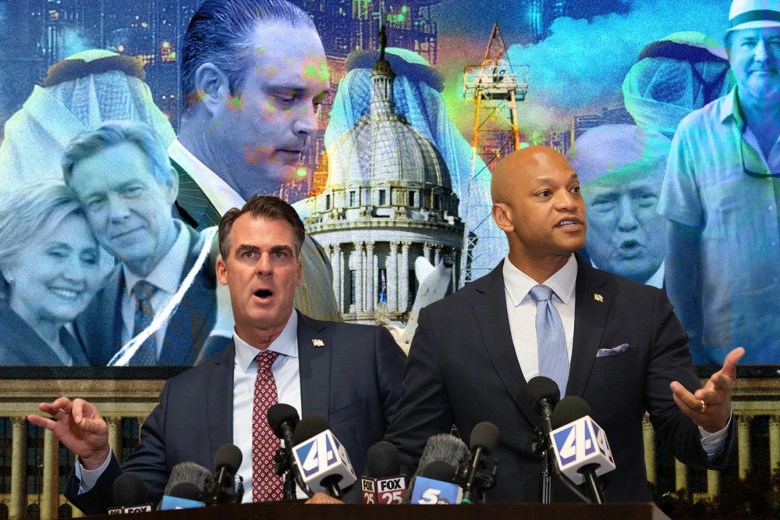
Abortion access. State income taxes. Welfare benefits. There’s a lot that Oklahoma Republican Gov. Kevin Stitt and his Democratic counterpart from Maryland, Gov. Wes Moore, disagree on.
But stopping robots from lying to voters at the whims of dark-money groups—that’s a common cause.
“When you literally, you know, confuse or lie to Oklahomans through AI, you can’t tell what’s real… I think that’s across the line,” Stitt said in late July, at the annual National Governors Association, or NGA, summer meeting in Oklahoma City.
It was the same weekend that Stitt, who served as the NGA chair for two years, passed the baton to his vice-chair, Moore, who agreed with him.
“It is true, you should not be able to use technology to distort facts and realities for people,” Moore said. “Particularly because people are very susceptible to these types of manipulations.”
Thirty-one states, including Maryland, have regulated the use of AI-generated advertisements – specifically deepfakes – in elections, according to the National Conference of State Legislatures.
Oklahoma is not one of them. And while Stitt is on his way out of office, he says that needs to change.
“We need to have some kind of regulation, especially around political campaigns,” Stitt said.
Why Oklahoma needs to regulate AI-generated political ads

Lee Anne Bruce Boone leads the Oklahoma Ethics Commission, which promulgates new rules through a public process and presents them to lawmakers for approval. She said one of the commission’s most vital jobs is staying proactive.
“We want to be looking forward and thinking about things that might be impacting our purview, our jurisdiction, and artificial intelligence is certainly one of those,” Bruce Boone said.
The ethics commission has been monitoring the issue in Oklahoma for some time, she said.
“We specifically had some mailers come to our attention several months ago regarding four different officeholders, two of which are involved in a current campaign cycle and two that are not.” Bruce Boone said, explaining that complaints came from a mix of elected officials, campaign representatives and members of the public.
“That kind of kick-started the process in terms of our discussion with the Ethics Commission and a concern about how that might be interpreted or reviewed by the Oklahoma voter,” she said.
But leading up to the June Republican Primary election, Make Oklahoma Great Again, a dark-money group that’s been buying many of the circulating ads, released a flurry of TV ads targeting gubernatorial candidates.
One ad accused then-candidate Charles McCall of secretly supporting sex changes for minors, showing deepfakes of him with a banana in his pocket and calling him “Banana Chuck” in parody of one of his own ads where he chops the fruit in half, saying, “I have a message for any lunatic pushing sex changes for kids: You first.”
McCall really did release an ad of him chopping a banana while threatening supporters of sex changes for minors, but in his version he touts outlawing the practice and banning boys from girls’ sports.
Another ad by the same group attacked Mike Mazzei, one of the frontrunners for the GOP nomination for Governor in the August 25 runoff, along with incumbent State Attorney General Gentner Drummond.
That ad starts with a deepfake scene of 2016 presidential candidate Hillary Clinton on a stage, while Trump pouts at a banquet table in the foreground.
“Trump’s MAGA movement; Crushed by crooked Hillary if Mike Mazzei got his way,” a male voice says, going on to accuse Mazzei of voting to remove Oklahoma from the Electoral College in favor of a national popular vote. Trump lost the popular vote when he won the 2016 presidential election.
Then, the ad transitions to deepfakes of Mazzei hanging out with Clinton and hugging her, while the voice calls him a “Clinton lover, Trump hater.”
One candidate the Make Oklahoma Great Again ads don’t attack is Drummond. The group most often depicts the attorney general as a heroic fighter pilot and the solution to Oklahoma’s woes, which has spurred accusations that his campaign is behind the false messaging about other candidates he means to beat.
Meanwhile, Drummond sued Gov. Stitt, the School Freedom Fund Oklahoma PAC and the Republican group Club for Growth in May for allegedly collaborating to air ads calling him “America’s Wokest RINO” (as if Trump said it himself), a Biden bankroller and a “defender of Godless liberals.”
One of the school freedom ads accuses Drummond of grifting federal Paycheck Protection Program funds for his private companies during the pandemic and of buying a $750,000 summer home in Maine.
“A public official fleecing the public and abusing our trust,” A female voice says, “Living high on the hog, summering in Maine, while Oklahomans foot the bill. It’s time for greedy Gentner to take a permanent vacation.”
Multiple businesses owned by Drummond received PPP loans totaling $3.6 million between 2020 and 2021, which were paid out to him by his own bank. That story came to light during his second campaign for attorney general when reported by The Oklahoman.
But AI ads have a way of taking grains of truth and sprinkling them into a mixture of deepfakes and heavy lies about events that never happened. It’s not the sort of thing Oklahoma regulators saw coming when they initially wrote the state’s ethics rules years ago, Bruce Boone said.
“Our existing rules, of course, didn’t anticipate the use of AI,” she said. “There have been a few changes in the past few years, but the bulk of them came over ten years ago. And really, I think the Commission is coming at this from a concern of let’s begin talking about this process now, because it’s a very serious matter and it involves constitutional issues as well.”
Willy-nilly laws around this could lead to violations of the First Amendment’s free speech protections, she said.
“In terms of, if anyone were to try to regulate content, I don’t think that’s the intent of the commission at this point, but there has been that discussion as well,” Bruce Boone said.
All roads lead to lawmakers

There are two avenues for AI regulation in Oklahoma: new ethics rules for political candidates and state officeholders, with civil and potentially criminal penalties for violations, or straight law proposals, with whatever rules state lawmakers see fit.
The point is to keep state elections and their participants fair and transparent, and, well, AI changes how political communications are created, Bruce Boone said.
“And we know voters deserve accurate information to make an informed decision,” she said. “So we want to be responsible and evaluate whether our transparency laws should evolve at the same time.”
But to become a reality, ethics rules and election laws require the buy-in of state lawmakers, because either way, the legislature gets the final say.
In Maryland, lawmakers have completely prohibited AI deepfake political ads. In other states, like Tennessee, deepfakes impersonating candidates must include certain disclosures.
Some states do both. All states have attached civil and/or criminal penalties for violations.
In Oklahoma, Roland Republican Rep. Jim Olsen chairs the House Elections and Ethics Committee. He supports new regulations that could eventually lead to prohibition.
“I think I would start with the disclosure and probably move on to the other one,” Olsen said. “I think that is not necessarily an either/or. Yeah. Eventually have both.”
The question, Olsen said, is not whether Oklahoma lawmakers should regulate AI political messaging; it’s how to do it without violating anyone’s First Amendment rights.
“The elephant in the room is what are the courts going to say?” he said. “But at the same time, we’re the legislators. It’s our job to legislate. And it’s the court’s job to take that next step if it’s challenged.”
In the Senate, Democratic Minority Leader Julia Kirt says her caucus has generally supported stronger regulations around AI in brief and sporadic conversations, or at least ensuring the ethics commission has the capacity it needs to investigate violations of new rules.
“That’d be my biggest worry,” the Oklahoma City Democrat said. “You know, if we slap some new regulations, but we don’t actually give them the capacity to follow up on it.”
The topic is bound to come up during next year’s legislative session; whatever lawmakers devise remains to be seen. But it’s already an issue in the runoff election to replace Stitt.
Drummond was blunt about his approach in a debate earlier this year.
“As governor, we’ll pass legislation that bans the manipulation of AI,” he said in a debate earlier this year. “Voters need to see the authentic person on the stage in their ads. And they need to be able to vote for the candidate that will represent them.”
Mazzei was more abstract.
“Artificial intelligence. We all need to deal with it appropriately and respectfully,” Mazzei said. “And when we’re dealing with information, we need to deal with the facts.”
The GOP nominee for governor this month will face off against Democrat and House Minority Leader Cyndi Munson and Independents Robert Brooks, Orlando Lynn Bush and Jerry Griffin in November.
Bruce Boone says the commission is interested in new AI rules, but that it’s a process with a statutory timeline, which requires commissioners to provide an opportunity for public comment and to agree on the newly written language.
“One commissioner may want to be more stringent, and others may want to be more lenient,” she said. “We may not get agreement.”
Bruce Boone said there is still time for commissioners to hear from the public and write and propose new rules, but maintained lawmakers can act completely independently of the ethics commission. In which case, the commission will be there to help.