


This article is a part of Snapshot: Election Guide, a collaborative journalism project between Tulsa Flyer, The Oklahoma Eagle, The Frontier, KOSU, La Semana and Focus Black Oklahoma designed to help Tulsa voters make informed decisions ahead of fall elections set for Aug. 25 and Nov. 3.
Many Oklahoma business leaders see a five-year property tax exemption for new or expanding manufacturers as a key tool to boost the state’s economy. But reimbursing local government entities for the cost of that program consistently goes over budget, requiring the state to make an additional appropriation at the end of the legislative session.
State Question 844, on the ballot this August, aims to reduce program costs by allowing the legislature to adjust reimbursement rates, but the move could take funding from some school districts.
Voters approved Oklahoma’s ad valorem tax — or property tax — exemption for qualifying manufacturers in 1985. As part of the program, the state must reimburse local entities, like public schools and county governments, for the full amount of tax revenue lost to the exemption.
In recent years, the cost of reimbursement has exploded as data centers and wind farms opened and expanded across Oklahoma. It peaked at $161 million in 2020 but has since dropped to about $89 million after both were disqualified from the program. But House Speaker Kyle Hilbert, R-Bristow, said the legislature has had to allocate extra money to the program’s costs during each of the 10 legislative sessions he’s served, and even before that.
The reason for the proposition
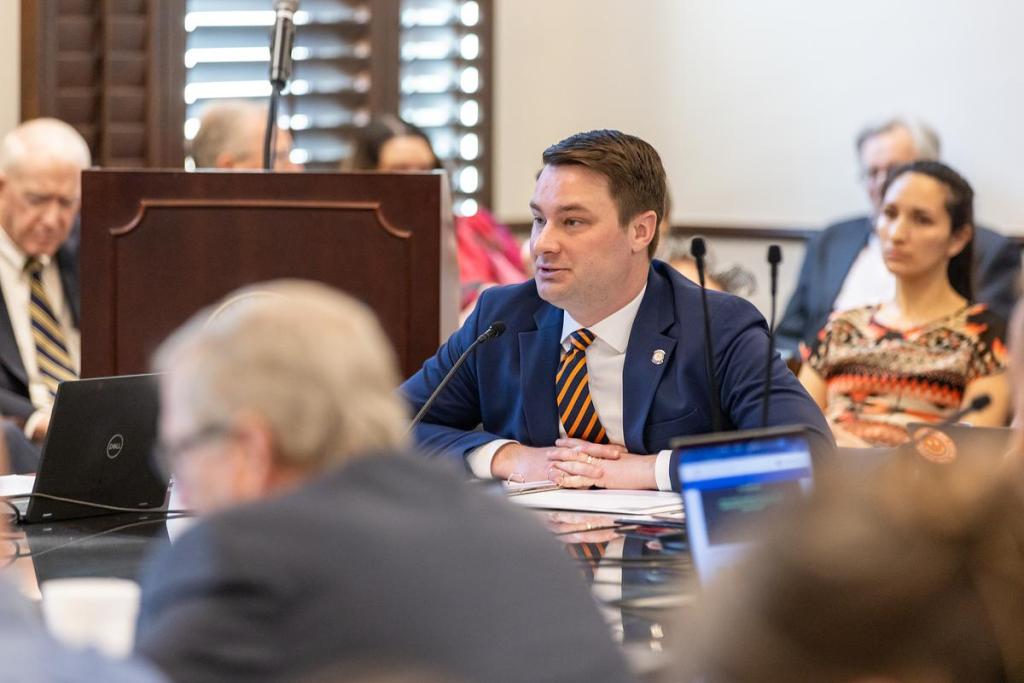
Hilbert is one of the authors of House Joint Resolution 1087, which proposes the question.
Hilbert said legislative input will give school budgets greater stability. He pointed to the fact that, once a five-year tax exemption ends for a company in a certain county, local entities sometimes are jolted by a budget decrease resulting from an initial property overvaluation.
County assessors not familiar with large manufacturing facilities can sometimes overestimate their value, and because companies don’t pay the taxes, they don’t contest the proposed amount. But when the exemption ends and companies are on the hook, they fight to bring that number down.
That’s the situation that unfolded in Minco, which is home to NextEra Energy wind farms. What adds to the pain is that some districts, like Minco, pass bond issues against the valuation of the property as determined by their county assessor. In Elgin, for example, the district had to raise taxes on residents to afford a bond after the value of the Blue Canyon Wind Farm was contested.
“What we’re trying to address is oftentimes the disparity that can happen in the assessment of the values of these properties,” Hilbert said. “Because what happens is there really isn’t anyone at the table fighting for Oklahoma taxpayers.”
If State Question 844 passes, part of the legislative effort to reduce costs may involve reducing the reimbursement rate for local entities. These entities will then have their bond proposal values capped in accordance with the reimbursed amount from the state, rather than the property’s true value. Although this may keep schools out of the same scenario as Elgin and Minco, they would no longer be guaranteed to receive the 100% reimbursement required today. Still, Hilbert said any money is more than local schools would receive without a manufacturer coming to their area.
“Whether it’s 100% or 50% or 70% of the assessed value being reimbursed, the county is getting more revenue than they were before,” Hilbert said. “And so, yes, I think it would be that if this program is happening, the taxpayers of Oklahoma should have a seat at the table and make sure that the reimbursement rate is fair and is good for the entirety of Oklahoma.”
Being able to spend less on this program could allow the legislature to allocate more money to school districts that need state support, Hilbert added. Mayes County, for example, receives the most reimbursement dollars from the program due to the presence of the MidAmerica Industrial Park in Pryor — the eighth-largest industrial park in the world. But Pryor Public Schools is able to spend over $16,500 per student, whereas the state average is around $12,000. Hilbert imagines that sending fewer state dollars to districts like Pryor could free up more funds for schools where spending is lower.
Ideally, Hilbert said, those changes to reimbursement rates would apply only to future projects. But it’s not for certain that’s how it would shake out.

Why many schools are opposed
Hilbert’s ideas about how to implement changes are not written into the measure, which in its text simply directs the legislature to make rules about reimbursement to “ensure that no individual county receives reimbursement in an amount detrimental to other Oklahoma counties.”
For Pryor Public Schools Superintendent Lisa Muller, that’s part of the problem with the proposal.
“While I know that proponents argue, ‘Well, we would have this additional money to give to all the other school districts,’ this state question does not guarantee that,” Muller said. “All the state question does is say that voters are going to give the legislature control over how to pay for this program and how to distribute the funds.”
The establishment of MidAmerica Industrial Park — anchored by a Google data center — has allowed Muller’s district to expand its offerings for nontraditional instruction, like sewing, karate and an eighth-grade trip to Washington, D.C. At the same time, they’re able to keep classes small.
Senate Bill 609, which passed in 2021, disqualifies data centers from the exemption. But the Google facility was grandfathered in, with it being eligible for the exemption on new equipment through 2036, although it no longer qualifies for the exemption on new construction.
Mayes County, where Pryor is located, currently receives more money from the reimbursement program than any other county, totaling about $35.6 million in 2026. But that is a decrease of about $4 million from 2025, which Muller points to as a sign that the exclusion of data centers from the program is working to reduce its overall cost.
With the help of increased tax revenue from these companies, Pryor Public Schools has been able to move off the state funding formula, which determines how much support districts should receive from the state. Muller points to the fact that, if the reimbursement rate is decreased, some schools may move back on the formula, meaning that the funding dedicated to formula spending may be diluted as it is spread across a larger number of schools.
In addition to the programming Pryor has been able to offer with its increased revenue, a chunk of the money goes towards the general fund, which supports operational costs. A decrease in reimbursement could lead to layoffs across the district. And because Pryor Public Schools has an active bond based on the expected property tax income, decreasing the reimbursement may also require the district to increase taxes on homeowners, even though the bond was approved by voters as an issue without a tax increase.
District leaders like Muller also argue that decreasing the reimbursement just isn’t fair. If the state exemption program didn’t exist, Pryor Public Schools would receive the full value of property taxes from the industrial park.
“I think it’s a little disingenuous to say, ‘Well, we shouldn’t have to give them that money,’ because the local district didn’t get to say, ‘We want to waive those property taxes or not waive them,’” Muller said. “That’s a state program. And there was a commitment when that state program was created to hold the taxing entities harmless for that.”

What the solutions look like
One previously proposed way to resolve some of the issues with the program has been to simply eliminate it, which would save the state money without taking anything away from local schools. Senate Bill 1595 would have done just that, and was passed nearly unanimously across both chambers of the state legislature in 2020 — including by Hilbert.
Gov. Kevin Stitt, however, vetoed the bill, seeing the tax exemption as a key tool in attracting business to the state. Local leaders like Oklahoma City Mayor David Holt and then-Tulsa Mayor G.T. Bynum praised the veto, arguing that the program supports economic development in their cities.
Muller sees the program as a good thing because she knows it was a factor when company leaders at MidAmerica Industrial Park brought their business to Pryor.
Although reducing government spending in areas like reimbursement might make taxes lower, it also reduces quality of life when there are fewer resources available for local schools and government, said Travis Roach, an economics professor at the University of Central Oklahoma. A company may not want to establish itself in an area with low-quality education, despite the available tax incentives, knowing that recruiting potential employees might prove difficult.
“It’s low taxes, but it’s also low services, low everything else,” Roach said.
In his view, any budget reductions should seek to limit programs that give money to large corporations that don’t produce jobs so that spending focused on quality of life metrics for Oklahomans can remain. Sending money to private businesses doesn’t solve specific problems Oklahomans are facing, like low-ranked education, he argued.
If State Question 844 doesn’t pass, Hilbert said the only other way the legislature can lessen the cost of the program is to reduce the number of entities that qualify for it, like it has done with wind farms and data centers.
Whether that must happen or voters give the green light to the question will be decided on Aug. 25. Voters can find information about their polling hours and location for that election on the Oklahoma Voter Portal.