


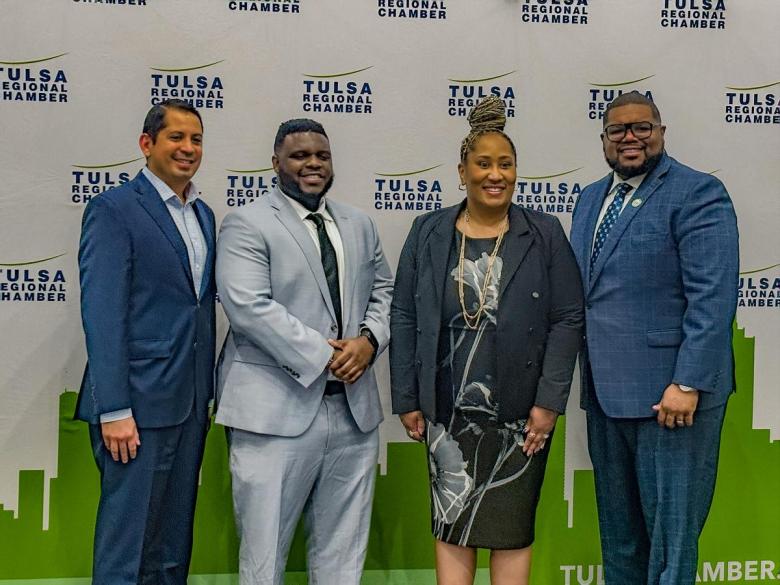
How do Tulsa business leaders increase diversity throughout their employee ranks? That was the question at the center of the Tulsa Regional Chamber’s annual state of inclusion event Thursday.
It came two weeks after the city released its equality indicator report, which tracks how the city is closing disparities between different racial, economic and geographic groups. Tulsa boasted its highest score since the report’s inception, but the unemployment rate for Black Tulsans is nearly double that of white residents.
Tawanna A. Black, founder of the Minnesota-based leadership group Center for Economic Inclusion, put it bluntly.
“There’s no reason not to be intentionally, not by happenstance, but intentionally diverse in every department and every level of our organizations,” she said.
Black was joined by Tyrance Billingsley II, founder of Black Tech Street; Rodrigo Rojas, chair of the Tulsa Area Hispanic Chamber of Commerce; and dozens of business owners and employees. The goal was to answer how diversity can help improve Tulsa’s economy.
Black’s conclusion was based on findings her center compiled:
- Diverse leadership teams deliver 19% higher revenue from innovation.
- Inclusive companies outperform peers by 35% in profitability.
- Black-owned businesses are among the fastest growing categories of new business starts nationally. In Tulsa, Black entrepreneurs are launching ventures at record rates.
Rojas pointed to east Tulsa’s Global District, calling the area surrounding 21st and Garnett one of the “highest sales tax volume commercial corridors in the city” and a prime example of how diverse communities can benefit an economy.
Black acknowledged diversity has become a loaded topic, noting federal policies that push back on diversity, equity and inclusion, or DEI.
“The (Trump) administration has certainly led a robust attack against diversity, equity, and inclusion … this isn’t about favoritism, this isn’t about elevating one population over another, but it’s about what’s best for an economy,” she said.
Tulsa, Black said, fits into the narrative and story of inclusivity in a unique way. She highlighted the destruction of Black Wall Street through both the 1921 Race Massacre and the 1960s urban renewal period to highlight how barriers to access can be both organized and spontaneous.
Despite the progress and resilience of marginalized communities, inequities still exist. Nationally, Black entrepreneurs receive an average of $36,000 in startup capital funding while their white peers receive $100,000-$150,000.
Billingsley II, whose company is heading an AI Cyber Lab center in north Tulsa, echoed Black’s views on the topic of access to resources and equity.
When it comes to “the AI revolution,” he said he’s never seen a more divided and exclusive group of people leading the charge. His goal is to make this technology accessible to the masses.
“I don’t believe, left to its own devices, that this AI revolution is going to be good for humanity,” he said. “(There’s a) 95% chance that this ends up terrible for everybody, most people, and great for a small few companies and a small few billionaires.”
Black’s gameplan for how businesses can measure their performance on DEI included establishing how much they spend on diversity, listing how many family-sustaining jobs were created and how much wealth it created for then owners and employers.
Ismael Lele is a Report for America corps member and writes about business in Tulsa for The Oklahoma Eagle. Your donation to match our Report for America grant helps keep him writing stories like this one; please consider making a tax-deductible gift of any amount today by visiting this link.
