

This is the first story in a three-part series detailing how U.S. immigration enforcement policies affect the people caught up in the process. As a warning, it discusses sexual assault.
As immigration enforcement in Oklahoma continues to ramp up, one Tulsa couple’s experience shows how the federal government is piling onto the trauma of people it has already deemed protected from deportation.
Vasquez, 49, and Ramirez, 40, are a married couple from Tulsa waiting on U visa protections, an immigration status reserved for victims of violent crimes who assist law enforcement in catching the perpetrators.
KOSU is only using their surnames because they fear retaliation from federal immigration officials during their pending visa case. This is the first part in a three-part series about their experience.
Vasquez and Ramirez applied for U visa protection after helping law enforcement prosecute a serial rapist in Tulsa County.
While they wait for the government to process their pending applications in a backlogged queue, their applications come with Biden-Era federal immigration protections called “bona fide determination” and “deferred action.”
It means they’re a low priority for deportation, and the federal government knows how they — both from Mexico — ended up living in the United States. It also means they have federal permission to be in the country as immigrants without a permanent status while they wait for that to change.
But halfway through last year, President Donald Trump broadened the scope of who could be detained and deported to include people like Vasquez and Ramirez. Their federal protections did nothing to keep them safe from the dragnet of immigration arrests sweeping the nation.
On the morning of Aug. 27, 2025, Ramirez and Vasquez were arrested by U.S. Immigration and Customs Enforcement (ICE) while driving home from buying tamales. The events of that day would cost them their home, jobs and health — and leave them in thousands of dollars in debt.
They spent months in immigration detention in Texas and Oklahoma. During that time, Ramirez suffered several seizures caused by her epilepsy. Vasquez waited, depressed and confused by his court hearings. But eventually, they were released — first, Ramirez, after four months; then, Vasquez, after eight.
Starting when Ramirez was released, KOSU spoke with the couple over several months, reviewed their public and private records, attended Vasquez’s online immigration hearing and interviewed involved legal experts to corroborate this story. Interviews with Ramirez and Vasquez were carried out in Spanish and translated by KOSU.
From tragedy to ‘a normal life,’ and back again

After visiting the country from Northern Mexico, Ramirez decided to overstay her visa in 2017. She said going home meant returning to a toxic and dangerous environment after her dad died and the family began feuding over property.
“Like anyone else in life, I just wanted to work for a while,” Ramirez said. “But I ran into problems in Mexico. I lost my property. So I decided it was better to stay here.”
Diagnosed with epilepsy and with no sure-fire way to make money for her medication back home, Ramirez felt staying was the sensible choice. Her medical needs and immigration status, however, made finding work a struggle.
She bounced around for a while until she landed a gig at a marijuana grow in Tulsa, where she worked for about 6 months. Here, her boss took advantage of her vulnerability.
Ramirez said her boss raped her at gunpoint several times.
She said she initially didn’t ask for help out of fear and the need for an income.
“He took advantage of me for a few months,” she said. “Until I finally got fed up.”
She’d told Vasquez, her friend at the time, what was going on. He helped her bring the case to the Tulsa Police, who investigated for three months before arresting the man oncharges of sexual battery. Shortly after the arrest, Ramirez’s former boss died by suicide while in jail and the case was dismissed.
In the aftermath, Vasquez helped Ramirez set up therapy appointments and connect with Catholic Charities of Eastern Oklahoma, a Tulsa nonprofit specializing, in part, in helping immigrants and refugees navigate life in their new communities. In 2020, officials at the nonprofit wrote Ramirez a letter supporting her U visa application with United States Citizenship and Immigration Services (USCIS), according to documents provided by Ramirez.
“Ms. Ramirez reported that he had raped her and forced her to perform oral sex on him at least six times over the course of her 6-month employment,” The letter reads. “Ms. Ramirez also reported that [her abuser] was an alcoholic and carried a gun with him at all times, threatening her with the gun while he was sexually assaulting her.”
The documents, along with the related lawsuit she assisted prosecutors with, helped Ramirez make her case to U.S. immigration authorities for the U visa.
She and Vasquez spent a lot of time together, Ramirez said, often when she was at her most vulnerable.
“We had become friends and started going out,” Ramirez said. “Then we got married in 2021…and started a normal life.”
They began renting a mobile home in Broken Arrow that year. Ramirez initially switched jobs to home cleaning services, then to helping Vasquez with contracted construction work.
The application process for a “non-immigrant U visa” can take years due to a cap of 10,000 applications accepted annually. People have to wait in a proverbial line for their hearing and an official decision. Family members are also eligible for what’s called a “derivative” visa, which offers the same protections for relatives of the main applicants.
So, Vasquez, who entered the country without permission in 2002 and has lived in the United States without a legal immigration status since, was also expecting the visa and benefitting from the same deportation protections his wife had.
With the pending U visa application, active federal work permits and their deferred action, all they had to do was wait until April of next year, when their final hearing is scheduled.
And that’s what they were doing, last fall, when they got pulled over by Oklahoma Highway Patrol. The officer was deputized by ICE and working alongside federal agents on “Fugitive Operations,” per a Department of Homeland Security report.

The arrest
Vasquez was driving his brother’s maroon Chevy Avalanche that day. He told the story of the couple’s arrest from his perspective during an interview in late March.
He said that morning they’d bought tamales and decided to make a stop at a client’s house to pick up some materials for a drywall job later. They were heading south on Garnett Road, about to reach the intersection with 41st Street, he said, when the lights flashed behind them.
“That’s where they pulled me over—because I didn’t turn on my turn signal at the traffic light,” Vasquez said. “And I told them, ‘Well, I’m not going to turn it on, because I’ve been driving straight from 31st. I didn’t turn.’”
“And then they asked for my license,” he said, relaying the quick exchange he had with the officer. Ramirez sat in the truck quietly next to him, handing over their documents and immigration papers as requested.
Vasquez did not have a license. He told the officer he was picking up tamales, but he had a work permit. He was asked if he had any weapons. He said no and then more law enforcement officers showed up.
“That’s it,” Vasquez said. “They took my permit and my insurance and everything…and then ICE showed up.”
An officer with a “Police ICE” Velcro badge attached to his vest walked up to the window and began asking them to exit the vehicle in Spanish, Vasquez said.
“As soon as they got me out, they handcuffed me,” Vasquez said.
Vasquez said the ICE officer didn’t offer any information about what was happening or where they were going. There was no indication that their pending visa applications would save them.
“I told them, ‘But I have a work permit and social security number. I’m about to get my driver’s license,’” Vasquez said. “‘We’re taking you because you’re illegals,’ is all he said.”
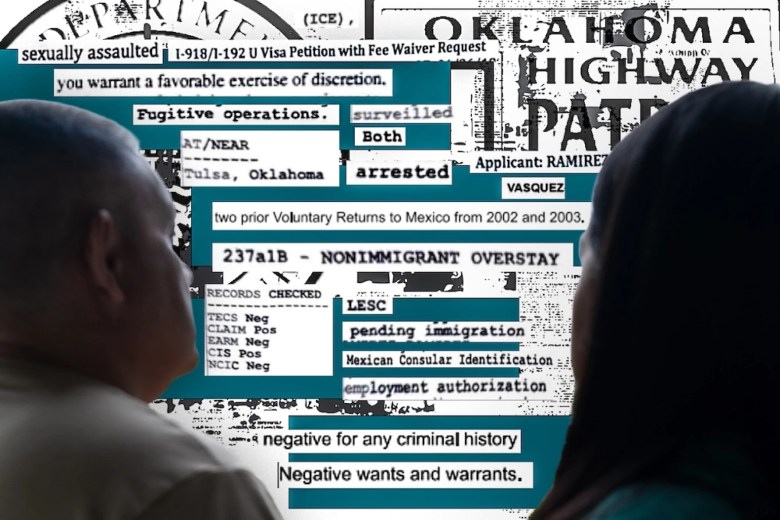
Ramirez and Vasquez provided KOSU with their “Inadmissible Alien” documents, which serve as the equivalent of arrest reports when federal agents detain someone for immigration violations. They are also called “Record of Deportable” and “I-213” forms.
And while the couple requested that the full reports remain unpublished to protect their identities, they’ve allowed KOSU to inspect the documents and share key, non-identifying information.
The details of the narrative in the arrest reports offer clarity into how the couple ended up in handcuffs.
The author identifies himself as ICE Deportation Officer A. Brown.
Brown starts by explaining that he, another Deportation Officer named J. Stanko, an unnamed state trooper and an unspecified number of Homeland Security Investigations (HSI) special agents were conducting “assigned fugitive operations” in the Tulsa area.
A “lead was developed by ICE” in Tulsa regarding an investigation into a person with the last name “Macario,” Brown wrote.
“The investigation revealed that MACARIO was a citizen and national of Mexico with a final order of removal from the United States and that she was a fugitive from ICE,” Brown wrote. “By law enforcement sensitive techniques, technology, and methods, it was also determined that MACARIO’s last known address was…”
KOSU is excluding the actual address to maintain the resident’s privacy. But it’s where Vasquez said he stopped to grab drywall for his job, while Ramirez sat in the truck. Vasquez said he doesn’t know the people living there personally, or anyone with the last name “Macario.”
“Special Agents from HSI witnessed a Hispanic female, matching the MACARIO’s (sic) physical description, leave the last known address (LKA) with an unknown male in a Marron (sic) Chevy Avalanche,” Brown wrote in the report. “The vehicle was surveilled from the last known address.”
During the surveillance, Brown wrote, the state trooper who made the stop witnessed Vasquez “make an improper” and noticed the truck he was driving had a “modified exhaust in violation of Oklahoma motor vehicle law.”
The couple said the trooper did bring up the exhaust but only after Vasquez denied ever turning. KOSU requested the relevant traffic stop records from the state Department of Public Safety, which responded to say no such records exist.
After describing the stop, the report does not mention “Macario,” the turn signal infraction, nor the modified exhaust were mentioned in the report again.
Vasquez presented his Mexican Consular ID, employment authorization and several documents showing his pending visa status. Ramirez did the same. She had a non-REAL ID card issued by Oklahoma.
“These documents were given to A. DO7131 Brown and record checks were conducted by the Law Enforcement Support Center (LESC) to determine validity,” Brown wrote in his report. “The LESC stated that both subjects were pending immigration but did not have any lawful status.”
They were both transported to a small processing office first, Vasquez said.
“At the office, another person asked us why they’d brought us there, that they couldn’t deport us,” he said.
The person processing them said their immigration status was supposed to keep them from being arrested, Vasquez said. Still, because they were there already, they needed to be booked anyway, Vasquez said he was told.
Vasquez was charged with unlawful entry for crossing the border illegally in 2002. Ramirez was charged with a non-immigrant overstay, for not returning to Mexico when her initial visitor’s visa expired.
They were taken to Tulsa County Jail, which was the last place they would see each other for the next eight months.
Part two of this three-part series will be published Tuesday on kosu.org.
This article was originally published by KOSU. You can see the original story here.