

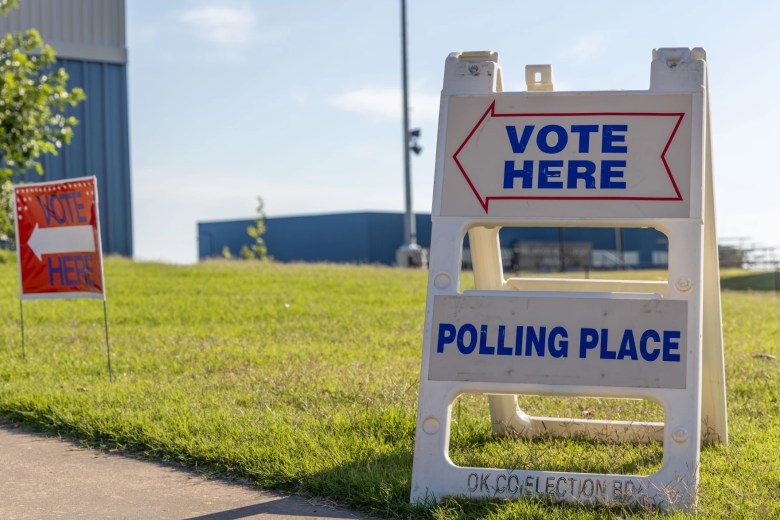
While partisan voters weighed in on key state and federal elections during Tuesday’s primary, Oklahoma’s nearly 500,000 registered independents were only eligible to vote on State Question 832, a ballot measure that would gradually raise the state’s minimum wage to $15 per hour.
In interviews at polling places in Oklahoma City, some independent voters told KOSU that they thought it was important for independent voters to cast their ballots on the minimum wage question, but criticized the closed primary system that bars them from voting in key races.
In March, the Oklahoma Secretary of State invalidated thousands of petition signatures for State Question 836, a ballot measure that would have opened Oklahoma’s primaries, placing all candidates for the same position on the same ballot, regardless of party. With too few valid signatures, the question failed to make it to the ballot. Advocates for the state question appealed the rejection of their petition at the beginning of the month.
Under the state’s closed primary system, only voters registered as Democrats, Republicans or Libertarians are eligible to vote for partisan candidates during the primary election, which this year included candidates for governor and a U.S. senator. Independent voters are, however, permitted to vote on ballot measures considered during the primaries. This year, that was only State Question 832.
Oklahoma political parties may open their primaries to independent voters. The 2026 election marked the first time in 10 years that they were not eligible to vote in Democratic primaries after the party had what it characterized as a “miscommunication” with the state Election Board, Oklahoma Voice reported in December.
Suzanne Peck, 62, said that Tuesday marked her first primary election voting as an independent after recently changing her voter registration. After researching various candidates running for governor and lieutenant governor, she had an “a-ha moment” at the ballot box when she discovered she could not vote in any race other than the minimum wage question.
“I felt like I was kind of shut up,” she said, adding that she would consider registering with a party again in order to have more options in future elections. Peck said she had hoped to vote for a moderate candidate.
Heather Davis, 53, joined Peck at the polls and is also a registered independent. She said she supported opening up Oklahoma’s primaries and had been following Mayor David Holt’s advocacy for State Question 836.
“I wish that we had the opportunity to vote for all parties at this juncture,” Davis said. “I was disappointed that we didn’t get that accomplished the last time around. So I feel limited as well. I definitely want to vote for the person and not the party, and I think that’s one thing that has not been great in our state.”
Davis said she believed the state should bolster mental health services and its support of people who are unhoused and victims of abuse.
For Marvin Burks, 71, concerns about education and the construction of data centers were top of mind. Burks said he recently attempted to change his registration from independent to Democratic, but that his application was not successfully processed. He said he believed the Republicans had controlled Oklahoma politics “for way too long.”
He said he signed the petition to put State Question 836 on the ballot and disapproved of the current closed primary system.
“I don’t like that at all because I’m paying for the primary,” Burks said. “You know, as an independent, I still pay taxes and that’s what’s paying for this primary location. When they had the independent write-up to get us included, I signed that. So I think all people should be able to vote.”
Burks noted that he supported State Question 832, which would raise the minimum wage, and that he would encourage other independent voters to do the same.
Ann Meeks, 67, and Stephen Greglewicz, 70, both said they are registered as independents and went to the polls on Tuesday to vote in favor of SQ 832.
They both said they would encourage other Independent voters to show up to the primary elections.
“I’m not sure they realize that they can vote, but they should be made aware that they are able to,” Meeks said.
Natalie Armour contributed reporting.
This article was originally published by KOSU. You can see the original story here.