

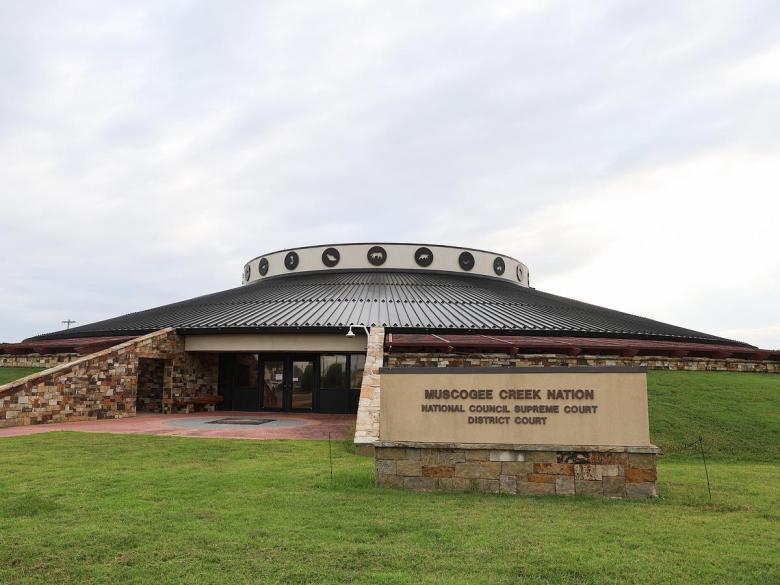
The Muscogee National Council issued a vote of no confidence against five of the tribe’s supreme court justices on Sunday.
The council argues the members violated their oaths of office when removing the tribe’s “by blood” citizenship requirement.
Thirteen representatives issued the vote of no confidence for Chief Justice Andrew Adams, Vice-Chief Justice Richard Lerblance, and justices Montie Deer, Kathleen Supernaw and George Thompson Jr.
Those five members issued a decision last July that ruled descendants of individuals formerly enslaved by the Muscogee Nation were entitled to tribal citizenship, striking the Muscogee constitution’s “by blood” citizenship requirement. Their decision cited the tribe’s 1866 treaty with the federal government.
The resolution, penned by Representative Lucian Tiger, argues that the court members violated their oaths of office by altering the Constitution.
Tiger told the council Article IX mandates the constitution can only be amended through a two-thirds plurality in the national council or from voters in a special election.
On Monday, he said the resolution does not pertain to the Freedmen decision. Tiger also said the court could have adopted the 1866 treaty without violating the 1979 constitution if it had held the treaty superseded it.
“Freedmen is never mentioned in the legislation,” Tiger said, “because my comment on that was, if that was the case, we would be doing a vote of no confidence every time they did something that we didn’t agree with … it was just solely on the fact that nobody without a vote of the people can strike language or add language to our constitution.”
One council member, Dode Barnett, opposed the measure. She called the resolution an “impotent gesture” that might not change anything.
“We couldn’t make the case in our own court system,” Barnett said. “I mean, the justices make the best decision they can with the information that they’re presented with.”
But this move, according to Tiger, is the strongest action the council can take against the court.
According to the tribe’s constitution, removing a supreme court justice requires a written petition consisting of 20% of tribal members and a three-fourths majority vote in the council.
“As legislators, as council, our hands are tied. We don’t have an opportunity to make a vote on that or take action on that,” Tiger said. “This is the strongest case that we could take, is showing that we have no confidence in our Supreme Court.”
On May 30, the tribe will hold a special election to amend the constitution. Those potential amendments include allowing the principal chief to appoint temporary special justices to ensure seven members hear each case; replacing the word “Muscogee” with the traditional “Mvskoke” spelling; and establishing three-term limits on representatives.
Tiger said that while the council’s decision was overdue, its vote Sunday was timed to coincide with that election.
But two individuals at the heart of the movement to attain citizenship for Muscogee Freedmen — Rhonda Grayson and Jeff Kennedy — are calling for the special election to be delayed. They argue around 4,000 Freedmen have been denied citizenship and the right to vote.
Grayson and Kennedy’s attorney, and Dode Barnett did not immediately respond to requests for comment.
Background
Cherokee Nation recognized full Freedmen citizenship in 2021, when its Supreme Court similarly removed “by blood” language from its constitution. The Seminole Nation also has limited citizenship for descendants of Freedmen.
The Muscogee Nation followed suit in July 2025, when its Supreme Court affirmed that descendants of people formerly enslaved by the tribe were tribal citizens.
Principal Chief David Hill issued an executive order a month later, pausing the issuance of citizenship cards to Freedmen descendants. Hill said the Supreme Court overstepped its authority when striking the constitution’s “by blood’ language.
Grayson and Kennedy have since challenged Hill’s order several times, most recently by demanding that the special election be postponed.
And earlier this month, the tribe’s Business, Finance, and Justice Committee also approved Tiger’s vote of no confidence.
This article was originally published by KOSU. You can see the original story here.