


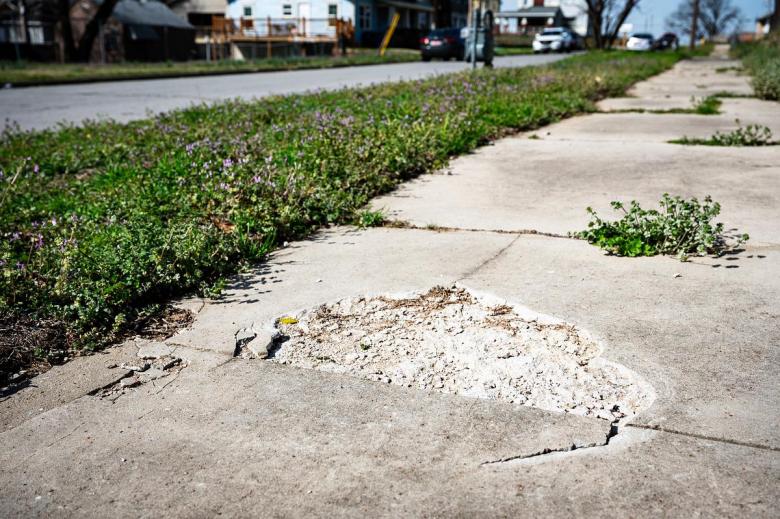
Tulsa needs a sidewalk rescue plan. That’s the response the Flyer heard from residents across town after the Tulsa Flyer reported last week that city councillors have hundreds of thousands of dollars in funds to improve their districts.
In 2019, the city approved the Improve Our District funds, giving each of the nine Tulsa council districts $1 million for things like infrastructure improvements and road repairs. Many of those districts still have funds to spend — and are determining how and where they should head.
Tulsans from the north, south and everywhere in between said sidewalks should be high priority. New sidewalks and repairs to existing sidewalks are needed all over, they said.
Tulsans make the case for sidewalks
Cherie Rucker, community engagement director of Tulsa’s Center for Individuals with Physical Challenges, argues that better sidewalks will improve public safety. The organization’s clients sometimes feel in danger when arriving at the recreation center, Rucker told the Flyer.
Some members of the organization use various modes of transportation and others live nearby the facility. All of them want to be able to get there without facing hazards, she explained.
“There is a lot of people who live close by and would like to just cruise on down but there are several sidewalks even here around the center where the sidewalk will just end,” Rucker said.
“It is very dangerous and this is not necessarily the city’s fault, but people (in cars) fly down Utica Street. It is definitely an issue for the members here.”
Tulsa’s problem with sidewalks is longstanding, with residents long complaining about the lack of pedestrian infrastructure included on street and land planning. As the city undergoes rapid growth, some believe the city’s investments in infrastructure has not kept up with the pace — especially when it comes to addressing Tulsa’s mix of older neighborhoods and new enclaves.
Sidewalk construction cost can vary. For example, construction on one mile of sidewalks on Mingo Road cost the city $500,000. That amount could increase if the city looked to extend sidewalks by additional miles. Minor repairs would cost the city less than full replacement and construction.

Fletcher Stewart, president of the Crosbie Heights Neighborhood Association, said that in certain parts of west Tulsa, some residents also consider the lack of sidewalks a public safety matter. A lot of the sidewalks there were built decades ago and now, “they are crumbling,” he explained.
Much of the responsibility for repairing sidewalks fell on the homeowners, he added, with little enforcement from the city.
“We have existing sidewalks throughout most of the neighborhood but they are in really bad shape, and the city can’t fund their repairs, due to complications of what the rules are,” Stewart said. “And it would be really unfair to property owners to start requiring them. (It) would be a huge cost burden to repair sidewalks at scale.”
John Villareal, principal and executive recruiter at Catalan Executive Search, LLC, is a lifetime Tulsan. Villareal often runs in various parts of the city, but he lives in Owen Park near downtown. That is where you can frequently catch him jogging.
In his view, the city has made efforts to improve sidewalks in new development areas, but overall, a lot more needs to be done.
“I have been on any given day all over these sidewalks on my run and I see it and they need to be repaired,” Villareal told the Flyer. “Our sidewalks and streets are too close together and it is very dangerous for pedestrians.”
What Tulsa leaders have to say about sidewalks
City councilors say they are aware of the calls for more and better sidewalks.
Last week, District 8 Councilor Phil Lakin told the Flyer he is looking to invest more of his nearly $1 million left in his district bucket towards more sidewalks in his community, along with road widening efforts.
In December, the Tulsa City Council announced a $500,000 investment going toward completing unfinished section sidewalks along South Mingo Road from East 81st Street to East 91st Street.
Lori Decter Wright, who represents District 7 on council, has a remaining $425,000 earmarked for other city projects. Wright told the Flyer she plans to use that money based on what constituent demands are.
“My plan for the remaining $425K allocation for District 7 is to listen to constituents’ needs and concerns and to continue to respond accordingly with solutions that will fit within the budgeted expenses and compliance requirements of this capital improvement program,” she told the Flyer.
‘Every single council district’
City leaders have tried to tackle Tulsa’s sidewalk shortcomings for years. In 2012, Tulsa adopted the Complete Streets program, a resolution designed to make streets safer for walking pedestrians, transit riders or bikers. One key aspect of the policy was that sidewalks were required to be a part of new roadway construction.
An outside agency conducted a walkability study in 2017, finding that there was not much comfort for pedestrians and many of the downtown streets almost functioned as highways. An assessment from the Tulsa City Planning Office in 2024 shows 38% of the recommended measures have been completed, with another 17% in progress.
But sidewalks remain “an issue in every single council district,” said Blake Ewing, a former District 4 city councilor. Whether certain neighborhoods or subdivisions have sidewalks in their community ultimately can be up to the “discretion” of the subdivision developer, he said.
Tulsa began efforts on changing sidewalk requirements in subdivisions in 2019. That change went into effect in January 2020.
“Mostly the closer you get to downtown, the more likely it is that you see sidewalks because the older parts of the city, it was standard practice,” Ewing said. “But then as they started building more suburban-style neighborhoods, I think like the ‘60s, ‘70s and ‘80s, when everyone had cars, I think the assumption was we don’t need sidewalks anymore because people have cars.”
That isn’t the norm now — nor should it be, Ewing argues.
“And now I think people are realizing, even though we’ve got cars and even though this is a very car traffic-heavy part of town, people still want to be able to walk,” he said.
News decisions at the Tulsa Flyer are made independently of our board members and financial supporters. Read more about our editorial independence policy here.