

Tribal gaming officials are sounding the alarm about prediction markets, or events-based wagering that operates outside the Indian Gaming Regulatory Act (IGRA) framework and tribal-state compacts.
One of the main issues highlighted is the Commodity Futures Trading Commission and its support for these markets and control over them.
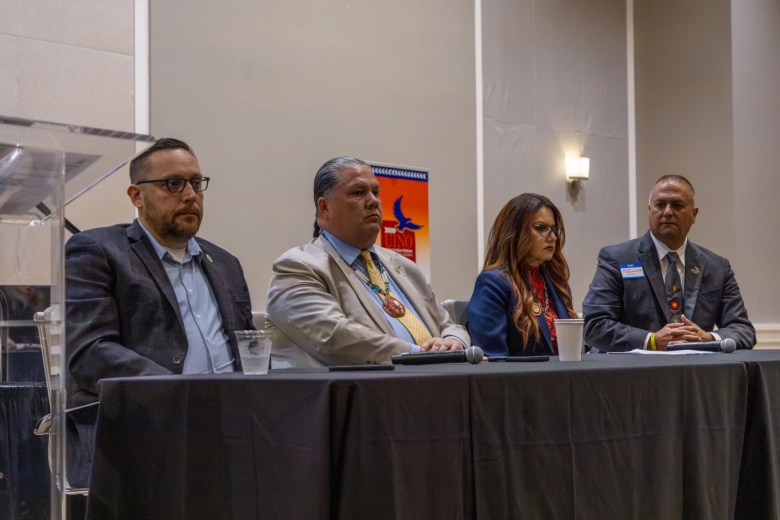
A panel addressed the issue at the United Indian Nations of Oklahoma’s quarterly meeting on Wednesday, offering potential solutions, including litigation and a recently introduced U.S. House Bill.
Evident in the name, prediction markets offer people a way to predict the outcome of an event and potentially make money off of it — depending on whether they guess correctly. While folks may use platforms, such as Kalshi or Polymarket, for wins or losses for major sporting events, some have even used them to predict outcomes of award shows such as the Grammys.
Jamie Hummingbird, a Cherokee Nation citizen and the chairman of the National Tribal Gaming Commissioners and Regulators, was among those who addressed tribal leaders about the current state of prediction markets.
“We are looking at whether or not this is something that the tribe is going to allow and whether or not this is something that is permitted within our state,” Hummingbird said during the meeting. “And if the answers to both of those questions are no, then the obvious answer is this is unauthorized gaming and therefore illegal in our jurisdictions.”
He said his job as a regulator is to advise tribal leadership of the facts and see how they wish to respond.
“So whenever tribes are looking at whether or not this is something that they wish to allow, whether or not it is legal or illegal at this point, it’s being permitted by the CFTC [Commodity Futures Trading Commission],” Hummingbird said. “So the legality of that is still in question. What is not in question is whether or not that is authorized.”
Causes of concern for Indian gaming officials
The Indian Gaming Association condemned the CFTC in late February for enabling the nationwide expansion of prediction market betting. As Jason Giles, the Indian Gaming Association Executive Director, pointed out during the panel, the CFTC currently has only one commissioner, Michael Selig, who is pro-prediction markets and also the chairman of the federal agency. The commission normally consists of five commissioners.
As CFTC Chairman, Selig has helped file amicus briefs on behalf of prediction markets, arguing that they are commodity derivatives markets over which the CFTC has exclusive jurisdiction.
“CFTC-registered exchanges have faced an onslaught of lawsuits seeking to limit Americans’ access to event contracts and undermine the CFTC’s sole regulatory jurisdiction over prediction markets. This power grab ignores the law and decades of precedent,” Selig said in a statement. “…As I’ve said before, the CFTC has the expertise and responsibility to defend its exclusive jurisdiction over commodity derivatives, and that’s exactly what we’ll do.”
In recent remarks, he also suggested that prediction markets are “truth machines” and a tool people use for reliable information, such as election results.
But Giles is concerned, as he said, tribal officials have been left out of the conversation, and controversy seems to follow prediction markets.
“The way the CFTC rolled this out, by slow walking it, promising roundtables with tribes, promising consultation with tribes, promising to let the court cases play out before they took any position on how they were going to react to this,” Giles said. “All were lies.”
Giles said a solution is out there, though Congress is now starting to understand what is going on. He specifically pointed to House Bill 7840, introduced by Representative Blake Moore of Utah, which is being referred to the House Committee on Agriculture.
“This is the bill we need to make these lines clear because the courts are struggling with it,” Giles said.
As Giles noted, litigation is a way of fighting the CFTC, but noted it’s costly — unlike pushing a bill, which seeks “to amend the Commodity Exchange Act to prohibit event contracts based on terrorism, assassination, war, gaming, illegal activity, election outcomes, government activities, or other activities determined by the Commodity Futures Trading Commission … and to allow States to exempt themselves from the prohibition on gaming contracts.
“We know that the CFTC is for farmers; it’s not for sports books, and they’re trampling over your exclusivity in Oklahoma,” Giles said. “And whoever the next governor may be …before you even begin to talk about amending the compacts for sportsbooks and everything, you have got to get in there and get the state going after these prediction markets full bore.”
Sportsbetting vs. Predicting Sports Outcomes Using Prediction Markets
Sports are a big part of prediction markets, as seen in this year’s Super Bowl. One web-based prediction market platform, Kalshi, reached more than $1 billion in trading volume, according to reporting from CNBC.
Hummingbird explained how sports betting, which is not legal in Oklahoma, differs from using prediction markets.
“The result is the same,” Hummingbird said. “You’re putting money on the outcome of a certain event, right? Whether or not the Thunder win. So if you are placing a bet or if you’re buying a contract, the net effect is the same. … but where they differ is where we come in — on the regulatory side of things.”
He said regulating gaming is important to protect the integrity of operations, such as licensing vendors and employees.
“Nobody is looking at what’s going on here,” Hummingbird said. “Nobody’s looking at whether or not we have underage gambling going on.”
Iowa Tribe Chairman Jacob Keyes attested to how prediction market companies have reached his 17-year-old son and his friends.
“All of his friends talk about placing bets,” Keyes said. “Mobily, they’re already doing it.”
That is one of the reasons, he said, why he thinks sports betting needs to be brought to Oklahoma.
“We need to have sports betting in Oklahoma designed by the tribes [and] controlled by the tribes so that it’s regulated in that way,” Keyes said. “And then on top of that, if those kids are doing it, their parents are doing it.”
Keyes said Oklahoma is already behind the eight ball, and it is time to compromise to pass sports betting legislation at the state capitol.
“What’s most important is, ‘Yes, you’ve got to fight for your tribe and what’s best for your tribe,’” Keyes said. “…But at the same time, we’ve got to fight just to make sure it gets done.”
Sports betting bills have been introduced and failed in the state legislature for the last several years. Lawmakers, the tribes and Gov. Kevin Stitt have struggled to find common ground while debating the issue. Stitt is slated to leave office in January of 2027.
This article was originally published by KOSU. You can see the original story here.