


Gov. Kevin Stitt, a citizen of the Cherokee Nation, has repeatedly called for limits to tribal sovereignty and has claimed Oklahoma’s reservations were disbanded upon statehood, despite the landmark McGirt case that ruled half the state was tribal land.
He recently did so during his appearance on NPR’s Morning Edition and this year’s State of the State address. He talked to Inskeep about his Cherokee heritage.
“I’m very proud of my heritage,” Stitt said. “But I would differ in the fact that a lot of people think that, well, Indians are owed something, or they need special treatment, or you know, if you read anything about me in Oklahoma, I’m in a little bit of a conflict with some of the tribes because I don’t believe we should be divided based on race.”
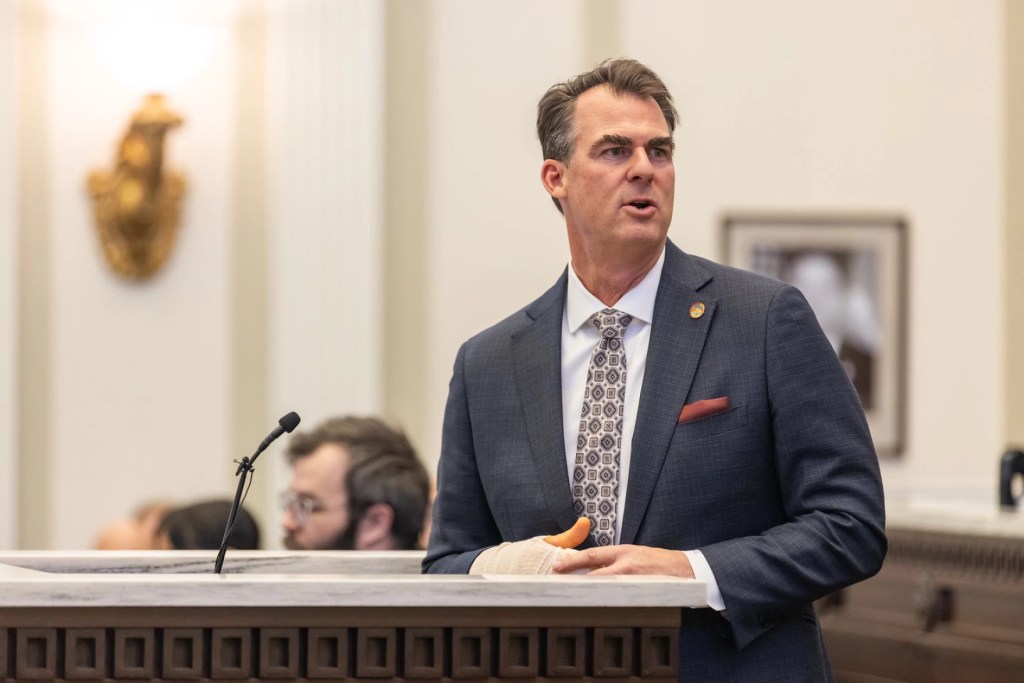
Stitt argued against the landmark McGirt decision, which ruled that much of eastern Oklahoma is still reservation land.
Cherokee Nation Principal Chief Chuck Hoskin Jr. disagrees about what Stitt said. He sat down with KOSU’s Sarah Liese to talk about the interview, his frosty relationship with the governor and what he hopes to see in the state’s next executive session.
Sarah Liese, KOSU Indigenous Affairs Reporter: Steve Inskeep, a host of NPR’s Morning Edition, interviewed Oklahoma Governor Kevin Stitt last week. They discussed the landmark McGirt decision that reaffirmed half of Oklahoma as Indian Country, including the Cherokee Nation reservation and Stitt, again, argued that tribal citizens are receiving special treatment based on race. Do you agree or disagree with what he said there?
Chuck Hoskin Jr., Principal Chief of the Cherokee Nation: Well, I disagree with it. And it wasn’t new or surprising. The problem is, it was probably new and surprising to 99% of NPR listeners who aren’t living what life is every day in the state of Oklahoma in which tribal nations are doing incredible things where there’s not some special race treatment, where there’s not some racial tension that the governor has tried to tell the country through NPR, but he’s done it before to the Wall Street Journal. So I wasn’t surprised. I do disagree with him. He is describing something that doesn’t exist in law, policy or fact or reality. And that’s troubling that he has a national audience to make, frankly, more ignorant on the subject that the country needs to know more about.
Liese: Stitt also used rhetoric suggesting that Native Americans need special treatment or, as he put it, that they’re owed something. What do you say to this, and what I presume he’s talking about, trust and treaty responsibilities?
Hoskin Jr.: Well, there is an obligation on the part of the United States to make good on promises — promises for the Cherokee Nation and other tribes that have taken the form of treaties, which are the supreme law of the land. And of course, there’s court decisions and statutes that collectively represent the trust responsibility. And so there is an obligation. There’s a bill that has never been fully paid. I think if people came to Oklahoma, they would see what it means when at least some of the obligation is met. They would see health care systems that are based on policies in which the United States said, “Yes, we should provide health care and then let tribes run health care systems and build them up.” They would see economic enterprises that are creating jobs and economic vitality. That is sovereignty, and that is America, tribal sovereignty. That’s America keeping its promise when it’s put into action. And I think most Americans would be pleased with the results and want more of that. The governor wants less of that.
Liese: Another topic of conversation was immigration. I wanted to follow up on a Cherokee Nation statement from late January regarding potential ICE operations in and around the tribal community. What is the scope of ICE operations in the area, if any?
Hoskin Jr.: There has not been really a discernible increase in ICE enforcement activities in our tribal communities. It was not to say that we’re not being watchful of it. But there hasn’t been what we’ve seen, for example, in the state of Minnesota, which has caught global attention for reasons that are really troubling. [We] have not seen that within the Cherokee Nation. The Cherokee Nation has a robust, very professional law enforcement agency, the Cherokee Nation Marshal Service. And we’ve got preexisting great relationships with federal law enforcement agencies. So my sense is that if ICE were to increase its activity within Cherokee Nation communities, that there would be a dialogue that at least would be based on a preexisting relationship. But I have to say, I just like any American…am troubled by some of the scenes that I’ve seen and the shootings. And that’s not really consistent with what Cherokee Nation law enforcement adheres to. And so we would have an opportunity hopefully to address that if it were to occur, but have not seen it yet.
Liese: So Stitt will leave office in January of 2027. What qualities are you personally, as the leader of the Cherokee Nation, looking for in the next Oklahoma Governor? And what are your top priorities to work on after new state officials take office?
Hoskin Jr.: Well, I think what I’m looking for, and I think most Cherokees are looking for, is a governor who will try to take the state back to a time –and it’s not a distant past – in which governors of both parties across administrations were viewing tribes as friends and partners, and viewing tribal sovereignty as an opportunity on which to build great systems and opportunities for prosperity. I mean, we saw that in Governor Fallin. We saw that in Governor Brad Henry … You can really go quite a ways back and see that Oklahoma was making steady progress on state-tribal relations. So we need somebody that believes fundamentally that tribes have a role in the 21st century. If any governor who believes that succeeds Gov. Kevin Stitt will make a marked improvement on relations because he genuinely believes, I think to his core, that tribes have no real reason, let alone right to exist as governments. I mean, his State of the State address was essentially a prescription for the termination of tribes. He didn’t use that phrase, but everything he described was towards a conclusion that was inescapable, which is that he views tribal governments as not needing to exist. So there’s really nowhere to go but up in terms of that relationship. We need a governor that wants to build this state up where it is deficient, and it is deficient in public education, infrastructure and funding. It’s deficient still in some basic infrastructure for a lot of particularly rural parts of the state. Those things align as much with the interests of the Cherokee Nation as things like gaming compacts and state tribal relations. So we’re looking for that too. And I think we’ve got some great candidates who are speaking to those issues. Thankfully, we’re not going to see, I think, a Kevin Stitt 2.0 out of this group of candidates.
Liese: And this is something that I asked you after the State of the State, but how you reconcile with Gov. Kevin Stitt being the governor of Oklahoma, but also being a Cherokee Nation citizen and pushing for tribes to not exist. And you mentioned something also today, this, this phrase faster, alone, further together. And I wonder if that is even applicable with, with Gov. Kevin Stitt.
Hoskin Jr: Well, I think it’s applicable in that it’s sort of juxtaposed with what … Gov. Kevin Stitt sees the role of government in society. It’s sort of every person for himself. And he also sees tribes as somehow involved in this zero-sum game with the state, in which if tribes assert sovereignty or get or measure some, or have some measure of progress in some area, it has to come at the expense of the state. By definition, he looks at it as essentially a spreadsheet. And relationships in states and in communities and in society are not spreadsheets. They are about building things. And so that’s something you have to do together … Oklahoma could be head and shoulders above much of the rest of the country, because we have these 38 federally recognized tribes that are all engaging in self-governance, trying things, changing policy, adopting policy, investing in systems and economic development opportunities that can all increase everybody’s well-being. I mean, health care is a great example of that. Education is another example of that. And I think the next governor will see that, surely, because the opposite vision espoused by Gov. Stitt has led to a real breach, a real gap between tribes and the governor’s office anyway.
Liese: Is there anything that you wanted to clear up from, from that interview or from the State of the State?
Hoskin Jr: Well, I think this whole notion that tribes are are to be viewed through the lens of racial relations is really damaging. It’s damaging in that it feeds into purposefully into a lot of rhetoric and policy in this country that’s really designed, I think — and I’m talking about nationally — to play to people’s worst fears and anxieties and anger about how they perceive race in their lives and in American history and what’s going on right now. So I think it’s designed to play into what’s going on in the country right now in terms of race relations. It’s also fundamentally detached from federal law, federal policy — the notion that tribes are sovereign nations and that our citizens are citizens of a tribe. And so that I think is damaging and that I think we have to continually push back on that… People understand America in terms of this collection of people that fall into racial categories, and it’s difficult for, I think, many Americans to understand that ‘Indian’ is not a race for the purpose of talking about citizenship and tribal nations. And so I fear that that is going to have a corrosive effect on federal Indian policy in the future if it takes hold.
I mean, if we’re talking about the opportunities for tribes to be part of the economy through federal contracting, we’ve already seen efforts to reduce us to racial classifications. And to be sort of lumped into this, frankly absurd and contrived and constructed for political purposes, DEI debate. But that is part of, I think, a narrative that many in the country, particularly Governor Stitt, would like to apply to tribes. So the level of ignorance in the country about tribes is very high, and that’s for a lot of historic reasons. Governor Stitt has increased that ignorance, even as his own ignorance seems to have increased. He’s sharing that with the world, and so the opportunity to push back on that for a tribal leader is few and far between. And so anytime we can talk about it, we need to talk about it. Tribes are sovereign governments. Our citizens are citizens of tribal nations. We have the same interest as any country on the face of the planet have, and we ought to be able to advance those interests using our sovereignty.
KOSU mental health and addiction reporter Sierra Pfeifer was also in attendance at the interview and interjected with a question at the end.
Pfeifer: I just am curious about how a lot of times it comes up to be a tipping point of like an us-versus-them mentality. And I feel like you’ve been kind of speaking to that, but how do you push back against that? And what would you want a national audience to know about like why that collaboration?
Hoskin Jr.: I think a lot of Americans do understand politics and policy as some sort of a fight or some degree of tension. And that tension is resolved in someone’s favor or someone’s disfavor. And that does happen in politics. And it happens in policy. But I think if people knew more and I’d like them to know more about what’s going on in the state of Oklahoma, they would see that it’s not a daily contest of who wins, because it turns out that if the Cherokee Nation is investing millions of dollars into water infrastructure and doing it with the state, that rural communities benefit from that because otherwise they have crumbling water infrastructure. And it doesn’t matter whether you’re Native, it doesn’t matter whether you’re a Black American, it doesn’t matter what your background is, whether you’re White. Everyone benefits from having reliable drinking water and ways to deal with wastewater. And those are very basic things that aren’t controversial, but they’re lacking in a great many parts of this country, including a lot of rural Oklahoma. If they see that tribes are actually providing solutions to that, then they see that this is less of a contest and more of a question of how can we build a community that everybody wants to live and work in? That’s just one sliver of policy.
This article was originally published by KOSU. You can see the original story here.