
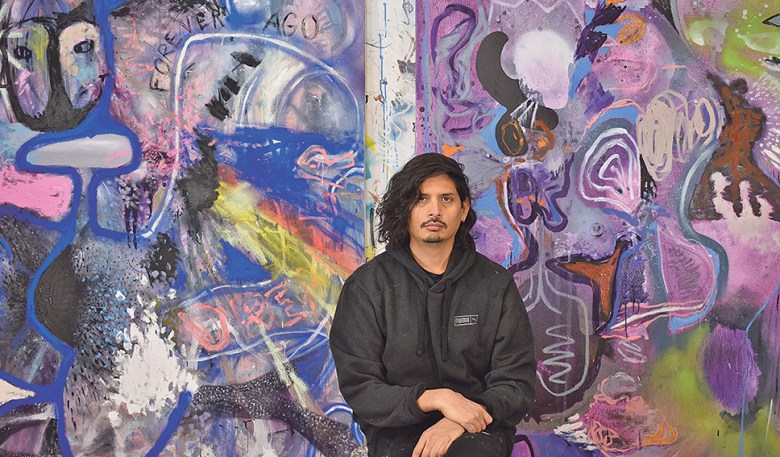
Gabriel Arturo Rojas was born in Argentina to Bolivian parents and arrived in the United States before memory could fully take hold. What remained was feeling. America was the first thing he learned to sense—its streets, its silences, its contradictions. Tulsa became home not by choice, but by growing into it. Still, like so many who arrive too early to remember and too late to fully belong, Rojas grew up inhabiting a space slightly off-center: American in practice, immigrant in the eyes of others, Latino by inheritance, and always trying to understand where he fit.
That in-between space is where his art began to speak, and where his hands found a way—through paint—to express everything vast and immeasurable that words could not hold.
An artist and muralist based in Tulsa, Oklahoma, Rojas explores the relationship between memory processes and ritual through abstract painting. His work does not seek to tell a linear story, but to gather fragments—emotions, symbols, gestures—layered until meaning begins to surface. “I aim to create that productive tension in painting,” he explains. “Increasingly layered like life; assimilating my thoughts, influences, and experiences in ways that words cannot express.”
For Rojas, abstraction is not an escape from reality, but a more honest way of entering it. “I find abstraction an interesting way of expressing my views of the world,” he says. “I don’t consider all my paintings completely abstract because I use signs, symbols, doodles, texts—lots of representation—that get fragmented and abstracted through the process. And that’s my identity: trying to understand yourself in the world, among fragments.” What remains open on the canvas reflects the experience of living between cultures, languages, and expectations—gaining new depth and resonance through paint.
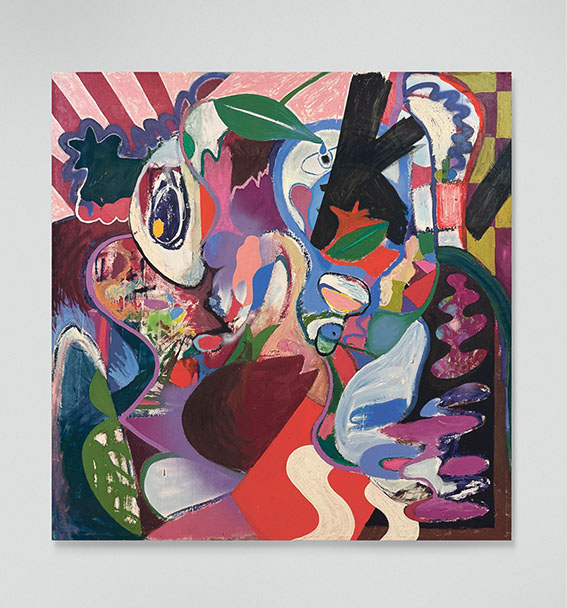
Inspiration often begins quietly. Sometimes it is a phrase, sometimes a word, sometimes an image that awakens a memory. From there, emotion turns into meaning, and meaning shifts. Rojas allows this transformation to unfold organically in the studio, trusting intuition while grounding himself in discipline. Creativity, he insists, is not just inspiration. “You have to work at it for it to appear,” he says. “It requires hours, like any other job.”
Rojas has been painting since childhood—always. For him, art is not a profession one enters and exits, but a way of being in the world. “Art is a way of life,” he says simply. His practice is deeply tied to a search for identity. Through painting, he tries to understand who he is, where he comes from, and how experiences such as migration, loss, and displacement shape his way of seeing. “I use painting to understand what I’m trying to make sense of about the world and about myself,” he reflects.
He reveals that a lot of his work has an “emo” sensibility, and admits that the feeling of alienation has been a driving force in why he makes paintings. “Loneliness is sort of a symptom of this feeling of alienation- or a projection of misunderstanding. I misunderstand quite often and I feel misunderstood,” Rojas explained.
Rojas said that a world saturated by imagery, fake news, and extremism, “‘representation’ seems to be dictated by external sources, and I am invested in my own discovery of that ‘representation’, sometimes cliche, sometimes emotional, sometimes confrontational, but always in dialogue with this internal process of identity formation.”
In this moment, when an administration has criminalized the immigrant experience. Rojas says it is troubling to see families being destroyed, loss of life, and dignity. He reminds us that everyone’s voice matters, and if you have something to express but don’t know how to put it into words, creativity can serve as a vessel. “For me, painting acts as that structure to overcome boundaries, and where new potentials can be revealed,” the artist said.
There is a profound emotional sensitivity running through his work, born from lived experience. It comes from the burden of growing up as a Hispanic immigrant who became American, from a complex family history, from being born in one country, the child of another, and raised Latino in Tulsa—always near the center, yet never fully inside it. His story, like that of many immigrants, often unfolded quietly, in the shadow of the American dream. Through art, Rojas brings that subtlety into the light, asserting that perspectives formed on the margins carry deep value.
In addition to his studio practice, Rojas teaches art classes at the University of Rhode Island, where he works with small groups of students. He also works with Latino youth, leading workshops and art camps
As a teacher, he is focused and attentive, offering tools rather than formulas, and guiding young artists in the search for their own voice. Teaching, like painting, is for him an act of care.
“I’m not trying to be the best at anything,” he says. “Just the best version of myself.” The phrase captures both his ethic and his clarity. At a moment of growing artistic maturity, Rojas continues to search for his truth, while hoping to reach more people, share his work with the world, and show that immigrants bring other ways of seeing, feeling, and creating.
“I think a lot of the younger generation can relate to the questions I pose in my work, and if I can reach others and if they feel more empowered to express themselves, then I am happy,” Rojas said. “I hope they feel less alone, and I hope they feel more represented.”
His advice to artists is simple and sincere: enjoy the process. Because for Gabriel Arturo Rojas, the process is where healing begins—where memory becomes ritual, abstraction turns into language, and a life lived on the margins finds its way to shine.
This article was originally published by La Semana. You can see the original story here.