


Whipping through an angular, inflatable obstacle course, 16-year-old pilots make hairpin turns and nail-biting dives all while standing safely in the Booker T. Washington High School cafeteria. They dream of competing against other high schools next semester, maybe even flying drones professionally for the U.S. military as adults.
Tulsa hopes these amateur drone racers become part of its economic future. Over the last five years the region has built a $250 million runway toward becoming the “drone capital of the world.” But, even with rapid expansion of opportunities and funds, Tulsa’s youth need more support if the city wants to make good on its promise.
Educational leaders across the city say there’s room to grow manufacturing jobs for local talent and access to apprenticeship training. But first, they’ll need to solve a chicken and egg problem.
“If there’s not a manufacturing or service component here in Oklahoma ready to receive them, they will go where the jobs are,” said David Keely, executive director at The University of Tulsa’s Oklahoma Cyber Innovation Institute. “But how do you attract a service sector or manufacturing sector suite of jobs, if you don’t have a trained workforce?”
The cost of growth
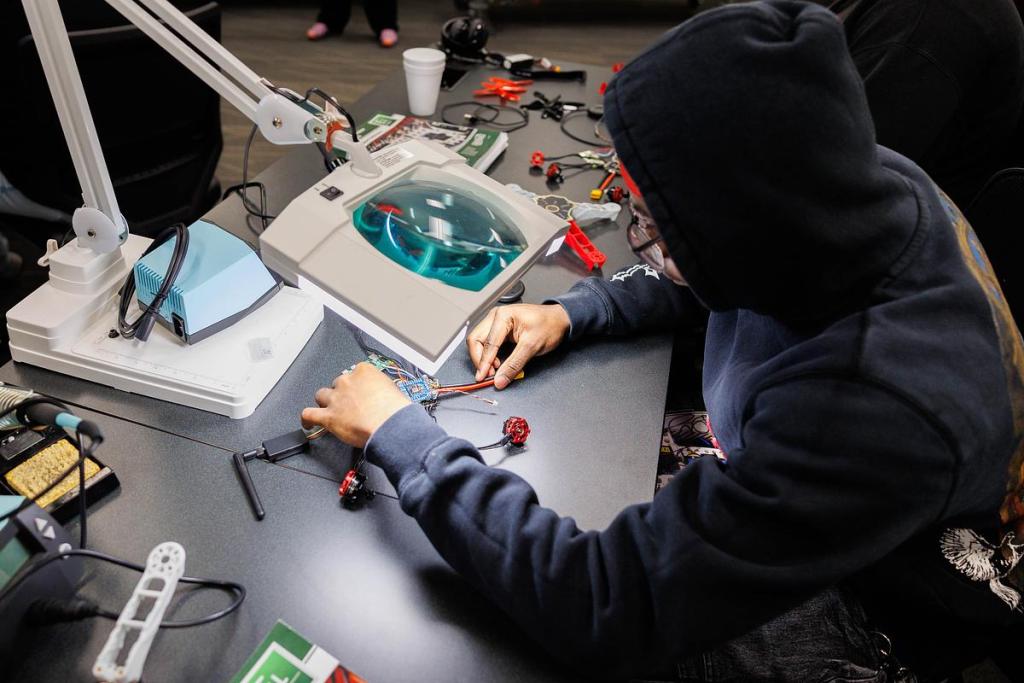
More Tulsa students are stepping up year after year, at increasingly younger ages. Bixby Public Schools has rapidly expanded its robotics and drone programs to become the largest in Oklahoma with 43 teams at eight campuses.
“It’s not cheap, but it’s a good form of education that gets kids excited and job ready,” said Traeton Dansby, robotics coordinator for the school system. Bixby funds the program through a mix of corporate sponsorships, events and tournaments, Dansby says.
“Kids are super invested in the match results and the rankings,” he said. “They have this desire to want to further themselves because they’re looking at it in the lens of the competition — I always like to joke and say we’re kind of tricking them into learning.”
A vast network of higher education institutions, tribal nations and nonprofits set their sights on growing Tulsa’s tech economy in 2020. Backed by Mayor G.T. Bynum’s administration, they leaned into the state’s massive aerospace industry, focusing on autonomous vehicles and drones.
The federal government also spent more than $90 million on Tulsa’s drone industry expansion with more than half of those federal dollars coming through a 2024 Tulsa Tech Hub grant. Overseen by the George Kaiser Family Foundation-backed Tulsa Innovation Labs, that $51 million is spurring new drone ranges, more K-12 programming and a slew of institutes at local colleges and universities.
Part of that funding goes toward K-12 initiatives, like a “Pathways to Opportunity” push for STEM programming in 32 clubs across seven public school feeder patterns.
“Let’s give you the opportunity, let’s give you the knowledge you need,” said Ramona Rogers, a career tech teacher and Booker T. Washington’s 2025-26 teacher of the year.

Adding more competitive spaces
Tulsa is hosting more and more competitions for drone racers and robotics competitors, including at Skyway Range, an Osage Nation drone range partnered with Tulsa Innovation Labs. It will host one of the nation’s largest annual unmanned aerial systems competitions for university and high-performing high school students in September 2026.
Tulsa Tech’s 60-hour Advanced Air Mobility Certificate program is training for operations and manufacturing jobs with a focus on drones. Students couple traditional skillsets like coding in Python, hydraulics and electronics with drone manufacturing and flight.
“I think that just all of the hype, if you will, around drones and advanced mobility in Tulsa has helped a great deal because you’ve got a lot of entities around the city that are pushing initiatives,” said Matt Litterell, executive director of workforce and economic development for Tulsa Tech. “We’ve chosen traditional manufacturing pathways and coupled it with that new industry.”
The program will stay free until Biden administration infrastructure funding expires in two years. Litterell hopes federal Workforce Pell Grants can keep the program available at a low cost.
Companies like Bama and Nordam are already recruiting from the program. The South Central Oklahoma Workforce Board predicts demand for local jobs in engineering and computer systems will spike more than 10% by 2029.
Immediate career pathways bring students in, Litterell says, but their new passion for drone flight keeps them enrolled.
“I think the next phase of this development will be in the area of apprenticeships,” he said, letting students earn-while-they-learn with wages and credit locally. “That allows us to expand the number of students who are serving into industries that maybe we haven’t served previously.”


The nuances of The University of Tulsa
The University of Tulsa was tasked with a different charge by the federal government.
Its Oklahoma Cyber Innovation Institute is tackling the “achilles heel” of autonomous vehicles — cybersecurity. While TU students are conducting research alongside industry experts, the university is also teaching cybersecurity courses in four Tulsa high schools that incorporate drones and other autonomous vehicles.
TU’s cyber program has a near 98% job placement rate, but the majority of those jobs aren’t local, according to Keely.
Nearly 78% of Oklahoma college graduates with STEM degrees still live and work in the state five years after graduation, according to a 2024 employment outcomes report. That’s 6% lower than the undergraduate average and dips further for engineers.
Jobs in manufacturing and aerospace products are only now returning to pre-pandemic heights based on reports by the Oklahoma Employment Security Commission and federal Bureau of Labor Statistics.
“If you can get prospective companies to come take a tour, sit in the classroom and hear the instruction of what’s going on and then see the numbers, we’re cranking these people out,” Keely said. “And the only reason why they’re not still here is because you’re not here to employ them.”
Tulsa Innovation Labs, Oklahoma Cyber Innovation Institute and Skyway Range receive funding from the The George Kaiser Family Foundation, which has also provided funding for the Tulsa Flyer. News decisions at the Tulsa Flyer are made independently of our board members and financial supporters. Read more about our editorial independence policy here.
