

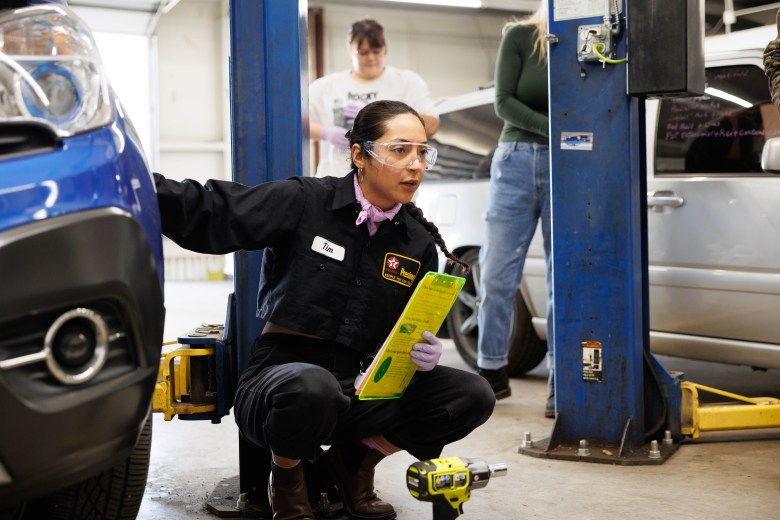
Onyx Montes decided to move to Tulsa from Chicago about three years ago. The journey would take her 13 hours, and she wanted to be prepared to drive — and fix — her car alone.
She spent a full day at four different auto shops in Chicago, attempting to convince shop owners to teach her the skills she needed: Learn to change a tire, change oil and check fluids.
Each auto shop owner declined to teach her for free, but she remained persistent.
“I just wanted to be as prepared as I could and I also have had this car that I just got,” Montes said. “I knew that with this new car, I wanted to take care of it and I wanted to extend its longevity for as long as I could and also so that I wouldn’t have any issues on the road.”
She eventually found a shop willing to teach her. Now, she’s bringing those skills to Tulsa after moving to the city through the Tulsa Remote program.
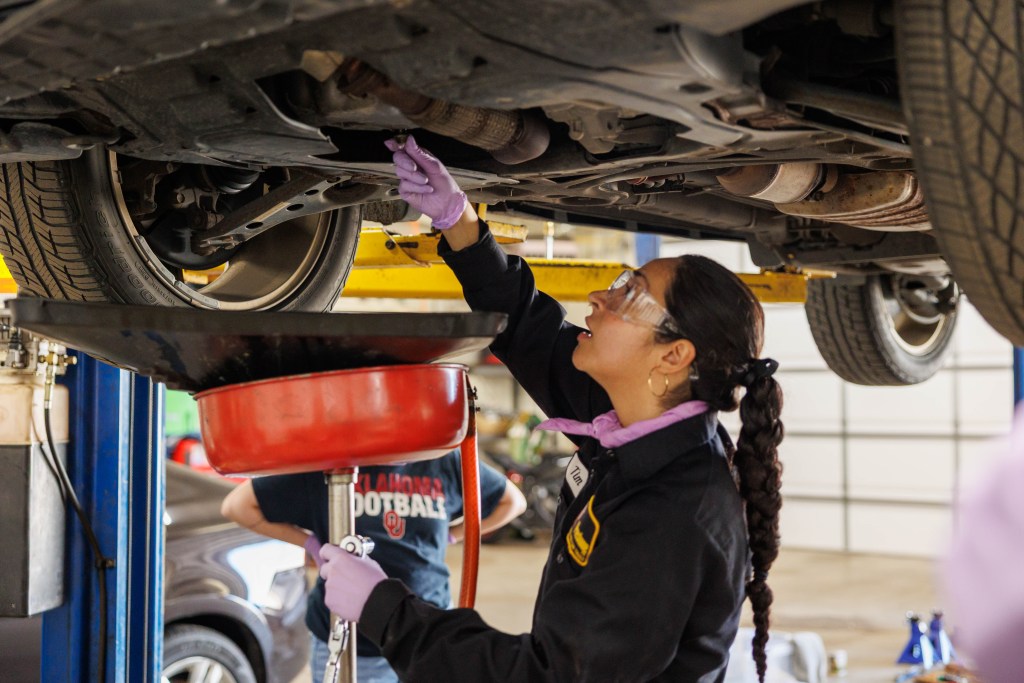
In August, Montes launched Tulsa Girl Power, a set of workshops aimed at empowering women in spaces they’re typically not considered, especially male-dominated fields such as the automotive industry. While she doesn’t own her own shop, Montes is partnering with local shops and has instructed women at her apartment complex.
“This is still a field that needs a lot of women representation with women making up so little of the workforce in automotive,” Montes said. “Yet, they’re a lot of the consumers. But what would happen if women were involved in all steps of the process, not just the consumer part? I think it would be a big positive shift.”
She hopes to teach other women, including on the eastside, to take up space and learn how to use their voice. Here’s how she found hers.

Learning the skills
Montes’ tour of auto shops concluded at Runge Auto & Tire in Chicago, where she spent the next year shadowing mechanics and learning the basics of her vehicle.
Tim Runge, owner of Runge Auto & Tire, remembers Montes waiting patiently in line behind customers before she asked for free lessons. Montes had to pitch to him twice because, as he recalls, he stared at her a little cross-eyed.
“I said, ‘If you want to learn, my guys are more than willing to help and teach,’” Runge said. “You don’t often get a young person like that coming in with that type of attitude. I took her in the back and introduced her to everybody and I said, ‘Have at it, kid.’”
Runge told her to find an employee she felt most comfortable learning from. She left most days dirtier than his own employees, he said.
“It was, like, eye opening to see that women can definitely do this work,” Montes said. “It’s intimidating because you don’t see a lot of women, which is why I think representation is so important.”

‘Calladita te miras más bonita’
Montes remembers being told as a child that “calladita te miras más bonita,” translated to “you look prettier when you’re quiet.” The phrase is often repeated to Latina girls and women.
She was always taught to be in service to others and be a “good girl.” She never thought she’d be helping other women this way.
“As a Latina, I’m always thinking about representing and being a role model for other Latinas,” she said.
During her Tulsa Girl Power workshops, she first teaches women how to accomplish the basics through demos. She then directs them to do the same things on their own respective vehicles.
Amira Abujbara, a Tulsa-based filmmaker and writer, was at Country Bird Bakery when she noticed a sign on the wall. It was pink and had a girl posed in overalls with tools in her hand. The flashy flyer grabbed her attention.
She recently purchased a car and wanted to have a sense of ownership and understanding of it, she said. Abujbara has attended all three workshops Montes has hosted so far.
“This was the first space I’d ever been in that was around cars that was a women-centered space,” Abujbara said. “It’s just incredibly rare and it made me feel comfortable asking questions.”


Montes has also empowered her to ask the right questions about costs if she has to get her car serviced. During a workshop, she changed an air filter — and Abujbara was shocked at how easy it was to do.
“A cabin air filter change is so easy and you get charged so much for it,” Abujbara said. “So just things like that where it’s like, OK, this is not only making me feel more comfortable with my car but it’s also kind of financial empowerment.”
Leaving an impact
Montes has her eyes on other aspects of empowerment. Tulsa Girl Power has hosted sessions on pay negotiation and transparency and zine-making, and Montes plans to expand to other sectors like self-defense skills.
She recently hosted a workshop at Svenskraft Auto in east Tulsa, where she says the area has a lot of blue collar culture, such as mechanics, tire shops and trade apprenticeship schools.
“It’s an area that fascinates me and echoes the environment I’d love to do more workshops in,” Montes said.
In addition to reaching new areas of the city, she has been intentional with the organization’s branding, leaning into femininity with her use of pink in advertising around town.
“I kind of poke fun at that, like having a pink-related aesthetic for Tulsa Girl Power as a way to poke fun a little bit of the whole like ‘women are not allowed in this male, greasy, gritty, dominant (field),’” Montes said.

Tulsa Girl Power is her way of being the change she wants to see.
“I wanted to use my knowledge in a way that was beyond myself,” Montes said. “I had those skills. I wanted to share them in a way that I thought I would have wanted to have when I was in Chicago.”
This article was produced as part of a partnership between the Tulsa Flyer and La Semana, a Tulsa-based bilingual Spanish-English newspaper serving Latino communities in Oklahoma.
News decisions at the Tulsa Flyer are made independently of our board members and financial supporters. Read more about our editorial independence policy here.