


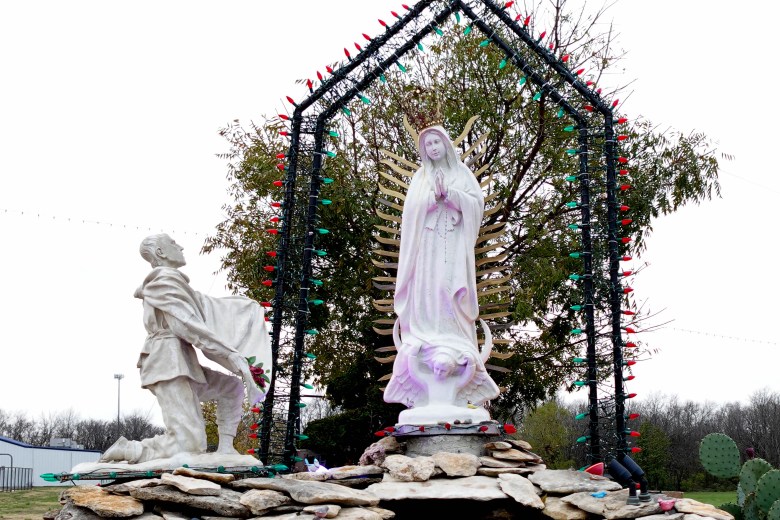
Thousands of Catholic churchgoers will gather across the country and Latin America to celebrate La Virgen de Guadalupe’s birthday Dec. 12.
In Tulsa, some churches join in celebration and unite their respective communities for danzas, or dances, serenades, food, prayer and mass.
Here’s everything to know about La Virgen de Guadalupe – also known as Virgin Mary – and the celebrations.
What is the story behind La Virgen de Guadalupe?
The name refers to the specific apparition of the Virgin Mary in December 1531 in Mexico. Her story begins when she first appeared to Saint Juan Diego at the Tepeyac Hill, now Mexico City, on the morning of Dec. 9.
Juan Diego heard music coming from the sky as he walked to mass, said Denny Rodriguez, a parish master of ceremonies at east Tulsa’s St. Thomas More Catholic Church. He was instructed to go to the bishop of his church and request construction of a chapel honoring La Virgen de Guadalupe. The bishop didn’t believe him.
She appeared to Juan Diego three more times before the bishop agreed. During the final appearance on Dec. 12, she instructed Juan Diego to gather flowers as a sign to take to the bishop.
Once he did, the bishop finally believed him and began building the chapel.
Why is she celebrated?
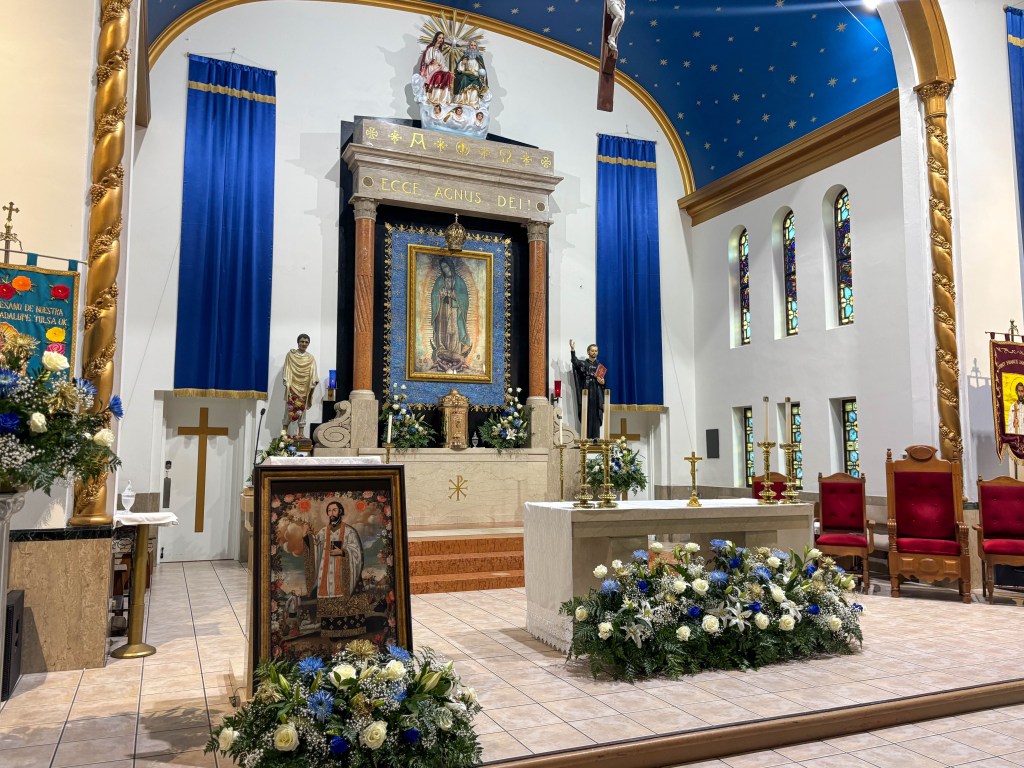
The love Catholics have for La Virgen de Guadalupe is because she’s “the mother of the true God for whom we live,” said Rev. Elmer Rodriguez of Tulsa’s St. Francis Xavier Catholic Church. He says people celebrating her must remember Jesus is the center of everything
The celebrations give her the respect and honor she deserves for carrying Jesus, he added. No matter where you go, you can find events honoring her.
She is one of the most adorned saints by Hispanics across Latin America, he added.
“It’s a celebration that unites us,” he said. “It’s a celebration that identifies us.”
She also has many titles, including the Patron Saint of Mexico, Empress of the Americas and the Reyna de la Diocesis de Tulsa – the Queen of the Diocese of Tulsa.
How is she celebrated in Tulsa?
Churches across Tulsa celebrate La Virgen de Guadalupe in the dozen days leading up to Dec. 12, a date often referred to as her birthday.
Churches typically celebrate with a docenario, a 12-day period of devotion and prayer, where they offer mass, prayers, devotions and more dedicated to specific issues or groups in honor of La Virgen de Guadalupe.
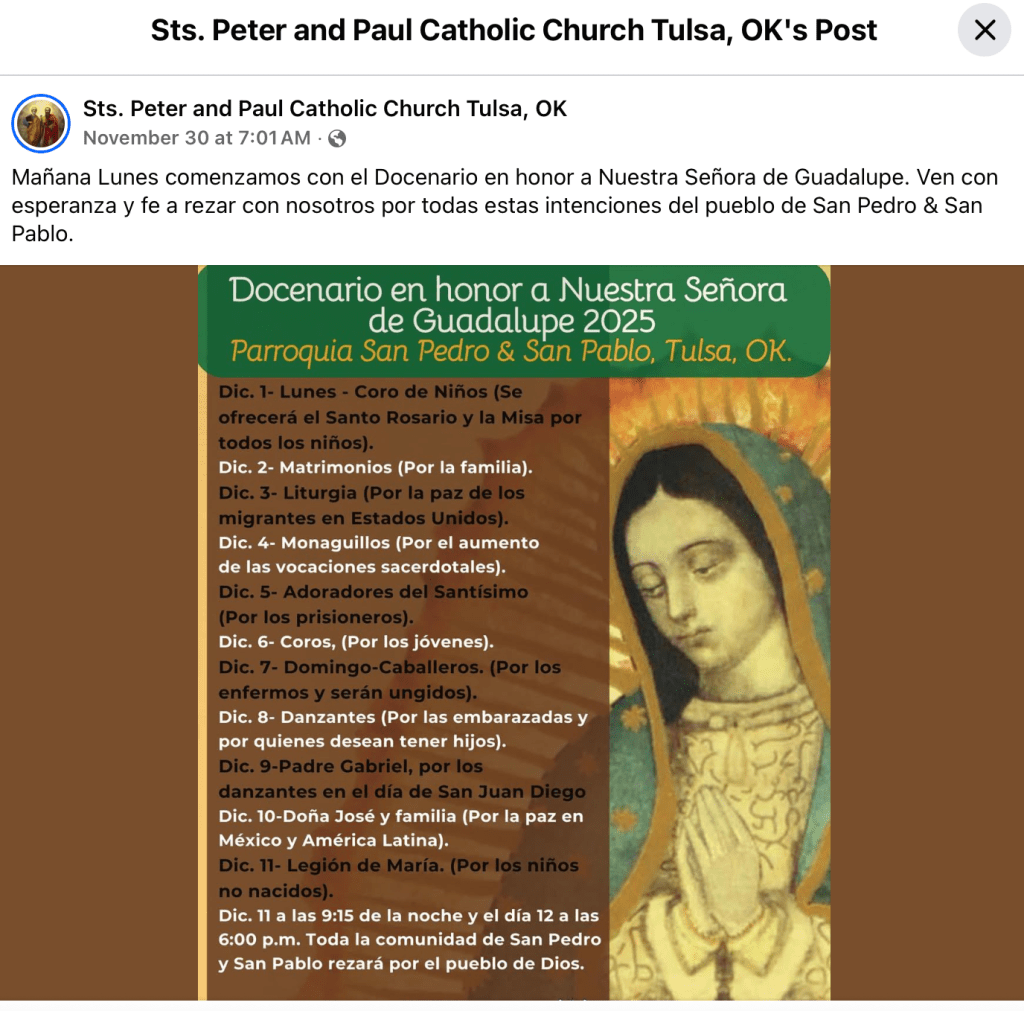
For example, Sts. Peter and Paul Catholic Church hosted a prayer session on Wednesday dedicated to peace for migrants in the United States. St. Thomas More Catholic Church offered prayers to different Mexican states throughout the 12 days.
The 11th day of the docenario is often a long celebration that begins towards the latter end of the evening.
People can find mariachi bands and singers prepared to serenade La Virgen de Guadalupe. Matachines will also perform religious dances as a form of prayer.
Churchgoers come prepared to ring in La Virgen de Guadalupe’s birthday with midnight mass Dec. 12. Churches offer a full day of celebrations including mass, prayer of the rosary and performances of las mañanitas, which is the traditional Mexican birthday song.
Where can you celebrate?
There are various places people can celebrate in Tulsa on Dec. 12.
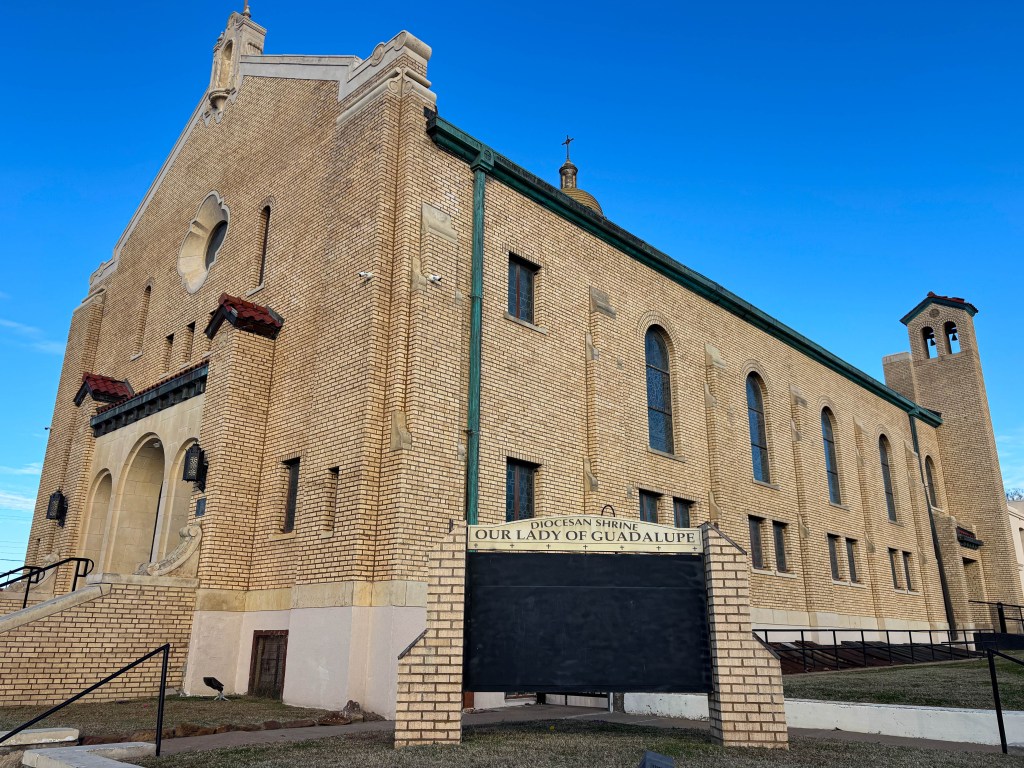
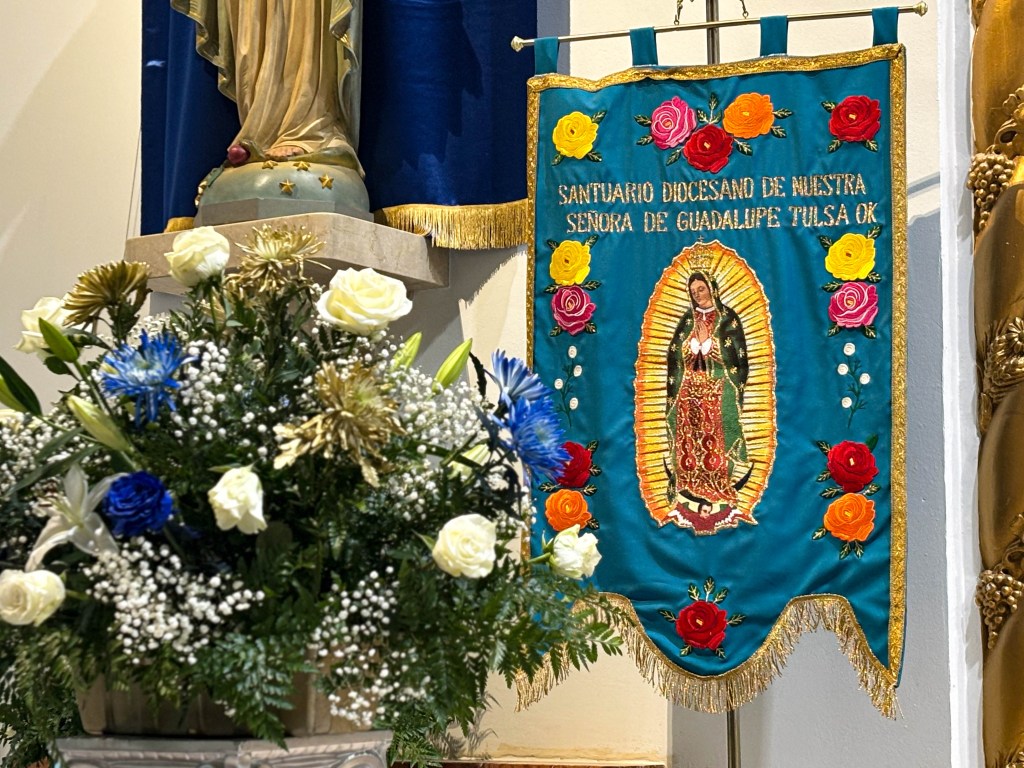
St. Francis Xavier Catholic Church has been dedicated as a Shrine of Our Lady of Guadalupe since Aug. 1, 2004. A replica of the image of La Virgen de Guadalupe that stands inside the Basilica of Our Lady of Guadalupe in Mexico City is placed in the center of the shrine.
St. Francis Xavier Catholic Church, 2434 E. Admiral Place Blvd.
- Midnight: Rooster’s Mass with Marita and Mariachi
- 1-5 a.m.: Serenades
- 5 a.m.: Las mañanitas with Mariachi and Prayer of Rosary
- 6 a.m.-6 p.m.: Mass
- 9 a.m.: Mass in English
- 6 p.m.: Prayer of the Rosary
- 7 p.m.: Mass
- 8 p.m.: Blessing of the Roses and Procession around the church
St. Thomas More Catholic Church, 2720 S. 129th E. Ave.
- Midnight: Rooster’s Mass with Marita and Mariachi
- 5 a.m.: Las mañanitas
- 5:30 a.m.: Rosary at dawn
- 6 a.m.: Mass in Spanish
- 9 a.m. Mass in English
- 12 p.m.: Rosary
- 12 p.m.: Mass in Spanish
El Centro de Evangelización Nuestra Señora de Guadalupe, 1541 E. Newton Place
- 1 p.m.: Mass in Spanish
- 5 p.m.: Mass in Spanish
- 6 p.m.: Rosary
- 7 p.m.: Mass
Sts. Peter and Paul Catholic Church, 1436 N. 67th East Ave.
- Midnight: Mass
- 4 a.m.: Drummers
- 5 a.m.: Mañanitas with Zenaida and Mariachi
- 6 a.m.: Mass de Mañanitas
- 7 a.m.: Breakfast
- 9 a.m.: Mass in English
- 7 p.m.: Daily mass
Why is the holiday important?
Elmer Rodriguez believes that the more people know about these celebrations, the richer they become, especially if they are not Catholic or don’t identify as Hispanic.
“When we get to know those around us, we can stop being afraid, because sometimes we’re afraid of things different than us,” he said.
For example, he’s come across people who aren’t used to the danzas and have said it’s witchcraft. They don’t understand the culture, he said.
“But when you understand the culture, you understand that they pray, not only with words, but they pray with the colors they’re dressed in, their suits and their dances are also prayers,” he said. “So, they don’t express themselves verbally, but with symbols and their body.”
La Virgen of Guadalupe appeared for everyone and is the Mother of God, Denny Rodriguez said. That belief can build bridges between different cultures, he said.
“And it’s also a way of teaching unity,” he said. “The unity that our community has, because it’s something that has always characterized Hispanics — that we are very united.”
This article was produced as part of a partnership between the Tulsa Flyer and La Semana, a Tulsa-based bilingual Spanish-English newspaper serving Latino communities in Oklahoma.
News decisions at the Tulsa Flyer are made independently of our board members and financial supporters. Read more about our editorial independence policy here.
