




Life after jail comes with a set of struggles only those who experience it can imagine. On Friday, dozens of educators and nonprofit workers got a glimpse through a simulation hosted by Tulsa Community College.
The program, developed by Penn State University’s Restorative Justice Initiative, puts participants in a fictional city as ex-convicts. That city was set at Boston Avenue United Methodist Church, where 16 tables lined the gym, each representing things like ID agencies, courts, banks and counseling.
Participants had a set amount of time to complete specific tasks, including obtaining an identification and finding employment, food, water and transportation. Many struggled because of simulated long wait times, slow buses or closed stations — real issues that formerly incarcerated people face.
“I did my best to avoid it, but unfortunately, I couldn’t,” said Lakisha Cyrus, coordinator of NewLife PREP, a local program that helps former inmates transition to life after prison. “So although I tried to avoid the system, the system still caught up to me.”
Failure to complete those tasks sent about 30 participants out of roughly 40 back to jail for probation violations or failure to attend required counseling.
“We wanted to do this so bad, because we do know that the system is broken,” said Ramona Curtis, director of workforce programming at TCC and an event organizer.
Not every participant was given equal circumstances. Some were given more money than others, or easier access to employment and family members to help their situation.
“There’s so much about what it means to come home from prison that a simulation could never and should never capture it,” said Liana Glew, prison education program manager at Restorative Justice Initiative. “It may scratch the surface of some of the frustration and pain and isolation, but it will never capture that whole experience.”
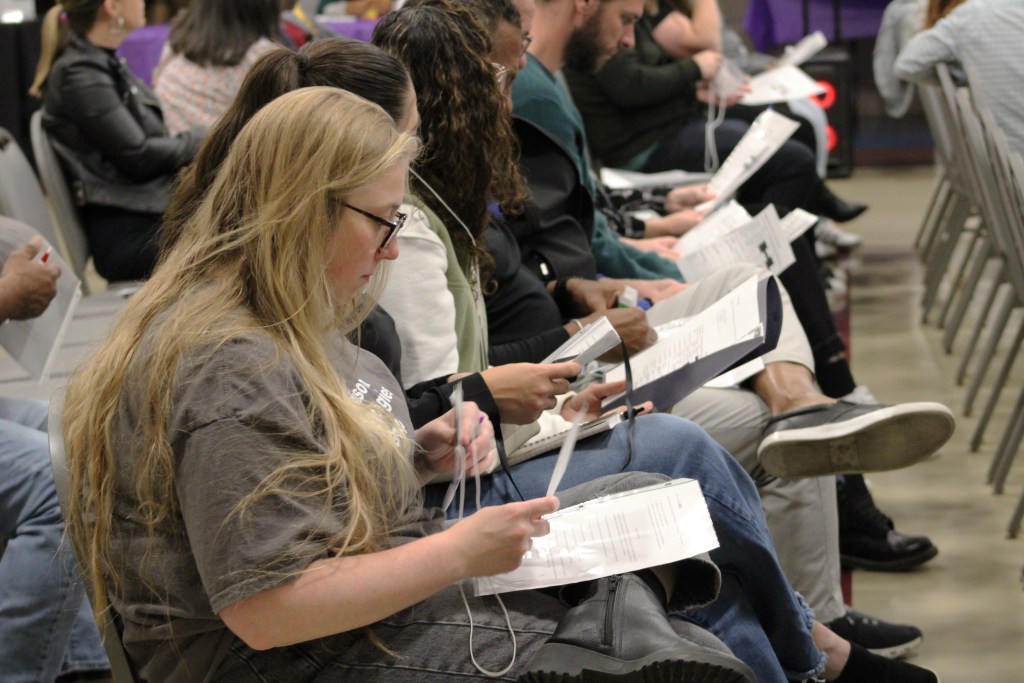
Part of that experience gave participants to donate plasma for money or gamble at the “chance table,” where they could choose to commit a crime in exchange for money at the risk of going back to jail.
According to the Restorative Justice Initiative, 64.7% of people released from prison will be re-incarcerated within three years, with 30% of those released are rearrested within the first six months.
The simulation was designed to bring more attention to the cycle of mass incarceration in the U.S, which imprisons more people than any other country in the world. Oklahoma has the fourth-highest incarceration rate among all states, according to Oklahoma Watch.
At the end of the simulation, both participants and volunteers separated into small groups to discuss how they can make the reentry process easier.
Some common solutions rose to the surface: better access to housing and education; a busing system specifically for people reentering society; and a program for reentry for people currently incarcerated.
“Some of the folks coming back from prison are educated. They have skills, but we need to re-skill or upskill,” Curtis said. “And so I will always say that pre-release is a great place to start for those things.”
For those reentering society, Curtis suggested services such as Tulsa’s Center For Employment Opportunities, JusticeLink Tulsa and the hosting organization Tulsa Community College.
Ismael Lele is a Report for America corps member and writes about business in Tulsa for The Oklahoma Eagle. Your donation to match our Report for America grant helps keep him writing stories like this one; please consider making a tax-deductible gift of any amount today by visiting this link.
