


At the beginning of Saturday’s Tulsa Symphony concert, conductor Ron Spigelman posited the idea that orchestras should be considered “transportation companies,” as the music they perform has the power to “take you anywhere you might want to go.”
The itinerary planned for this particular concert, the second in the orchestra’s Patti Johnson Wilson Classics Series, was one designed to help the audience slip the surly bonds of Earth in search of galaxies far, far away, powered by some of the most familiar melodies of the 20th century and aided by images of mankind’s best efforts to see what lies beyond the infinite.
The program featured selections from John Williams’ scores for the “Star Wars” film series, as well as an excerpt from his score of “E.T. the Extra-Terrestrial,” and English composer Gustav Holst’s 1918 orchestral suite “The Planets.”
Pairing these two composers and these works in one program was not a random choice. Williams has long acknowledged “The Planets” was a major influence on him when he was working on the first “Star Wars” film — in part because director George Lucas used Holst’s music as aural placekeepers in early stages of filming, to give Williams some guidance as to what sort of effect was wanted for certain scenes.
That was one of the many insights Spigelman shared during the course of the evening, from pointing out specific passages in the “Star Wars” pieces that echo themes from “The Planets, to sharing how seeing the first “Star Wars” film inspired his own musical career. His desire to share his solo trumpet version of the film’s main theme with his neighbors, Spigelman said, led to his “learning what a cease and desist order was.”
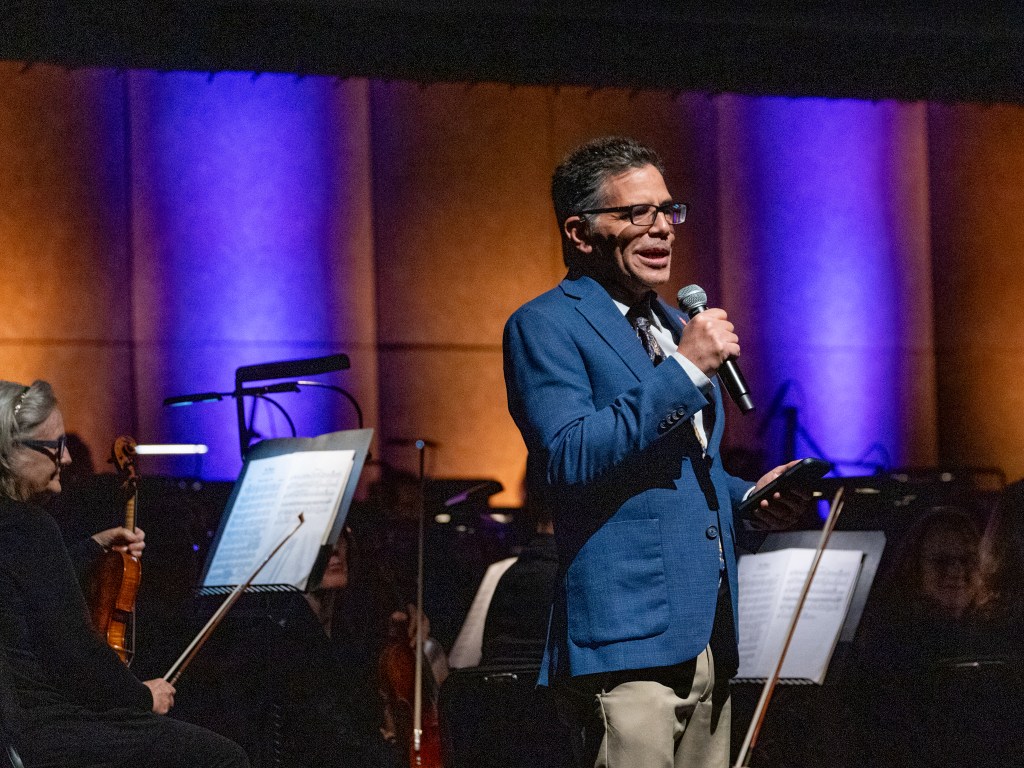
Spigelman, who for many years was the orchestra’s principal pops conductor, has often returned to the TSO podium when the organization presents “movies with live orchestra” concerts. That skill came in handy as the presentation of “The Planets” was accompanied by a series of short films by astronomer and visual artist José Francisco Salgado.
Salgado said his films — one for each movement of Holst’s suite — used imagery that was completely science-based, whether it be Galileo’s drawings of the phases of the planet Venus, or pictures captured by the Hubble Space Telescope. Even the animated sections, such as the landing of the Curiosity Rover on Mars, were based on scientific research.
The result deepened the impact of Holst’s music, as Salgado’s films were as filled with color, emotion, dazzle and mystery as the music itself. The Tulsa Symphony, expanded to 90 musicians for this concert, gave a thrilling performance of this piece.

The violence and terror of “Mars, the Bringer of War” packed a chill-inducing wallop. The mysterious, ethereal aura created in “Neptune, the Mystic” opened up the piece to what lies beyond. Images of nebulae and galaxies far beyond our solar system filled the screen in time with the wordless vocalizing of the Tulsa Chorale’s Women’s Chorus, prepared by the chorale’s artistic director Zachary Malavolti.
Ron Predl, TSO’s executive director, said this concert set a record for ticket sales and the most since 2018, when the orchestra presented Britten’s “The War Requiem” on Veterans Day.
News decisions at the Tulsa Flyer are made independently of our board members and financial supporters. Read more about our editorial independence policy here.