

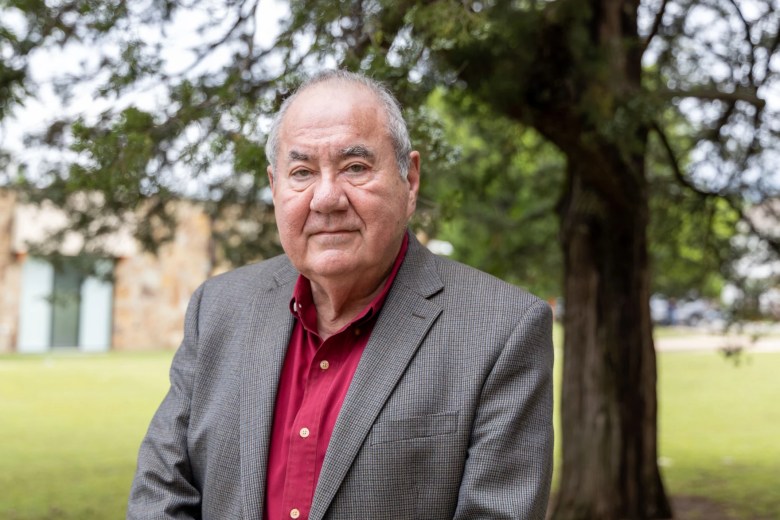
Geoffrey Standing Bear served 12 years in office as Osage Nation’s principal chief. During his tenure, he helped the tribe navigate the second-largest fee-to-trust acquisition in Bureau of Indian Affairs history, Killers of the Flower Moon production and cultural preservation.
Standing Bear chose not to run again for principal chief, as he now has his sights set on the Osage Minerals Council, the governing body that oversees the tribe’s mineral affairs of the Osage Mineral Estate.
As the tribe’s general election nears on June 1, 2026, Standing Bear sat down with KOSU’s Sarah Liese to discuss the end of his time as principal chief and the start of a new chapter.
His decision to retire as principal chief and the priorities he set out
Standing Bear said it was “just time” to retire as principal chief, despite the tribe allowing five terms, and that his late uncle Henry Lookout inspired the decision.
“He used to be head committeeman when I was young. We’d always dance that Ilonshka, … he would cut off the dance. He’d say, our people say, ‘Well, when it’s going good, it’s time to quit.’ And I can see the wisdom in that,” Standing Bear said.
Standing Bear also said he felt the tribe had accomplished multiple goals he set, including land acquisition, cultural preservation and language conservation.
In 2024, Osage Nation acquired concurrent jurisdiction over 43,000 acres of fee-to-trust land now called the “Osage Nation Ranch.”
That culminated an eight-year process that first began when the tribe purchased the land from CNN founder Ted Turner in 2016. It marks the second-largest fee-to-trust acquisition in U.S. history, and the largest in Oklahoma history.
The area is home to around 300 roaming bison.
“We developed relationships with the InterTribal Buffalo Council with different tribes, Cheyenne (and) Arapaho, other tribes, and we’re all working toward that same goal of restoration of the lands,” Standing Bear said. “We work with the Nature Conservancy further north here, and they have scientists and talk about certain birds, certain insects come in, and how it takes many decades to truly bring back that ecosystem. So that was a plan of ours, and we’ve been following that.”
The tribe also reacquired land in Missouri last year, including a sacred site known as “Sugarloaf Mound” located near the St. Louis Arch. Osage Nation is also planning to construct a $100 million, 40,000-square-foot casino and resort on the state’s Lake of the Ozarks.
Standing Bear said a trip to the land in Missouri and Vann Bighorse, Osage secretary of language, culture and education, inspired further efforts to preserve the Osage language.
“He said, ‘I just want to tell everyone that as I was praying, I realized this is probably the first time in 150 years that our language has been heard in this valley we’re in right now,” Standing Bear said. “I talked to him and he said, ‘Chief, this is the last train out if we don’t preserve this language, if we don’t get aggressive about it, if we don’t do more.”
That led to engagement with other tribal nations looking to preserve their languages, he said, including Pueblo tribes and tribes in the Rio Grande Valley.
“We’re all trying to bring our languages back and into daily use,” Standing Bear said. “… So that energy in Missouri is tied directly to land, culture and language.”
Minerals estate and self-governance
Standing Bear has also advocated for the Osage Nation to assume direct control of its minerals estate, a 1.47 million-acre oil and gas subsurface of the reservation, as federal funding becomes more scarce.
It’s a proposal he intends to continue if elected to the minerals council, and a move similar to the Southern Ute Indian Tribe’s actions earlier this year, which received authority over energy-related business from the federal government.
“The funding to fulfill the trust responsibilities and treaty rights is becoming diminished,” Standing Bear said. “For example, the Bureau of Indian Affairs Osage Agency is terribly underfunded. (It) can’t fulfill, in my view, its responsibilities to the Native Americans as set out in federal statutes, set out in treaties.”
The Osage Nation Congress and Osage Minerals Council both opposed plans to extendthe council’s authority over the minerals estate last year.
But Standing Bear said he believes the tribe can come to an agreement.
“It’s the whole issue of what Killers of the Flower Moon was about. It’s about us controlling our own property and our own lives, and that’s a scary territory for Osages. Many Osages say, ‘Oh, we can control our property as long as the federal government tells us what to do,’” Standing Bear said. “But that’s swinging. That’s changing, changing fast. If we don’t catch it now, it may not come back for a while and this momentum will be lost.
“It’s our land. This is our oil. This is our territory. Why are we letting the federal government control it and oversee the loss of control?”
Department of Energy money
Earlier this month, Standing Bear promoted the use of energy funding to expand oil production at the “State of the Tribal Nations” in Tulsa. There, he said he hoped to rebuild the oil and gas industry in the reservation.
And in April, the Department of Energy announced it would allocate $50 million in grantsfor tribes to participate in its push for international energy dominance.
Standing Bear said Eric Mahroum, director of the Office of Indian Energy Policy and Programs, visited the Osage Nation this month. He said he requested $2 billion from Mahroum.
‘Killers of the Flower Moon’
Apple Studios filmed Killers of the Flower Moon in and around Osage Nation throughout 2021. The film, based on a true story and a book by David Grann, covers a series of murders committed on tribal members within the reservation in the 1920s.
Standing Bear worked on the film as a consultant. He said he advocated for the film to be shot on location with Osage culture and language.
“If you’re going to film somebody else, that’s your right. But I’m going to have Osages. I’m going to ask my legislature to fund hotel rooms and food and stipends, travel stipends,” Standing Bear said. “I told those people in the film bureau, they better be using our language because (if) they don’t, it’s not going to be pleasant.”
But he said his worries were quelled when he met with Martin Scorsese, who affirmed that the film would be shot with respect for the Osage people and their history.
“Before I said a word, he just went through that checklist that it’s going to be our culture, it’s going to be on our lands, it’s going to be Osage, and he’s going to show us respect,” Standing Bear said.
Advice for future leaders
Standing Bear said the next Osage principal chief must contend with a lack of federal funding.
The Trump administration’s proposed 2027 budget would reduce the BIA’s annual funding by $743 million. Last year, the bureau’s budget numbered around $2.8 billion. The U.S. Senate Committee on Indian Affairs has questioned the cuts.
“That’s a huge cut of already stripped of funding set of agencies,” Standing Bear said. “So you got to watch out for that.”
Standing Bear also encouraged the future generation of tribal leaders to stay on top of pressing issues and carry forth efforts to preserve culture.
“I’ve done my best for 12 years. I’ve really done my best. But now these others got to come in here and they got to work hard. You can’t just not work on these things. It’s relentless,” Standing Bear said. “But for every problem, there is a solution. You’ve just got to find it. We got through Covid. We’ve gotten through all these other issues, almost lost our language, had no land … our culture is strong. Our people are dancing strong.”
This article was originally published by KOSU. You can see the original story here.