



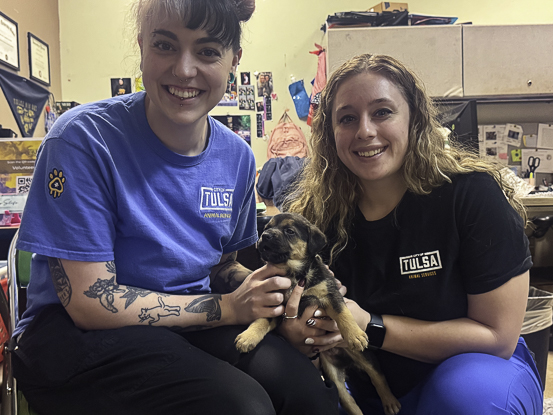
A day at a Tulsa Animal Services veterinarian clinic resembles an ER. There’s constant triage and unpredictability, but the beep of monitors is replaced by continuous barking.
“It’s a lot of organized chaos happening, but I can say that our team does handle it very well,” said veterinary clinic supervisor Taylor Roepke-Perez. “We are definitely spread a little bit thin … It’s something that you kind of have to get a little creative about.”
Throughout 2025, the shelter operated over capacity and closed the year with nearly 9,000 intakes. Stray intakes grew by 32% from the year before.
All that adds up to more stress on the vet assistants.
“I feel like every day is typically mixed in with the chaos of not knowing what’s gonna happen,” said veterinary assistant Emma Lollis. She said they have been operating over capacity for the past few years.
Lollis, 26, has spent four years in the clinic. Her hairstyle pays homage to Cruella de Vil — two-toned, black and white. Her energy makes her seem much younger than she is.
A typical day for Lollis starts with an 8 a.m. staff meeting. Then she begins administering medicine while also being prepared for any challenge that could be sent her way.
On a recent winter morning, that came in the form of having to care for three injured dogs who likely got hit by cars. They were brought to the clinic, where one didn’t survive. The others were being “kept comfortable” as Lollis and Roepke-Perez decided next steps.
This has become far too typical, Lollis said, and it overwhelms the number of animal control officers patrolling Tulsa.
“When you have a large population of dogs on the streets and only eight animal control officers for the whole city, it’s really hard to get them off the streets until something bad happens to them,” she said. “But I feel like, since being here for the last four years, unfortunately, there’s a lot of times where it feels really overwhelming.”
The department receives about 16,000 calls for service a year while animal control officers usually conduct more than 500 cruelty investigations. That shakes out to 40 calls per day, which can lead to compassion fatigue. The term refers to the exhaustion and burnout that comes from caring for others and being exposed to trauma in high-stress environments.
Roepke-Perez said it can seep in daily as they juggle a mounting workload.
“It’s like a brain fog,” she said. “I just feel a little bit slower and, in return, my body just feels so tired. You’re physically dragging yourself through it, and it’s tough.”
That’s something TAS manager Sherri Carrier is trying to address. Staff can now get therapeutic support and additional training from the city’s public safety division.
“We have a group that we’re working with for compassion fatigue, stress and mental health services that doesn’t cost them anything and they can go as many times as they want,” Carrier said. “The harsh reality … is we have to take care of the people that are taking care of the animals.”

For Lollis, she says the constant demands while she’s on the clock give her a little boost.
“Being honest, the energy, the adrenaline, the back and forth, the 27,000 things at one time, that’s my jam,” she said. “So all the triages, all the ins and outs and people poking their heads in the doors, and they’re like, ‘hey, we need you here’ … You have to stay on top of it.”
Employees say they are also affected by negative comments on social media. Among the lost and found posts on Reddit or NextDoor, it is not uncommon to see posts about the facility and leadership. In one, a resident questioned a lack of compassion among shelter employees, then suggested that management should resign if they are burned out.
But Lollis said they’re doing their best with the resources they have.
“We see all the Facebook comments,” she said. “Just because we clock in every day and we get paid to be here does not necessarily mean that we’re emotionless, that we are deserving of the hate and the closed mindedness.”
Help, in the form of space, is on the way.
A new 24,000-square-foot facility is slated to open at 5995 E. 36th St. N. this fall, expanding capacity with more than 100 added kennels. It will replace the current shelter at 3031 N. Erie Ave.
A new pod design will replace the current open space configuration to reduce the spread of disease. But they still need more staff.
“I would love to have two full time doctors. “That being said, I need the support staff for those doctors,” Roepke-Perez said, noting she only has funding to support one full-time vet. They recently hired a part-timer.
The new shelter still needs critical items such as generators, shade and a high‑tech cleaning system. The Tulsa Community Foundation is accepting donations to support those needs.
For now, Roepke-Perez said she hopes people understand the high intake is more than their current facility is designed to manage.
“I really would love to see some of the more positive comments supporting what we’re doing,” she said.
