

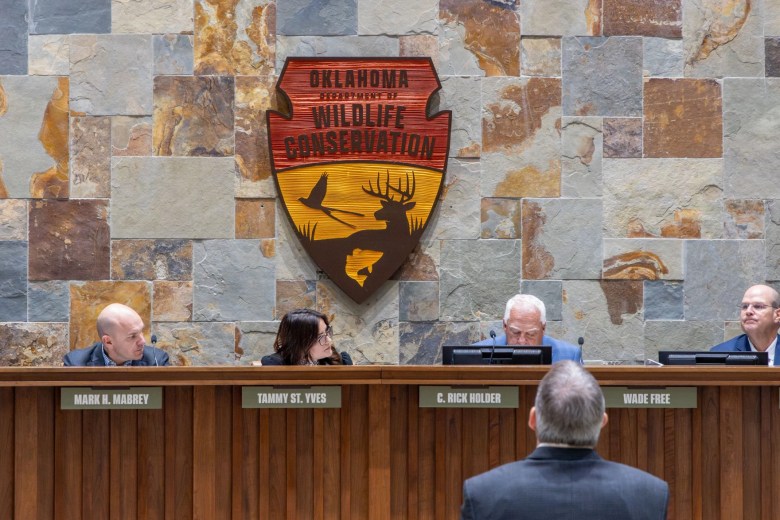
Amid a legal battle over tribal hunting and fishing rights, the Oklahoma Department of Wildlife Conservation has decided to hire its own attorney rather than using representation from the Attorney General’s Office. They also requested that Drummond stay out of pending wildlife cases.
The Oklahoma Department of Wildlife Conservation Commission entered into an executive session on Friday morning to address the ongoing conflict over hunting and fishing licenses on tribal reservations. Their meeting follows a federal lawsuit filed this week by the Cherokee, Choctaw and Chickasaw Nations against Gov. Kevin Stitt, a special prosecutor and ODWC officials over a state policy that limits where tribal hunting and fishing licenses are valid on reservations.
They unanimously passed a motion, introduced by Commissioner Jess Kane of District One, requesting that the Attorney General not interfere, as he formerly promised, in wildlife cases pending before district courts.
Drummond asked the department to end the policy and dismissed at least one misdemeanor charge against a Choctaw citizen ticketed for hunting without a state license within the Choctaw reservation.
Another motion, introduced by Commissioner John Zelbst of District 6, attempted to halt the issuance of citations to tribal members for not having state-issued licenses by having the Attorney General provide a formal opinion.
“I have a second motion that we ask the Attorney General to issue a formal opinion concerning the informal opinion that he issued to us, or sent to us the informal letter, that he put that in a formal opinion, which would be the force of law,” Zelbst said.
ODWC Secretary Mark Mabrey seconded the motion, but it was not supported by the commission. Regardless of the failed motion, Drummond could still issue a formal opinion.
Shortly after the meeting, he issued a statement.
“I am always willing to work with our agencies to make sure that they are following the law,” Drummond said in a written statement. “Asking the chief law officer to violate his oath shows a complete disregard for our laws – something that we’ve experienced with Gov. Stitt for far too long. The law has not changed and neither has my commitment to it.”
A spokesperson for Stitt’s office argued the governor is the one upholding the law.
“The courts have continued time and time again to clarify that the misguided SCOTUS McGirt decision is for major crimes only,” Stitt spokesperson Abegail Cave said in a text message. “The Governor welcomes the opportunity to continue to protect the rule of law in Oklahoma.”
Drummond is a candidate to be Oklahoma’s governor. In a social media post, Stitt further implied Drummond favored tribal hunters and fishers because they supported his campaign.
“When you’re living in the real world, hunting laws apply to all people, regardless of if you’re making political contributions to the right candidate,” Stitt posted on X, alongside a picture of a deer overlaid with “All Oklahomas, All Laws: No Exceptions.”
The largest tribes headquartered in Oklahoma used to buy state hunting and fishing licenses to pass along to their citizens, according to compacts between them and the state. Stitt did away with those compacts in 2021, at which point the Five Tribes entered a reciprocal agreement with each other to allow hunting and fishing for their citizens on all five reservations.
Until last month, when the ODWC issued a policy update saying tribal licenses were only valid on trust land within reservations. The stance, a department spokesperson said, was based on Stroble v. Oklahoma Tax Commission, a court case dealing with tribal jurisdiction over taxes for citizens living and working on a reservation. The ODWC said it felt that the case had more bearing on wildlife code enforcement than McGirt v. Oklahoma, which affirmed tribes’ jurisdiction over major crimes committed by tribal members on reservations.
Drummond and other attorneys have disagreed with this interpretation.