


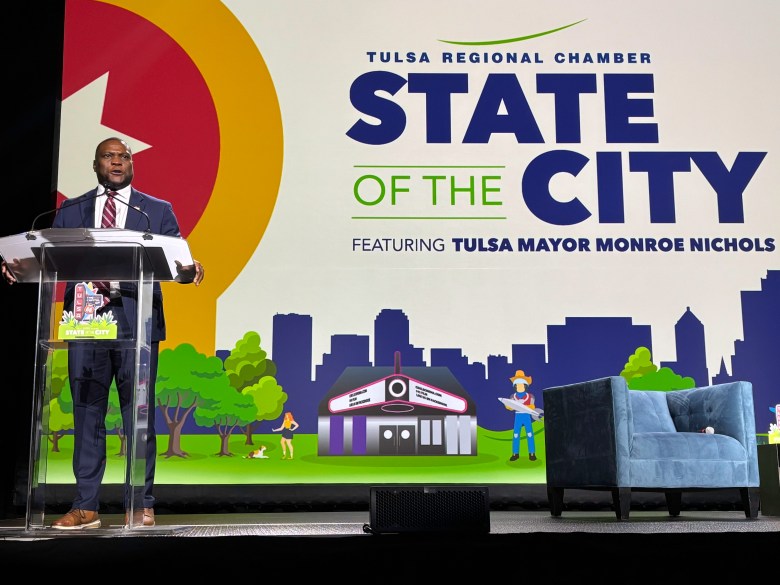
Last week, Tulsa Mayor Monroe Nichols told the audience at his State of the City speech that he was fulfilling campaign promises, especially when it came to curbing homelessness.
Thursday, he did it again — this time to more than 1,000 city, business and civic leaders at the Tulsa Regional Chamber’s State of the City event.
Nichols said the city is working to resolve homelessness — work that he says will require more city revenue. He pointed to the six issues he campaigned on: ending homelessness, addressing affordable housing, raising outcomes for students, expanding economic opportunities, making Tulsa safer and improving relations with tribal nations.
“Six issues, big and complex for sure,” Nichols said. “But I campaigned on all that was possible if we worked together.”
Nichols said he needs more money to make good on those promises. Earlier this month, he asked Tulsa City Council to put a 0.7% sales tax increase on the ballot. The proposal, he said, would generate an additional $80 million during the city’s 2026-2027 fiscal year and would have funded anti-homelessness programs, fixing affordable housing and addressing public safety issues.
Council members pushed pause on the plan for now. But Nichols drilled home why solutions on increasing economic growth are important during a panel after his speech.
Nichols said the city is “spending more than we are bringing in” and that has to change. In September, a city audit found Tulsa had a $15.2 million deficit, which exceeded the city’s budgeting limits. In 2025, the city planned for $393.6 million in spending but exceeded that goal with $408.9 million in expenses. In his new economic plan, Nichols does not want the city to be reliant on its unbalanced budget.
“I don’t think it is a great practice going forward,” Nichols said. “I think you really have to make sure that what you spend and what you take in, are the same.”
The city still remains fully funded, the mayor said, noting it can still pay its police officers and firefighters. But he has also pushed for salary increases.
The mayor also highlighted the city’s efforts in repurposing resources it already has. He pointed to a new low-barrier shelter, announced in October, that will be built at the county’s former juvenile detention center.
It will be the city’s first designated low-barrier shelter, providing 175 beds and other services for unhoused Tulsans.
“It is a massive step in our effort to be able to decommission encampments responsibly, to be able to get people off the streets and get them supported,” Nichols said. “We don’t have the resources and assets right now. It is going to be a gamechanger as we work on getting people not just off the streets, but making sure they don’t return to the streets.”